
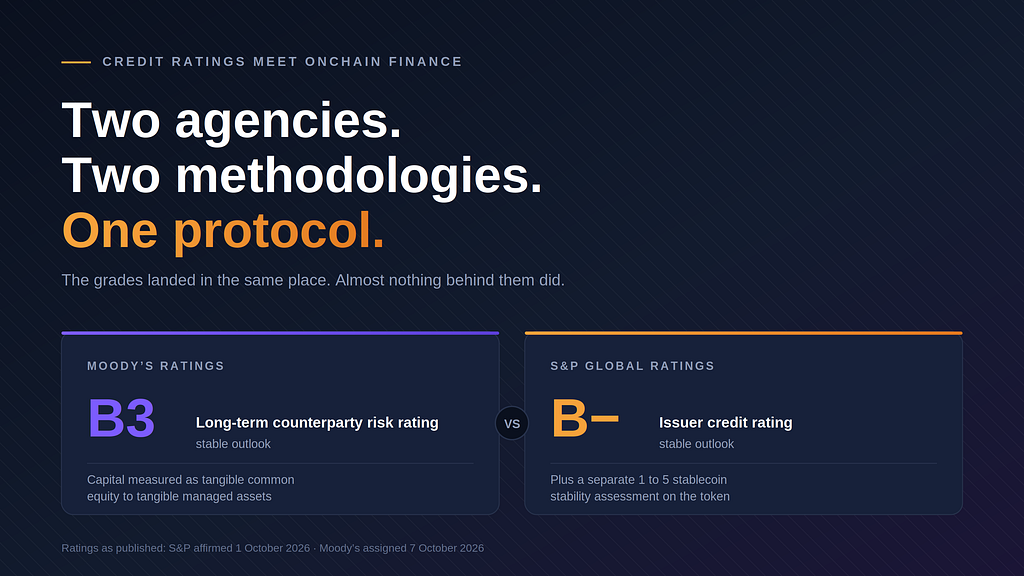
Two agencies graded the same stablecoin protocol six days apart. The letters matched. Almost nothing behind them did.
Two agencies. Two methodologies. One protocol. The grades matched. The frameworks behind them did not.
Six days in October changed how onchain credit gets talked about.
On 1 October 2026, S&P Global Ratings affirmed a B- issuer credit rating with a stable outlook on Sky Protocol.
On 7 October, Moody’s Ratings assigned the same protocol a B3 long-term counterparty risk rating, also stable. It was the first rating Moody’s had issued on any stablecoin protocol.
On the published mapping tables, B3 and B- are the same rung. Two agencies. Two teams. Two frameworks. One answer.
Except they were not answering the same question.
The agreement is in the letter grade. The disagreement is in everything that produced it.
That gap is the most useful thing to come out of October for anyone trying to underwrite onchain exposure.
Most of the coverage reported the grade and moved on. The grade is the least interesting part.
What the two frameworks chose to count, and chose not to count, tells you far more about how traditional credit analysis is going to treat onchain balance sheets from here.
Here is what each framework measures, where they split, and the one thing they both landed on.
What Moody’s and S&P Global crypto ratings actually measured
Three separate published instruments are now attached to one protocol. People keep collapsing them into a single headline. They are not the same product.
Moody’s assigned a counterparty risk rating, not an issuer credit rating. A counterparty risk rating asks whether a counterparty can meet its financial obligations. B3, stable outlook, 7 October 2026. Sky Frontier Foundation corrected its own announcement headline the following day to make that distinction clear.S&P Global assigned an issuer credit rating. B-, first assigned in August 2025, affirmed with a stable outlook on 1 October 2026. That one asks how creditworthy the issuer is.S&P Global also publishes a stablecoin stability assessment, a completely separate scale. USDS and DAI sit at 4, constrained.
Three questions. Three scales. One protocol.
One protocol now sits on three published scales, each answering a different question.
Why a stablecoin stability assessment is not a credit rating
S&P says this plainly on its own product page, and it is worth repeating, because the market keeps blurring the two.
A stability assessment measures whether a token can hold its peg, factoring in both redemption and secondary market price.
It runs from 1, very strong, to 5, weak. It compares stablecoins with each other.
A credit rating measures whether the obligation gets redeemed on demand.
It compares stablecoins with bonds and other rated debt instruments. It explicitly does not reflect secondary market price volatility.
The mechanics inside the stability assessment are where it gets interesting.
S&P starts with an asset assessment covering credit risk, market value risk and custody risk.
Then it asks how far overcollateralization and liquidation mechanisms offset those risks. That produces a score.
Then five more factors get applied on top:
GovernanceLegal and regulatory frameworkRedeemability and liquidityTechnology and third-party dependenciesTrack record
Here is the part most people skip. Those five can only pull the score down. In S&P’s own wording, the final assessment can be in line with the asset assessment or lower. It cannot be higher.
S&P’s stability assessment runs 1 to 5. USDS and DAI sit at 4, constrained. The five additional factors can only pull the score lower.
The overcollateralization gap, and where the two rating methodologies split
This is the real divergence. It is not a disagreement about facts. It is a disagreement about what counts.
In S&P’s stability framework, overcollateralization is an explicit mitigant. Available overcollateralization and the robustness of liquidation mechanisms sit inside the asset assessment itself. Post more collateral, offset more asset risk.
Moody’s counterparty framework measures something else entirely: tangible common equity against tangible managed assets.
Reported coverage of the rating put that at roughly $90 million of equity against about $10 billion of managed assets as of September, a ratio near 0.9%.
Collateral a borrower posts against a loan is not equity. It secures a position. It does not absorb a loss at the protocol level.
So a protocol can be heavily overcollateralized and thinly capitalized at the same time. Both frameworks are reading the same balance sheet and pricing different lines on it.
Overcollateralization is a mitigant in one framework. It is not capital in the other. Both statements are published, and both are true.
If you have ever argued with someone about whether a collateral ratio makes a stablecoin safe, that argument just got settled in the least satisfying way available. It depends which question you were asking.
The capital ratio Moody’s put a public threshold on, and where it stood when the rating was assigned.
Where Moody’s and S&P do agree: capitalization is the binding constraint
Two separate teams, two separate methodologies, and they named the same weakness.
Moody’s cited very low capitalization, confidence-sensitive stablecoin liabilities, and the operational, governance, legal and regulatory risks that come with a DAO structure and a permissionless stablecoin model.
S&P cited weak risk-adjusted capitalization, high depositor concentration, centralized governance, and regulatory uncertainty around decentralized protocols.
Both credited the same strengths: low historical credit losses, a material share of liquid assets, and profitability relative to asset risk.
Moody’s noted roughly 45% to 50% of assets held in stablecoins and tokenized money market funds, with around 25% in crypto-backed loans.
Moody’s then did something agencies rarely do so publicly. It printed the number.
Upgrade considered if the capital ratio rises above 2.5% and is expected to stay thereReview for downgrade if it falls below 0.5%, on consecutive quarterly losses, or on weakening liquidity
That is a scoreboard anyone can check.
What a rated protocol actually does about a flagged weakness
The Q3 2026 report from Sky Frontier Foundation, published 29 October, reads like a direct response to that scoreboard.
Sky Reserves stood at $85.08 million at quarter close, against a $150 million medium-term Solvency Reserve target$28.47 million was remitted to reserves during the quarter, against a $2.64 million deficit in the same quarter a year earlierUp to 50% of monthly Net Revenue is routed to reserves until the target is metGross Protocol Revenue reached $99.29 million, up 14.2% year over yearNet Revenue was $37.19 million, a sixth consecutive positive quarter, with margin widening from 31.0% to 37.5%
Excluding draws made during the period, the report states Sky Reserves would have grown 38% in the quarter.
A published target, a published funding rule, and a live dashboard to check the build against.
Whether it closes the gap is a question for the next few quarters, not for this post.
Sky Reserves at $85.08 million against a $150 million Solvency Reserve target, with up to half of monthly Net Revenue routed there until it is met.
How the Sky Savings Rate, sUSDS and USDS sit inside a credit frame
Worth separating the pieces, because the ratings do.
USDS is the base stablecoin and the unit of account for borrowing. sUSDS is the yield-generating version.
Supply USDS, receive sUSDS, and the position accrues at the Sky Savings Rate with no lockups and no exit fees. The rate is variable and set by Sky Governance, currently 3.80% APY.
The yield is not conjured out of nothing. Sky Agents borrow USDS liquidity under governance-set risk parameters and deploy it into diversified strategies. Revenue from those deployments is what funds the rate.
What the agencies rated is the protocol. Not the savings rate, not the token price. That distinction matters the next time someone forwards you a headline.
The numbers underneath, as of early November: $15.23 billion of total collateral against 9.59 billion of stablecoin supply.
sUSDS supply was $4.52 billion at Q3 close, up 118% year over year, and $4.72 billion by 21 October.
Galaxy added $100 million of sUSDS to its balance sheet in September and approved it as collateral across its institutional trading business.
The figures the agencies were reading, and the live figures anyone can check today.
Why one rated protocol in a $293 billion market is worth your attention
Total stablecoin market capitalization sat at roughly $293.8 billion on 3 November 2026, according to DefiLlama. Hundreds of tokens. One protocol carrying two agency ratings.
That is not a quality claim. It is an access claim.
A great many institutional mandates simply cannot hold an instrument that no recognized agency will score, regardless of how the instrument actually performs.
A rating does not make an exposure good. It makes it legible to a risk committee that needs a comparable number in a column.
Sky Frontier Foundation has said the long-term ambition is an investment-grade rating.
That is a long way up from B3 and B-, and both agencies have already published what would move it.
The question I keep turning over
If your framework treats borrower-posted collateral as a risk mitigant, you get one answer.
If it treats loss-absorbing equity as the only buffer that counts, you get a different one.
Crypto has spent a decade arguing the first position. Rating agencies have spent a century on the second.
Which one would you underwrite with? And if you run a risk framework of your own, where does borrower-posted collateral sit in it: mitigant, capital, or neither?
Tell me in the comments, and tell me why. I will argue back.
Moody’s and S&P Are Rating Crypto Now. Their Methodologies Disagree. was originally published in Coinmonks on Medium, where people are continuing the conversation by highlighting and responding to this story.