
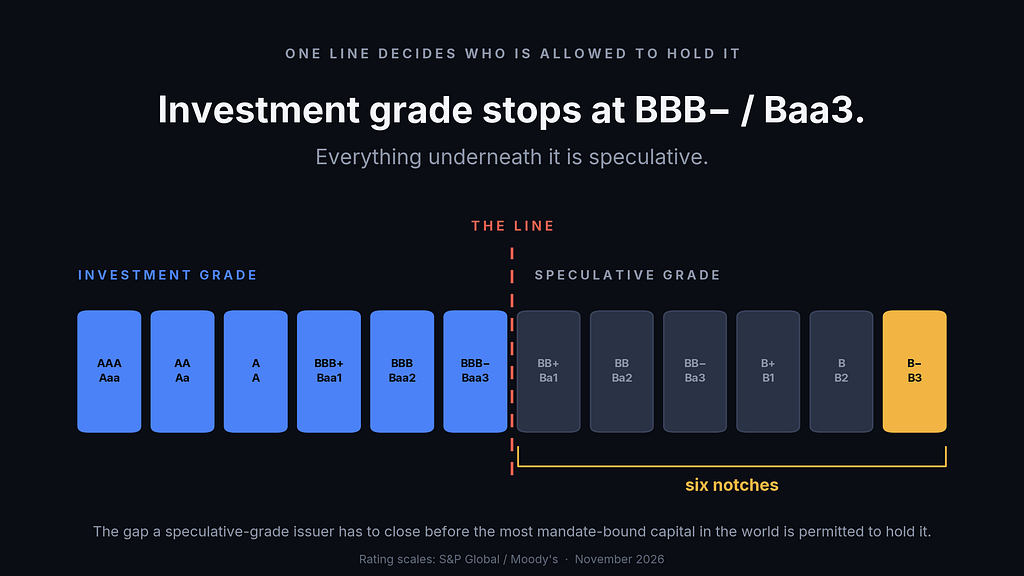
One line decides who is allowed to hold it. Everything underneath is speculative.
Most arguments about trust in crypto end in a shrug.
In October, one of them ended in a letter grade.
On 1 October, S&P Global affirmed Sky Protocol at B−. Six days later, Moody’s assigned B3. Two agencies. Two review teams. Two methodologies. One answer.
Neither grade is investment grade. Both sit six notches below the line.
Read that as bad news if you like. Here is the other reading. For the first time, a decentralized protocol has been measured on the exact scale a pension fund is legally required to use. The answer came back “not yet.” The question is now answerable at all.
““Not yet” and “unmeasurable” are very different answers.”
What Does “Investment Grade Crypto” Actually Mean?
It is not a vibe. It is a rung on a ladder.
Investment grade starts at BBB− at S&P and Fitch, and at Baa3 at Moody’s.Everything below that is speculative grade. The market’s blunter word is junk.The single notch between BBB− and BB+ is the most consequential boundary in the bond market.Above it, pension funds, insurers and reserve managers are permitted to hold. Below it, mandates often force them to sell, whatever the manager personally thinks.
So “investment grade crypto” is not a slogan. It is a specific, checkable question: has a recognised agency placed a digital asset issuer at BBB− / Baa3 or better?
For stablecoin protocols, nobody has. Not yet.
Two agencies, two methodologies, one answer. Six notches is the distance.
Why Two Credit Rating Agencies Graded the Same Onchain Protocol in Seven Days
S&P first rated Sky Protocol in August 2025 — the first full credit rating any major agency had given a DeFi protocol. It affirmed B− with a stable outlook on 1 October 2026.
Moody’s followed on 6 October with B3 and a stable outlook, its first rating of any stablecoin protocol. That makes Sky Protocol the only stablecoin protocol currently assessed by both.
Why bother chasing a grade you know will be low? Because a rating is a passport, not a trophy.
A risk committee can file it. B3 lands in the same spreadsheet column as a B3 corporate bond.Prime brokers, insurers and structured product desks get a standardised measure instead of a bespoke argument from a founder.The protocol becomes comparable. Comparable is the precondition for being allocated to at all.
Six Notches Is a Distance, Not a Verdict: What Both Agencies Actually Flagged
Here is the part most of the coverage skipped.
Both agencies published what is holding the grade down, and they landed on the same thing: capital.
Not the collateral. Not the code. Not the audits.
S&P flagged thin capitalisation, depositor concentration and governance concentration.Moody’s named the size of Sky Reserves as a central factor, and flagged the thin capital buffer explicitly.Neither cited a failed redemption, an exploit or a broken peg.
That distinction matters more than the letter. A thin equity buffer is arithmetic, and arithmetic can be fixed. A broken redemption mechanism cannot.
Plenty of outlets ran the story as “junk grade”, which is technically correct and analytically lazy. Junk is a category. The useful information is which line item put it there.
One small detail says a lot about how this is being handled. On 8 October, the foundation corrected its own headline, swapping “issuer rating” for “counterparty risk rating.”
A one-word fix on a release nobody would have challenged. Precision about what you have been given is, in the end, the thing the agencies are scoring.
“Both agencies flagged the buffer. Neither flagged the backing.”
The Reserve Math Anyone Can Check in Two Minutes
Sky Governance has set a $150M medium-term Solvency Reserve target. The numbers come from the Q3 2026 Quarterly Report, published by Sky Frontier Foundation on 29 October 2026.
Sky Reserves closed Q3 at $85.08M.$28.47M was remitted to reserves during the quarter.A year earlier, Q3 2025 ran a $2.64M deficit. That is a swing of roughly $31M year on year.
The gap to target is about $65M. At Q3’s remittance rate, that is a little over two quarters of arithmetic.
Nobody has promised a date, and the pace moves with Net Revenue. But it is a sum you can do yourself, which is the entire point.
In March, governance had already cut the daily buyback by 87% to feed the buffer. That was an unpopular vote. It is also the one the agencies are now scoring.
Capital was the flag. Capital is also the thing with a published target and a running total.
Can a Protocol Afford Its Own Upgrade? Six Quarters Say Maybe
Reserves get built out of earnings, so the earnings are the real story.
Sky Protocol in Q3 2026:
Gross Protocol Revenue of $99.29M, up 14.2% year on year.Net Revenue of $37.19M, up 11.8% on Q2. The sixth consecutive positive quarter.Net Revenue margin widened to 37.5%, from 31.0% in Q2.Total expenses fell 16.0%.
Six profitable quarters is not a long record by corporate standards. It is an unusually long one in onchain finance, where most protocols have never published an income statement at all.
A rating agency cannot underwrite a narrative. It can underwrite six quarters of published results.
Where the Sky Savings Rate, sUSDS and USDS Sit Inside a Credit Rating
A rating on a protocol is, in practice, a rating on the things it issues.
USDS is the foundational stablecoin — soft-pegged to the dollar, backed by a surplus of collateral, and convertible 1:1 through the Peg Stability Module.sUSDS is the yield-generating version. Hold it and it accrues the Sky Savings Rate, compounding programmatically with no lockups and no exit fees.The Sky Savings Rate is funded by the Sky Agent Network: independent capital allocators that access USDS liquidity under risk limits set in public, deploy it, and pay fees back to the protocol.
At Q3 close, Protocol Collateral stood at $11.41B, against USDS supply of $9.70B and sUSDS of $4.52B. Collateral exceeds the stablecoin supply it backs.
The rate itself is variable and set by governance, so it is published live on the protocol dashboards rather than printed in articles. Which is the correct way round.
The three numbers a credit analyst opens first. All three are public and all three are dated.
Did the Rating Change Anyone’s Behaviour? Check the Balance Sheets
The standard objection to credit ratings in crypto is that nobody acts on them.
Then Galaxy did.
In September, Galaxy added $100M of sUSDS to its corporate balance sheet and approved sUSDS as eligible collateral across its institutional lending business.A $500M warehouse lending facility between Sky Agent Grove and Galaxy had financed $375M of loans by the end of Q3.Standard Chartered initiated research coverage of SKY on 11 September.
None of that required an investment grade rating. All of it required a protocol legible enough to underwrite. That is the quiet thing a B3 buys you.
What Would Actually Have to Change to Reach Investment Grade?
Based on what the agencies themselves published, four things:
Capital. A thicker buffer relative to the liabilities it supports. This is the named constraint, and the only one with a public target attached.Concentration. Fewer dominant holders, and less dependence on any single governance participant.Allocator diversification. Four Prime Agents accounted for roughly 65% of consolidated assets in September, with Spark near 36% and Grove near 24%.Durability. Agencies want cycles, not quarters. Six positive quarters is a start, not a record.
Sky Governance has stated a higher capital ratio as an objective and an investment grade rating as a long-term ambition. That is a stated goal, not a forecast, and it should be read as one.
Reserves are paid first, automatically, every settlement cycle. No vote required to keep going.
The 60-Second Credit Check for Any Stablecoin
Save this one. It works on any issuer, rated or not.
Is it rated at all? By whom, at what grade, on what date. An unrated issuer is not safer. It is unmeasured.Issuer rating or stability assessment? They answer different questions. Do not let a marketing page blend them.What did the agency flag? The named weakness tells you more than the letter does.Where is the capital buffer, and is it growing? Find the number and the trend, not the adjective.Does the protocol publish an income statement? No revenue line means nothing to build a buffer from.Can you verify it yourself? Collateral, supply and reserves belong on a live dashboard, not in a PDF from March.
The honest answer to the question in the title is no. Not today.
B− and B3 are speculative grade. Six notches is a real distance, not a rounding error, and anyone selling it as a victory is selling you something.
But the question stopped being rhetorical in October. Two agencies put an onchain protocol on the same ladder as every corporate borrower on earth, published their reasoning, and named a constraint with arithmetic behind it.
That is usually what progress looks like, right before it looks like a headline.
“A grade you can argue with beats a trust-me you cannot.”
So what is your read? Does a credit rating from a legacy agency actually belong on a decentralized protocol, or is it a category error dressed up as validation? I would genuinely like to hear the case against. Drop it below.
Can an Onchain Protocol Be Investment Grade? The Question Just Got Real was originally published in Coinmonks on Medium, where people are continuing the conversation by highlighting and responding to this story.