
How customizable, ready-made financial platforms help businesses launch faster, scale smarter, and focus on customer value
Fintech customers expect payments to work smoothly, financial services to feel simple, and digital experiences to be secure. For businesses entering this market, building every part of a financial platform from scratch can be expensive and time-consuming. White label technology offers another route: use an existing technology foundation, customize it, and deliver the service under your own brand.
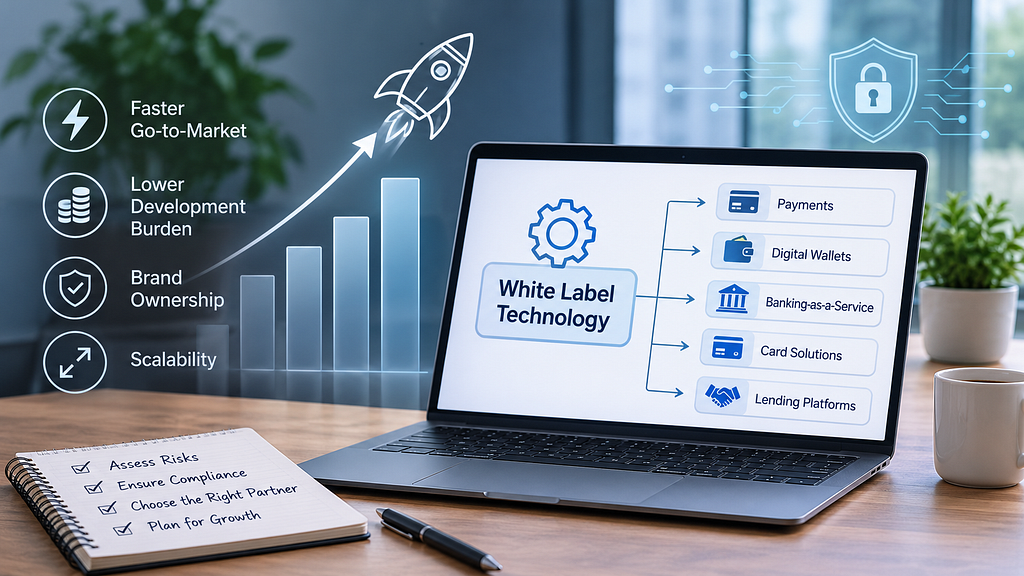
ChatGPT Generated Image
A white label provider develops a product that another business can brand, configure, and offer to its customers. In fintech, this may include payment gateways, digital wallets, card-management tools, onboarding systems, or lending workflows. The business can focus on its audience and service instead of creating every technical component itself.
The benefit is more than a faster launch. Used carefully, white label technology can influence how a fintech SaaS company develops products, serves clients, and builds recurring revenue.
Why Building Everything from Scratch Is Difficult
Financial software involves much more than designing screens and connecting an API. A production platform may need transaction processing, authentication, reporting, integrations, monitoring, data protection, and operational support. It must also be tested for failures and changing customer needs.
For startups and growing software companies, building and maintaining these capabilities internally can stretch budgets and delay market entry. White label solutions offer an alternative: use established core components, then focus development on the features and experience that make the business distinctive. This does not eliminate technical responsibility; it changes where effort is invested.
How White Label Technology Supports SaaS Growth
1. Faster Time to Market
A ready-made platform can reduce foundational development. Businesses may configure branding, workflows, user roles, and integrations instead of creating every component independently.
This can help a company test demand earlier, gather feedback, and improve its offering. Speed should never replace security testing, compliance reviews, or operational readiness.
2. A Lower Upfront Development Burden
Building fintech software requires engineering, infrastructure, testing, maintenance, and upgrades. White label technology can reduce some of that workload and make costs more predictable, depending on the provider and contract.
Resources can then be directed toward customer acquisition, support, product design, and market-specific features. Compare total cost of ownership — not only setup fees — including transaction charges, customization, support, upgrades, and exit costs.
3. Brand Ownership and Customer Experience
White label products can provide branded portals, dashboards, mobile experiences, notifications, and customer journeys. This gives a SaaS business greater control over how its service is presented.
However, branding must not mislead customers about who provides a regulated service, holds funds, issues cards, or processes transactions. Responsibilities should be explained accurately in customer terms and agreements.
4. Customization for Different Markets
Different customers need different workflows. An online retailer may prioritize checkout, refunds, and reconciliation. A marketplace may need seller onboarding, split payments, and payouts.
White label systems can offer configurable modules and integrations for these needs. The sensible approach is to customize where it creates value while keeping the stable core platform manageable.
5. Scalability and Recurring Revenue
A SaaS business aims to serve more customers without increasing operational effort at the same rate. A well-designed platform can support multiple clients through configurable environments, role-based access, and reusable integrations.
Depending on its commercial model, a provider may earn subscription fees, implementation fees, usage-based charges, or revenue from additional modules. Sustainable growth still depends on reliability, retention, support, and transparent pricing.
Where White Label Technology Is Making an Impact
Its applications extend across several fintech areas:
Payment gateways: Branded payment acceptance, transaction dashboards, refunds, and reconciliation.Digital wallets: Wallet experiences with balance views, transfers, and transaction histories, subject to licensing and partner arrangements.Banking-as-a-Service (BaaS): Banking capabilities integrated through authorized financial institutions and infrastructure partners. A technology provider does not automatically become a bank.Card-as-a-Service: Branded card experiences and management workflows supported by licensed issuing and processing partners.Lending platforms: Application journeys, document collection, eligibility workflows, and repayment tracking. Lending decisions and obligations must remain with appropriately authorized parties.
These use cases are relevant to startups and established businesses seeking to add digital services, enter adjacent markets, or modernize customer experiences.
The Risks Businesses Should Evaluate
White label technology is not a shortcut around responsibility. Fintech depends on trust, security, and regulation. Before choosing a provider, assess:
Security and data protection: Check encryption, access controls, vulnerability testing, incident response, data storage, and independent assessments.Compliance responsibilities: Clarify who handles licensing, KYC, AML checks, sanctions screening, disclosures, complaints, and regulatory reporting. Requirements vary by country and product.Reliability and support: Review uptime commitments, disaster recovery, service-level agreements, support availability, and escalation procedures.Integration and flexibility: Confirm that APIs, documentation, reporting, and integrations fit the intended business model.Vendor dependence: Understand data portability, customer relationship ownership, customization limits, price changes, and switching procedures.
Verify provider claims through documentation, demonstrations, and contractual commitments. Using a white label platform does not automatically transfer every legal or regulatory obligation to the vendor.
Choosing the Right Growth Strategy
The best platform is not necessarily the one with the longest feature list. It is the one that fits the company’s customers, geography, risk profile, and roadmap.
Start by defining the customer problem and intended service. Map the required capabilities, identify regulated activities, and decide which responsibilities will be handled internally or by authorized partners. Compare providers on security, scalability, integration quality, support, pricing, and contractual clarity.
A pilot can test the fit before a full rollout. Begin with one use case and measure onboarding completion, transaction success, support requests, system performance, and customer feedback. Use the results to guide improvements and expansion.
The Future: Technology as an Enabler, Trust as the Differentiator
As fintech SaaS evolves, white label platforms will remain attractive because they combine established infrastructure with specialized customer experiences. APIs, automation, analytics, and modular architecture can make them more adaptable. Customers and regulators, meanwhile, will continue to expect safeguards, clear accountability, and dependable service.
White label technology does not guarantee growth or replace a sound business model. Its advantage is that it can reduce the burden of building common infrastructure, giving companies more room to solve specific customer problems.
The businesses most likely to benefit will choose partners carefully, customize with purpose, communicate responsibilities honestly, and treat security and compliance as foundations. In a market where trust matters as much as convenience, these practices can turn a white label product into a sustainable fintech SaaS business.
The Role of White Label Technology in Fintech SaaS Growth was originally published in Coinmonks on Medium, where people are continuing the conversation by highlighting and responding to this story.