
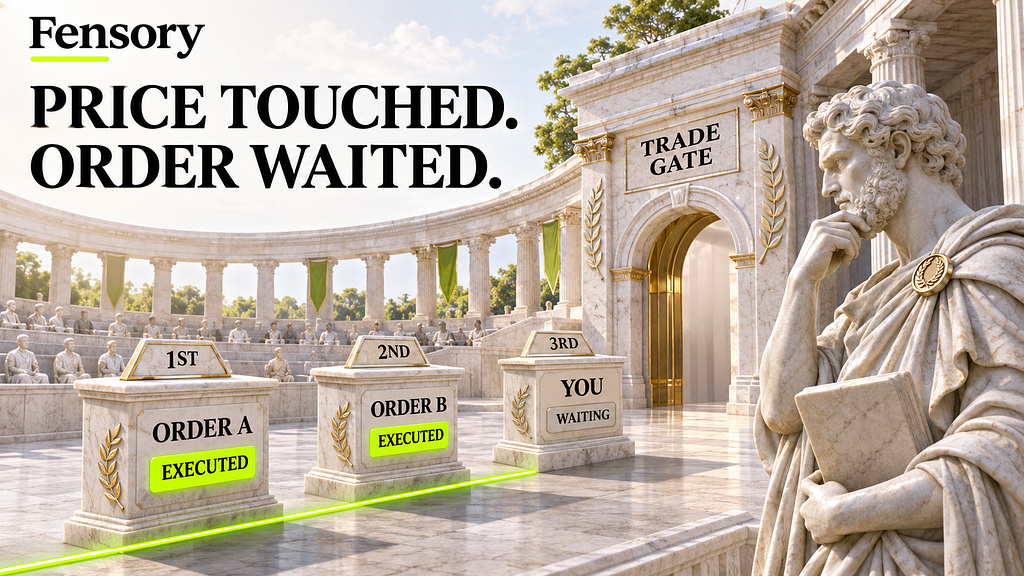
Reaching your price is not enough. Queue position and available volume decide whether the order trades.
The chart touched your limit price. Your order did not fill.
Both things can be true.
A limit order does not reserve the next trade at that price. It joins a queue. Orders at a better price trade first. Orders at the same price are generally handled by time priority, so the orders already resting there sit ahead of yours.
The visible price is only one part of the execution problem.
Price first, then time
Hyperliquid documents a price-time priority order book.
Price priority is straightforward. A buyer offering $100 ranks ahead of a buyer offering $99.90.
Time priority handles orders at the same price. If three buyers are already waiting at $100 when you place a fourth buy order at $100, the earlier orders are ahead of you.
Your order can be correctly placed, remain open and still receive no fill if the incoming sell volume is used up before reaching your place in the queue.
A simple queue example
Imagine the bid at $100 contains:
Trader A: 5 unitsTrader B: 10 unitsYou: 8 units
You are behind 15 units.
If a seller trades 12 units at $100, the chart prints $100. Trader A fills completely and Trader B fills 7 units. Your order receives nothing.
The market touched your price. It did not trade enough volume at that price to reach you.
If another seller trades 6 units, Trader B gets the remaining 3 and you receive a 3-unit partial fill. Five units of your order remain open.
This is why a candle cannot explain queue position.
The chart hides the path
A chart usually compresses many events into one bar.
It may show the high, low, open and close for a period. It does not show:
how much traded at each pricewhich side initiated the tradehow many orders were ahead of yourswhether your order was active for the whole periodwhether the price came from the same venue
Even a live last price can be insufficient. You need the order status and fill history.
Common reasons a limit order stays open
Not enough volume reached your queue position
This is the most intuitive case. The market traded at your price, but not through enough quantity.
The price came from another reference
A chart, index or oracle can move differently from the venue’s executable order book. A reference price touching your level does not mean someone traded against your order.
The order arrived after the trade
Fast markets can make the sequence look simultaneous. If the trade happened just before your order became active, there was nothing left to fill it.
The order had a condition attached
Post-only, reduce-only or other order instructions can change whether an order rests, cancels or is rejected.
What to check before replacing it
Do not cancel and resubmit only because the chart looks close.
Check:
Is the order still open?Is the limit price on the correct side of the book?How much size is ahead at the same price?Did actual trades occur at that price after your order became active?Did you receive a partial fill?Would crossing the spread change the execution cost more than waiting?
The last question matters. Moving a limit order toward immediate execution can solve the waiting problem by accepting a different price.
The useful mental model
A resting limit order is a request to trade at a price or better.
It is not a promise that the market will bring enough opposing volume to you.
When an order does not fill, separate the market view from the execution choice. Your price can be reasonable while your queue position is poor. Your thesis can be right while the chosen order never trades.
Fensory’s terminal keeps the live market and order controls in the same view. Use the order book, current status and fill records together before deciding whether to wait, replace or cancel.
Trading involves risk, including the loss of funds. This article is educational and is not financial advice.
Sources
Hyperliquid order book documentationHyperliquid order typesHyperliquid information endpoint for order status and fills
A resting limit order can be right and still not fill was originally published in Coinmonks on Medium, where people are continuing the conversation by highlighting and responding to this story.