
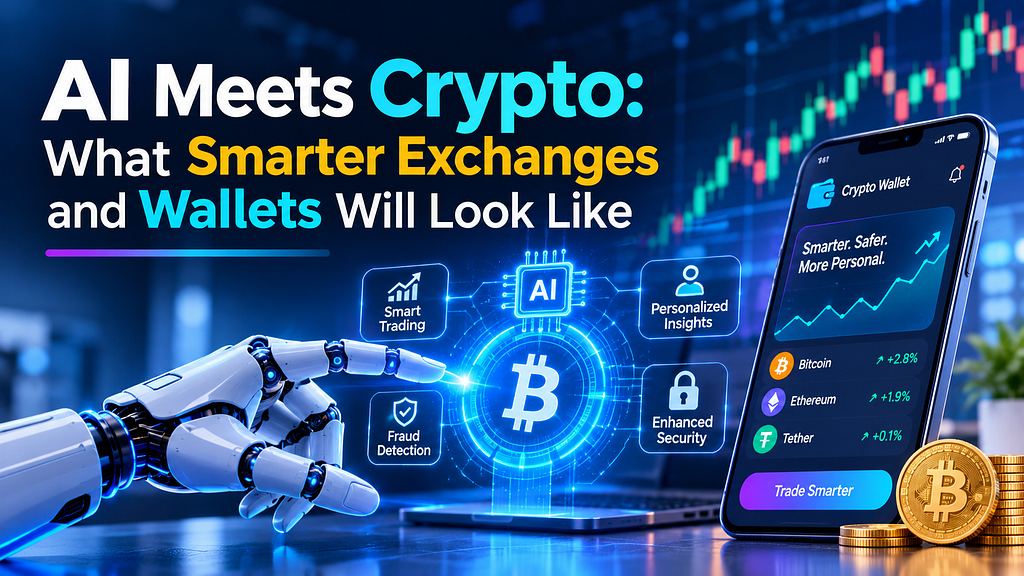
AI Meets Crypto: Smarter Exchanges and Wallets
The first time most people use a crypto wallet, it feels like defusing a bomb. Long addresses, unfamiliar warnings, fees that change by the minute, and the quiet fear that one wrong paste could send money into the void. Exchanges aren’t much easier, with order books, margin settings, and a flood of tokens nobody can vet.
This is exactly the kind of friction AI is good at smoothing out. And in 2026, the overlap between artificial intelligence and crypto is moving from conference talk to working products.
But it’s also a space full of hype. So let’s separate what’s genuinely useful now from what’s still experimental, and look at what a smarter exchange or wallet might actually look like.
Why AI and crypto fit together
Crypto produces enormous amounts of structured, public, real-time data: transactions, wallet activity, order flow, smart contract calls. AI thrives on exactly that. Meanwhile, crypto’s weak spots, such as scams, complexity, volatility, and irreversible mistakes, are the kind of problems pattern recognition can help with.
Industry analysts have pointed to AI and crypto as a growing, though still early, intersection. Some expect AI agents that can transact on-chain, along with AI-assisted tools for monitoring and managing infrastructure. Whether or not the boldest predictions arrive, several practical uses are already taking shape.
1. Smarter fraud and anomaly detection
This is the most mature use case, and the one with the clearest payoff.
Exchanges deal with account takeovers, wash trading, money laundering patterns, and suspicious withdrawals. Rules alone struggle because attackers adapt. Machine learning models can learn what normal behavior looks like for each user and flag deviations in real time, such as a sudden login from a new country followed by a large withdrawal to a fresh address.
What it looks like in practice:
Risk scores attached to logins, withdrawals, and transfersAutomatic holds or extra verification when something looks offPattern detection across linked accounts and walletsFaster triage for compliance and security teams
The key is balance. Too many false alarms frustrate honest users, while too few let fraud through. Good systems keep humans in the loop for borderline cases.
2. Wallets that warn you before you make a mistake
Irreversible transactions mean prevention matters more than any refund process. AI can help wallets act like a careful friend looking over your shoulder.
Imagine a wallet that:
Simulates a transaction and tells you in plain language what it will actually do before you signFlags suspicious contracts that match known scam or drain patternsDetects address-swapping malware or look-alike addressesExplains fees and suggests a sensible time to transact
These features don’t require futuristic technology. Many combine established security checks with models that classify risk, and they can dramatically reduce the number of costly beginner errors.
3. Customer support that actually answers
Anyone who has waited days for an exchange support reply knows the pain. Language models are now good enough to handle a large share of routine questions: why a deposit hasn’t arrived, how to verify an identity, what a fee means.
When designed responsibly, AI support can:
Answer common questions instantly, in multiple languagesPull in account-specific context, such as the status of a pending withdrawalHand off complex or sensitive cases to a human
There are important guardrails. A support bot should never invent policy, never ask for private keys or seed phrases, and never give anything that sounds like financial advice. Clear escalation paths and careful testing are essential.
4. Market surveillance and compliance automation
Compliance is expensive, repetitive, and high-stakes, which makes it a strong candidate for AI assistance.
Exchanges can use models to:
Detect potential market manipulation, such as spoofing or coordinated pump patternsPrioritize alerts so analysts focus on the highest-risk casesAssist with transaction monitoring and suspicious activity reportingSummarize case files for investigators
This doesn’t remove the need for human compliance officers or legal advice. It helps them spend time on genuine risks instead of drowning in noise. As regulations tighten in many regions, this efficiency matters more.
5. Personalized insights (carefully)
Users increasingly expect their apps to be smart. AI can power portfolio summaries, plain-language explanations of market events, and educational prompts tailored to a user’s experience level.
This is also where caution is most needed. There’s a big difference between explaining what happened and telling someone what to buy. Crossing that line can create regulatory problems and harm users. Responsible products focus on education and clarity, include clear disclaimers, and avoid promises or predictions presented as certainty.
6. AI agents that transact on-chain
This is the most talked-about and least settled area. The idea is that software agents could hold wallets, pay for services, rebalance positions, or execute strategies automatically.
The potential is real, since blockchains offer programmable money that agents can use without traditional banking access. But so are the risks:
Security: An agent with spending power is an attractive target.Accountability: Who is responsible when an agent makes a costly error?Manipulation: Agents can be tricked by malicious inputs or poisoned data.Regulation: Rules around automated trading and customer funds are still evolving.
A sensible approach is to start small: strict spending limits, allow-lists of approved actions, human approval for large transfers, and thorough testing on test networks. Treat full autonomy as a destination to approach carefully, not a feature to ship quickly.
What this means if you’re building
If you’re planning an exchange or wallet, AI features can be a real differentiator, but only if they solve real problems. A practical way to think about it:
Start where the value is measurable. Fraud reduction, faster support, and fewer user errors are easy to track. Flashy features that don’t change outcomes are not.
Protect your data. AI systems need data, and crypto platforms hold sensitive customer information. Be clear about what is used, where it’s processed, and whether any of it leaves your control.
Keep humans involved. For anything affecting funds, compliance decisions, or account access, design human review into the process.
Plan for failure. Models make mistakes. Build fallbacks, monitoring, and clear ways for users to appeal or correct errors.
Mind the rules. AI-driven features can trigger additional obligations around transparency, data protection, and consumer protection, depending on where you operate. Involve legal counsel early.
Questions to ask a crypto development company
When you speak to a potential partner about AI-enabled features, these questions separate substance from buzzwords:
Which AI features have you shipped in a live crypto product, and what were the results?How do you keep user data private when training or running models?How do you test for false positives and false negatives in fraud detection?What safeguards stop AI features from giving anything resembling financial advice?How do you handle security for any feature that can move funds?What happens when the model is wrong, and who can override it?Who owns the models, data pipelines, and code?
A capable crypto development company will welcome these questions. Evasive answers are a warning sign.
What’s hype and what’s real
To summarize:
Ready now: fraud detection, transaction risk warnings, support automation, compliance triage, market surveillancePromising, handle with care: personalized education, AI-assisted portfolio summariesEarly and risky: autonomous agents managing real funds without tight limits
The bottom line
The smartest exchanges and wallets of the next few years probably won’t be the ones with the most AI features. They’ll be the ones where AI quietly makes the experience safer and simpler: catching the scam before you sign, answering your question in seconds, and flagging the suspicious withdrawal before it’s too late.
In a space where trust is everything, that’s a more powerful promise than any futuristic demo.
AI Meets Crypto: What Smarter Exchanges and Wallets Will Look Like was originally published in Coinmonks on Medium, where people are continuing the conversation by highlighting and responding to this story.