
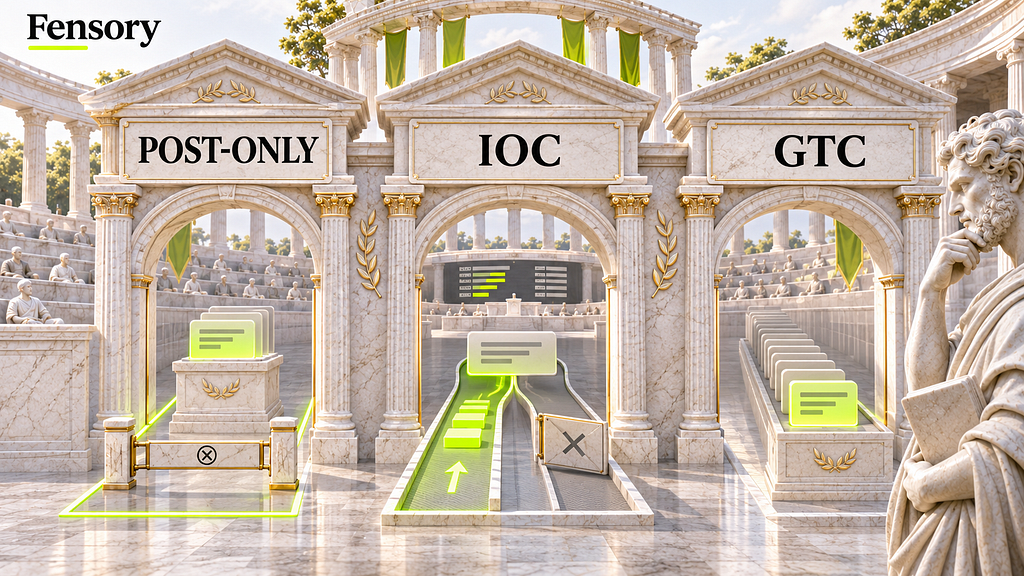
Time-in-force is not a minor order setting. It decides whether your order rests, trades immediately or disappears.
Three limit orders can use the same price and size, yet behave completely differently.
The difference is time-in-force.
Good-til-cancelled, immediate-or-cancel and post-only instructions tell the venue what to do when the order reaches the book. They answer three different questions:
Should this order wait?Should it trade now and cancel the rest?Should it add liquidity only?
Choosing one is part of the execution decision, not a technical afterthought.
GTC: let the order wait
A good-til-cancelled order stays active until it fills or you cancel it.
Use GTC when the price matters and you are willing to wait for the market to come to you. If part of the order fills, the remaining quantity can continue resting.
Example:
You place a GTC buy for 10 units at $100 while the best ask is $101. The order joins the bid side at $100. If sellers later trade 4 units against it, 6 units remain open.
GTC is useful for patient execution. Its main risk is forgetting that the remaining order is still active after your market view changes.
IOC: trade what is available now
An immediate-or-cancel order tries to execute immediately. Any quantity that cannot fill at the allowed price is cancelled.
Use IOC when you care about the liquidity available now and do not want a remainder resting in the book.
Example:
You send an IOC buy for 10 units with a $101 limit. Only 6 units are available at $101 or better. Those 6 can fill, while the other 4 cancel.
IOC does not mean all or nothing. It can produce a partial fill.
That detail matters when calculating the position you actually hold after the order returns.
Post-only: add liquidity or do nothing
Post-only is called ALO, or add liquidity only, in Hyperliquid’s documentation.
The instruction prevents the order from immediately crossing the book. If the order would trade as soon as it arrives, the venue cancels it instead.
Use post-only when your intention is to rest as a maker. It is not the right choice when immediate execution matters more.
Example:
The best ask is $101. A post-only buy at $101 would trade immediately, so it cancels. A post-only buy at $100.90 can rest if it does not cross the current ask.
Post-only protects the order’s role. It does not protect you from the market moving away while the order waits.
Same idea, three outcomes
Suppose the best ask is $101, with 6 units available.
You want to buy 10 units with a $101 limit.
GTC: 6 can fill now and 4 can remain open at $101.
IOC: 6 can fill now and 4 cancel.
Post-only: the order cancels because it would take liquidity immediately.
The chosen price is identical. The result is not.
A practical decision rule
Start with the job you need the order to do.
Choose GTC when:
the price matters more than immediate completionyou are comfortable monitoring an open remainderthe order may wait through changing conditions
Choose IOC when:
you want the quantity available nowyou do not want leftover size restinga partial fill is acceptable
Choose post-only when:
you want to add liquidity rather than cross the spreadcancellation is better than an immediate taker fillyou are prepared for the order never to execute
Verify the outcome, not the intention
After submission, inspect the actual order status and fills.
A trader may intend to buy 10 units but end up with 6 after IOC. A post-only order may cancel before entering the book. A GTC order may remain active after the first partial fill.
Your account state reflects the executed result, not the original sentence in your head.
In Fensory, review the order type, time-in-force and live book before submitting. Afterward, check the open order and fill records before making the next decision.
Review the available order controls
Trading involves risk, including the loss of funds. This article is educational and is not financial advice.
Sources
Hyperliquid order typesHyperliquid order book documentationHyperliquid information endpoint
Post-only, IOC and GTC solve different problems was originally published in Coinmonks on Medium, where people are continuing the conversation by highlighting and responding to this story.