
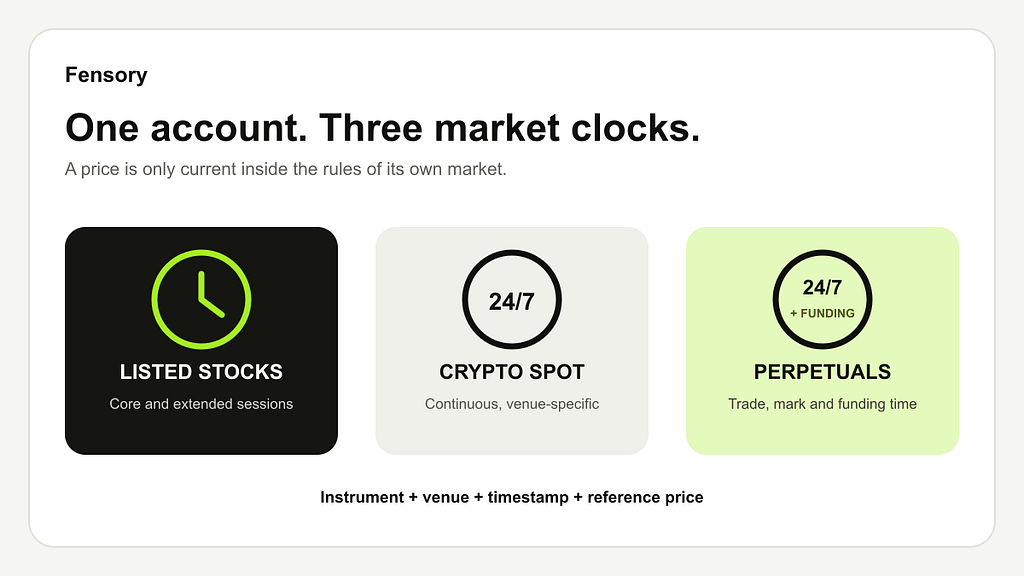
A price can be current for one market and stale for another because trading sessions, reference prices and funding intervals follow different schedules.
A price without a clock is incomplete information.
US listed stocks have defined sessions. Crypto spot markets generally trade continuously on the venue. Perpetual futures can also trade continuously, but their funding and mark-price mechanics introduce another schedule inside the market.
If you compare all three as though they share one clock, the apparent opportunity may be nothing more than a timing mismatch.
Listed stocks have a session structure
The core US equity session runs from 9:30 a.m. to 4:00 p.m. Eastern Time on regular trading days.
Some venues also provide pre-market and after-hours sessions. Nasdaq publishes a pre-market session from 4:00 a.m. to 9:30 a.m. Eastern and an after-hours session from 4:00 p.m. to 8:00 p.m. Eastern. The available liquidity, order types and execution conditions can differ outside the core session.
Weekends and exchange holidays create longer gaps. News can arrive while the core market is closed, and the next available equity price may reflect that information only when a supported session opens.
So a displayed stock close is not necessarily a live indication of where related markets are trading now.
Crypto spot follows the venue, not an exchange bell
Crypto spot markets are generally available around the clock on the venue where they trade.
That does not mean liquidity is constant. Activity can change by region, weekday, weekend and market event. Maintenance, network congestion or venue-specific limits can also affect access.
The important difference is that there is no universal daily close equivalent to the US equity core-session close. A chart can still choose daily candles and a timezone, but that is an analytical boundary rather than a market-wide closing bell.
When comparing two spot venues, check that both prices use the same asset, quote currency and timestamp. A one-minute mismatch can matter in a fast market.
Perpetual futures add funding and mark price
Perpetual futures do not have a scheduled expiry. Their design uses funding to help keep the contract near the underlying spot market.
On Hyperliquid, funding is paid hourly. A positive funding rate means longs pay shorts, while a negative rate means shorts pay longs. The rate is one input in the cost of holding a position. It is not a directional forecast.
Perpetual venues also use a mark price for margin and liquidation calculations. That price may differ from the most recent trade because it is designed to reduce the effect of isolated prints.
A perpetual market therefore has at least three relevant clocks:
the timestamp of the latest tradethe update schedule for the mark or oracle inputsthe funding interval
The same ticker can represent different instruments
A stock, a tokenized representation, a spot token and a stock-named perpetual can share a familiar ticker while remaining different products.
Before comparing prices, identify:
the instrument typethe venuethe trading session or continuous-market statusthe quote currencythe exact timestampthe reference price used for margin or settlement
Without that context, a price gap is only a gap between labels.
A practical comparison sequence
Suppose you are looking at an equity-related perpetual while the US core session is closed.
Step 1: Check the equity timestamp
Is the displayed stock price from the core close, an extended-hours session or a delayed feed?
Step 2: Check the perpetual timestamp
Confirm the last trade and mark price. Do not compare one live number with one stale close without labelling the difference.
Step 3: Check what happened while the stock market was closed
Look for company announcements, macro releases or broad market moves that could explain why the continuous market changed.
Step 4: Check liquidity
A continuous price is not automatically a reliable price. Inspect the spread and available size.
Step 5: Wait for comparable evidence when necessary
The next core session may narrow, confirm or reverse the gap. A mismatch between clocks is context to investigate, not a trade call.
One account needs several clocks
A multi-market interface should show the instrument, market state and timestamp close to the price. It should also make funding and margin references explicit for perpetual futures.
That prevents a common mistake: treating every green number as though it was produced in the same session under the same rules.
Open one market and compare its price with the correct clock visible
Sources
Nasdaq: US market holiday schedule and trading hoursNYSE: Trading informationHyperliquid Docs: contract specificationsHyperliquid Docs: funding
Educational market-structure context only. Not financial advice.
Stocks, Crypto Spot and Perpetual Futures Do Not Share the Same Market Clock was originally published in Coinmonks on Medium, where people are continuing the conversation by highlighting and responding to this story.