
An examination priority is a map of supervisory attention. It is not a new rule, a product approval or a prediction of enforcement.
Regulatory documents are easy to overread.
When a regulator lists artificial intelligence, cybersecurity or tokenization as an examination priority, headlines can quickly turn that into “new AI rules” or “regulator approves tokenization.”
Neither conclusion follows.
The US Securities and Exchange Commission’s Fiscal Year 2027 Examination Priorities are a useful example of how to read this kind of document accurately.
What an examination-priorities document is
The SEC’s Division of Examinations uses its priorities to explain where risk-based examinations of registered firms are likely to focus.
The document helps registrants understand areas that may receive attention. It also tells the public what the examination program considers important in the current environment.
The 2027 priorities include operational resilience, cybersecurity, protection of customer information, emerging and advanced technologies, and evolving market infrastructure such as tokenization.
That is meaningful. It shows which operational and conduct questions the examination program expects to matter.
It is not an exhaustive list, and it does not turn every named topic into a new legal requirement.
What it does not mean
It is not a new rule
Rules are created through a different process. An examination priority may reflect existing obligations, observed risks or areas where the regulator wants to understand current practices.
If a priority mentions AI, the correct next step is to identify which existing duties apply to the registered firm using it. The priority itself does not automatically create a standalone AI rule.
It is not a product approval
Mentioning tokenization or advanced technology does not endorse a product, issuer or business model.
Regulators routinely examine areas because activity is growing, controls are changing or failures could harm customers. Attention is not approval.
It is not an enforcement action
An examination looks at a firm’s practices and compliance. Enforcement is a separate process.
The existence of a priority does not prove that a named technology is unlawful or that every firm using it is under investigation.
It is not a market prediction
A regulator’s focus says nothing reliable about the future price, adoption or commercial success of an asset or technology.
Supervision is about conduct, controls and obligations. It should not be turned into a trading signal.
What financial-AI teams should take from it
The practical value is in the control questions behind the topic.
For AI and other advanced technologies, teams should be able to explain:
what the system is allowed to dowhich data it uses and how that data is protectedhow outputs are reviewed where review is requiredwhich records are retainedhow failures, overrides and incidents are handledwhether public claims match the system’s real capabilities
For tokenized market infrastructure, the same discipline applies to custody, settlement, recordkeeping and customer disclosures. A modern interface does not remove the underlying obligation.
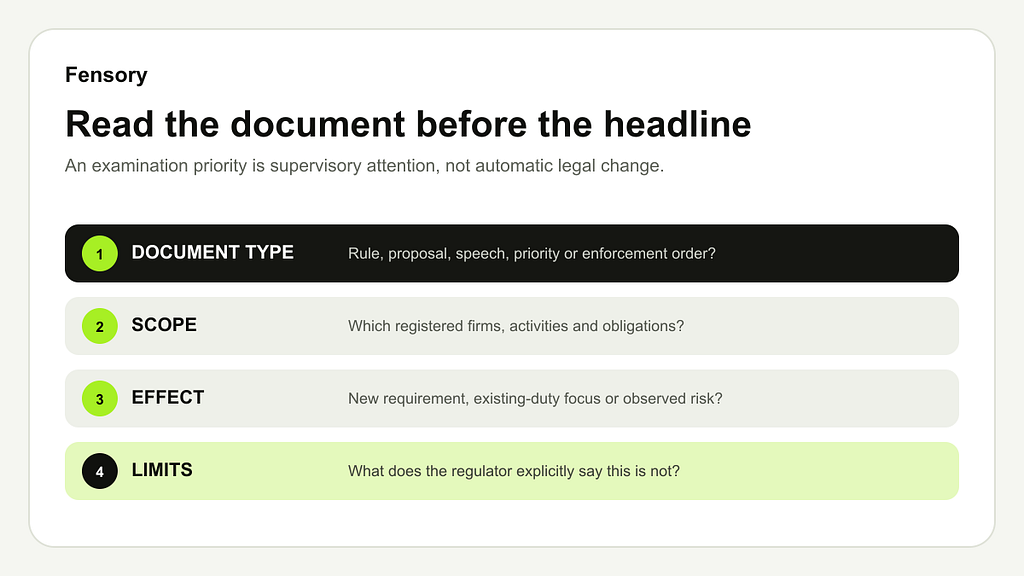
A four-part filter for reading the next announcement
1. Identify the document type
Is it a rule, proposal, speech, examination priority, staff statement, enforcement order or consultation? The label changes what the document can do.
2. Identify who it applies to
The SEC examination priorities concern its registered population and risk-based examination work. Do not silently extend the document to every software company or user.
3. Separate named risks from new obligations
Ask whether the document creates a requirement or points supervisors toward existing ones.
4. Read the limits
Official releases often say whether a list is non-exhaustive, whether priorities may change and whether the document has legal force. Those sentences prevent most headline errors.
Better regulatory reading produces better product work
Teams do not need to wait for a new rule before improving controls.
If a supervisory document highlights operational resilience, customer information and advanced technologies, those are reasonable prompts for an internal review. The review should be tied to the firm’s actual obligations and product surface, not to a dramatic interpretation of one paragraph.
That distinction keeps regulatory awareness useful. It also prevents marketing copy from implying an endorsement that does not exist.
Read the next supervisory document with the four-part filter
Sources
SEC: Fiscal Year 2027 Examination Priorities press releaseSEC Division of Examinations: 2027 Examination Priorities
Educational regulatory context only. Not legal, compliance or investment advice. The SEC has not endorsed Fensory or any product discussed here.
What a Regulator’s Examination Priorities Do and Do Not Mean for Financial AI was originally published in Coinmonks on Medium, where people are continuing the conversation by highlighting and responding to this story.