
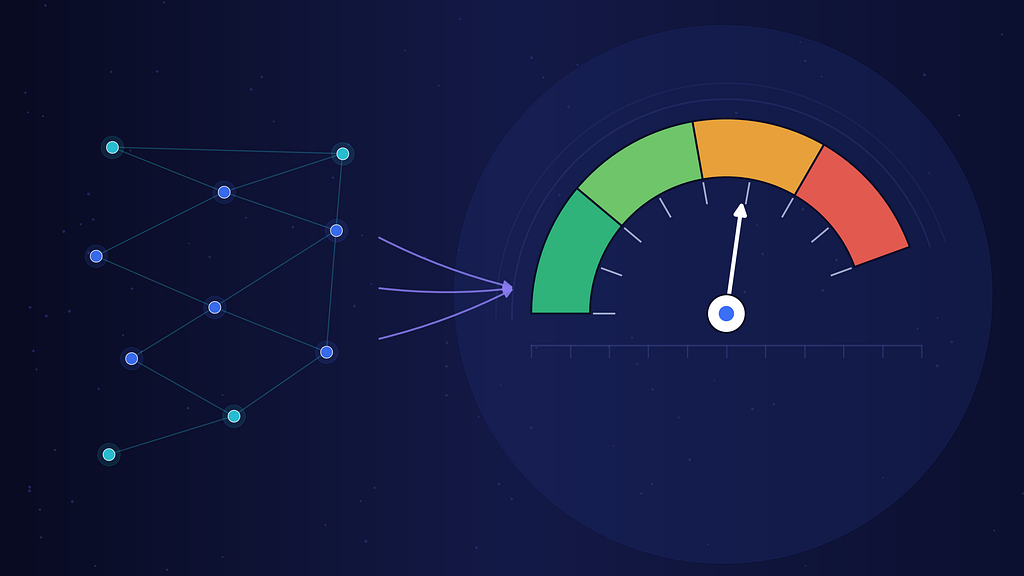
AI already runs the monitoring, the simulations, and a lot of the automation behind on-chain risk. Here is what it still can’t do on its own, and why your yield still rests on human judgment.
AI now runs much of the monitoring and automation behind on-chain risk. People still hold the dial.
Here is the short answer. AI already manages real parts of on-chain risk today.
It runs simulations, watches markets every second of every day, and adjusts protocol settings inside limits that people approve.
What it does not do yet is run the whole risk desk on its own. So the honest take on AI risk management in DeFi is this: yes for the hard, repetitive parts, and not yet as a manager you leave alone.
That gap matters more than the hype suggests, so let me walk through what AI does, where it hits a wall, and what measured on-chain risk really looks like.
The quick version
AI already runs simulation, monitoring, and bounded automation across DeFi.Firms like Gauntlet and Chaos Labs provide much of that risk plumbing.Automated systems act only within human-set, governance-approved limits.The real limits stay: stale data, models that get gamed, and crises no model has seen.Over-automation can spread risk, not contain it. AI augments risk management; it does not replace it.
What “managing on-chain risk” actually means
Managing on-chain risk means keeping a protocol solvent and liquid while markets move.
In plain terms, that is four jobs. Set the rules: collateral ratios, borrow caps, interest curves. Watch everything: positions, liquidity, oracle prices, concentration.
Stress-test: model crashes and attacks before they happen. Act fast: change settings the moment conditions change.
It is constant, data-heavy work, and the cost of getting it wrong is bad debt. No wonder teams want to automate it. It is also why a careless version is dangerous.
Where AI already runs the risk desk
AI already handles the simulation, monitoring, and bounded automation behind DeFi risk, and it is now core infrastructure. A few concrete examples, as of late 2026.
Gauntlet builds simulation-driven risk models and has acted as the economic risk brain for major lending markets, tuning parameters like collateral ratios and caps. It now runs some of the largest curated vaults too.
Chaos Labs runs AI-powered economic and security stress tests. Its risk oracles watch indicators in real time and push parameter changes within governance-approved bounds.
Aave’s renewal with the firm described more than 1,100 parameter updates.
AI-curated vaults from firms like Chaos Labs, Gauntlet, and Sentora now sit behind consumer products, rebalancing capital across Aave, Morpho, and Sky inside set risk targets.
AI does the speed. Humans still own the judgment and the brake.
The division of labor is simple. The machine does the speed: monitoring, simulation, anomaly detection, bounded adjustments.
The human keeps the judgment: which scenarios to run, which thresholds matter, which bounds to allow. This is real automated risk management in crypto, not a demo.
The part AI still can’t do
AI cannot be trusted to manage on-chain risk unsupervised, and 2026 showed why.
Start with the limits that never go away. It works inside human bounds, so that judgment stays human.
Models depend on data and oracles, and a stale price turns a smart system into a confident fool.
Models can be gamed by adversaries who know which inputs break them. And tail events escape training, because the crisis that matters most is usually the one the model has never seen.
A 2026 lending failure. The system acted on a price that was simply wrong.
The year drove this home. A string of lending blowups traced back to hardcoded or stale oracles.
In one case a collateral token was marked on-chain near $1.13 while it traded around $0.63 on the open market.
That is not a model being clever. That is automation acting fast on a wrong number.
The uncomfortable twist: automation can add risk. Fast, automated allocation paired with slow or sloppy controls, or a risk curator that itself fails, can spread a problem instead of containing it. Speed cuts both ways.
Governance-safe automation: humans still set the bounds
The norm today is not autonomous AI. It is governance-safe automation: people set the strategy and the limits, and AI acts inside them.
People decide the risk appetite and approve the guardrails. AI monitors, simulates, and makes bounded changes, often with a validation step before anything goes on-chain. And a human brake always exists.
You keep automation’s speed and keep accountability. Handing a model the power to act, with real money and real adversaries on the other side, should not be done blind.
What measured on-chain risk looks like: a Sky case study
The real answer to on-chain risk is not add AI. It is make the risk measurable. Sky is one of the clearer examples of that in stablecoins.
A quick primer, since the names trip people up. USDS is Sky’s fully backed stablecoin and the way into the system. It is the unit of account, not the yield.
sUSDS is what you hold to earn: you supply USDS, receive sUSDS, and it accrues the Sky Savings Rate over time. It is currently the largest rate-bearing stablecoin by supply.
The Sky Savings Rate is the governance-set yield behind sUSDS, funded by revenue from the Sky Agent Network, an independent set of capital allocators who put USDS to work across strategies like onchain loans, Treasury bills, and lending liquidity.
The Sky Savings Rate is produced, not promised. Revenue feeds a governance-set rate.
What makes it measured rather than trust me? USDS is over-collateralized and backed by diversified collateral, so the backing is not a single bet.
The yield is risk-adjusted and governance-set, not whatever the market will pay this week.
Sky is the only stablecoin protocol with credit ratings from both S&P Global and Moody’s.
Both are sub-investment grade, S&P at B- and Moody’s at B3, which is the honest part: independent agencies see real credit and concentration risk, and they publish it.
The infrastructure also carries a decade-long track record with no smart-contract exploit, and governance is building a $150 million solvency reserve.
Adoption is following. In September 2026, Galaxy Digital, a Nasdaq-listed firm, put $100 million of sUSDS on its balance sheet and approved it as institutional collateral.
And yes, this ties back to AI. Sky’s own 2026 roadmap names AI-driven automation as a growth theme, alongside Sky Agents and tokenized credit.
The through-line is the same: use quantitative, verifiable risk work, not guesswork.
If you want to go beyond the savings rate, Sky Vaults and stUSDS sit further out on the risk curve, and Sky Ecosystem Rewards layers in token incentives.
One honest caveat for savers: the Sky Savings Rate is variable. It has moved from roughly 8.75% in early 2025 to around 3.6% in late September 2026, and governance can change it. Read the live number before you decide anything.
The agent frontier, and why it’s still risky
The next step is AI agents that do not just advise but act, holding permissions and moving funds on-chain, including around tokenized real-world assets. Promising, and early.
Every limit above gets sharper when the model can pull the trigger. An agent that can act can also be manipulated or prompt-injected. A misbehaving agent causes harm directly, not as a suggestion.
Safety research keeps landing on the same answer: strict, often deterministic guardrails and clear permissions, not unsupervised control.
Full autonomy, with your money, is not here, and it is not obviously what you want.
Four rungs of machine autonomy. Most serious protocols sit on the third, on purpose.
So, can AI actually manage on-chain risk?
Yes for the parts that need speed and scale. Not yet as a manager you can leave alone.
AI already simulates, monitors, and adjusts risk faster than any human team, and it is now core plumbing for major protocols.
But it works inside human-set bounds, it can be wrong or gamed, it struggles with the crises that matter most, and letting it act unsupervised introduces fresh risk.
The grown-up version of on-chain risk is not a black box making the calls. It is measurable risk, verifiable backing, and humans who own the guardrails, with AI doing the heavy lifting in between.
AI can manage parts of on-chain risk as augmentation inside human guardrails. It is not yet a risk manager you can walk away from.
Frequently asked questions
Q. Can AI manage DeFi risk?
A. It already manages important parts, like simulation, monitoring, and bounded parameter changes, but inside human-set guardrails, not as a fully autonomous manager.
Q. What does AI actually do in DeFi risk management?
A. It stress-tests parameters, watches markets in real time, auto-adjusts limits within approved bounds, rebalances curated vaults, and flags anomalies faster than people can.
Q. What are the limits of AI risk management in DeFi?
A. It only acts within human bounds, depends on data and oracles, can be gamed, struggles with novel tail events, and over-automation can itself spread risk.
Q. How does Sky approach risk?
A. Like other protocols, Sky relies on quantitative, increasingly AI-assisted risk modeling to set the parameters behind USDS and the Sky Savings Rate, and its risk is also measured externally with credit ratings from both S&P and Moody’s. That does not make it risk-free.
• • •
On-chain risk is getting more measurable every year. That is the real story, bigger than any single model. If you want to see what governance-set, verifiable yield looks like up close, you can put your stablecoins to work on sky.money and read the live numbers on the dashboard.
AI Risk Management in DeFi: What It Can and Can’t Do was originally published in Coinmonks on Medium, where people are continuing the conversation by highlighting and responding to this story.