
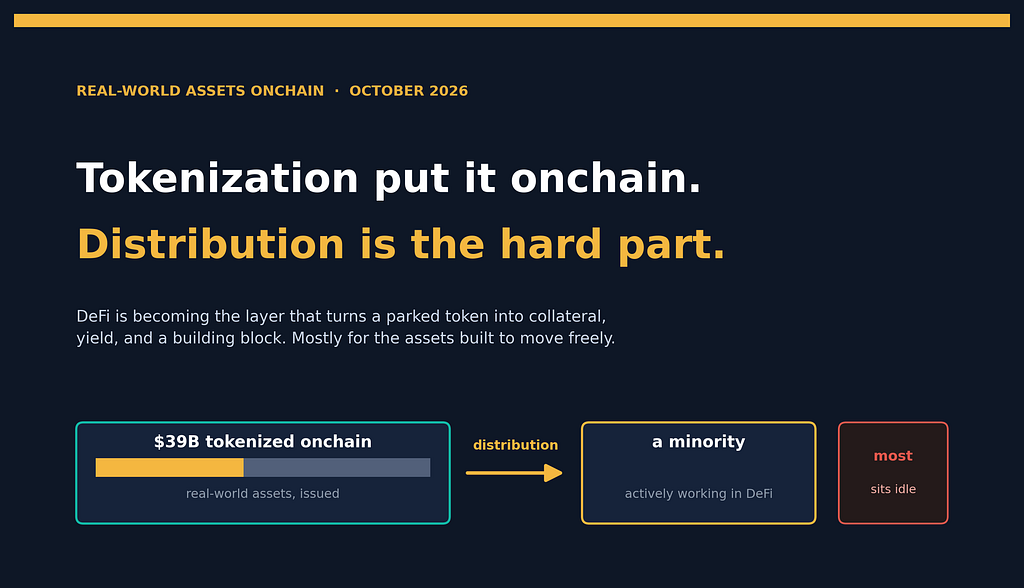
Tokenization put real-world assets onchain. DeFi is what makes them actually move. Here is where stablecoin yield, sUSDS and the Sky Savings Rate fit in.
Tokenization solved issuance; distribution is the harder, newer job, and most tokenized value still sits idle.
Here is the part almost nobody says out loud about tokenization: putting a real-world asset onchain is the easy bit now.
About $39 billion of tokenized real-world assets sit onchain today, excluding stablecoins, per RWA.xyz in mid-October 2026.
The underlying assets those tokens point to run into the hundreds of billions. Issuance is basically a solved problem, and the pipeline keeps filling.
Boston Consulting Group has projected tokenized assets could reach into the trillions of dollars by 2030.
But a token that just sits there is a receipt. Not a working financial instrument.
The hard part is distribution. Making that token useful. Lending it, borrowing against it, composing it into something productive. And more and more, that job belongs to DeFi.
So here is the thesis, plainly: DeFi is becoming the distribution layer for tokenized assets. Not all of them. Mostly the ones built to move freely.
Everything below is dated analysis, not financial advice, so check the live numbers before you act.
“Tokenization issues the asset. DeFi distributes its utility.”
Tokenization issues the asset. DeFi distributes it.
There are two separate jobs in bringing real-world assets onchain.
The first is issuance. Wrapping a Treasury bill, a credit position, or a dollar into a token.
Tokenization has largely cracked this. Onchain RWA value, excluding stablecoins, more than tripled in a year, past $39 billion by October 2026.
Tokenized US Treasuries alone are worth roughly $14.7 billion, with private credit and tokenized gold making up much of the rest.
The second job is distribution. Taking that token and making it productive. This one is harder, and it is where DeFi comes in.
DeFi protocols are composable. Drop a tokenized asset into them and it can be lent, pooled, borrowed against, and stacked into strategies without asking permission. A static record becomes a living building block.
Tokenization mints the asset. DeFi distributes its utility.
Tokenized RWA onchain value has more than tripled in a year. Source: RWA.xyz, dated; verify before publish.
How tokenized assets actually get used in DeFi
Once an asset can move freely, “distribution” stops being abstract. In practice it means a handful of concrete uses:
Collateral. Post a tokenized Treasury or a yield-bearing stablecoin and borrow against it, without selling the underlying exposure.Yield vaults. Supply the asset into curated vaults that put it to work across lending markets.Yield-trading. Split an asset into principal and future yield and trade them separately, as Pendle does, to lock in a fixed rate.Looping. Hold an asset for its base yield, borrow against it, redeploy, repeat. Powerful, and riskier.
Each of these turns a passive holding into something that earns or frees up liquidity. That is what “RWA in DeFi” really describes.
The four main ways a freely transferable tokenized asset gets put to work in DeFi.
The venues doing the heavy lifting
RWA deposits into DeFi lending and yield protocols climbed sharply through 2026, into the several billions. A handful of names carry most of the flow.
Morpho has become a leading venue, with hundreds of millions across dozens of RWA assets on several chains. Think of it as an onchain prime brokerage.Aave runs broad lending markets, plus a separate permissioned track for institutions.Kamino is the largest single-chain RWA venue, on Solana.Pendle handles the yield-trading and fixed-rate side.
Across these venues, RWA deposits roughly tripled in the year to mid-2026, climbing from a couple of billion dollars into the several billions.
One detail worth sitting with: credit tokens and tokenized gold currently make up most RWA collateral, more than Treasuries. These rankings shift fast, so treat them as a snapshot.
Leading DeFi venues distributing tokenized assets (snapshot, verify).
The catch: most tokenized RWA still sits idle
Now the honest part, because the headline numbers hide it.
For all the momentum, most tokenized real-world assets are doing nothing in DeFi.
By one 2026 analysis, more than half of reported RWA value sits idle. Issued, held, parked. Not circulating.
Why? Design.
A lot of tokenized assets, especially the institutional ones, are permissioned.
They need KYC, allowlisting, or jurisdiction checks, and they carry transfer restrictions. You cannot just drop them into an open protocol.
A token you cannot move without permission cannot be distributed by a permissionless system.
So the thesis needs a sharper edge. DeFi is not distributing all of RWA. It is becoming the distribution layer for the assets that were built to be distributed.
“A token you can’t move without permission can’t be distributed by a permissionless system.”The composability gap: by one 2026 estimate, more than half of tokenized RWA value is parked, not circulating.
Why permissionless, composable assets win
The assets that actually move through DeFi share a profile. Freely transferable. Built in standard token formats. Composable by default.
Yield-bearing stablecoins fit that mould almost perfectly. So do some freely transferable Treasury tokens. Heavily gated institutional tokens, however large, mostly do not.
The lesson for anyone issuing a tokenized asset is blunt. Composability is not a feature you bolt on later. If you want distribution, you design for it at issuance.
Where Sky fits: USDS, sUSDS and the Sky Savings Rate
Sky is a clean example of the permissionless side of this story. One example among several, not the whole trend.
Start with USDS, Sky Protocol’s stablecoin and the entry point to everything else.
USDS is over-collateralized, backed by a diversified mix that includes tokenized real-world assets like short-duration US Treasuries.
As of late October 2026, Sky.money’s homepage showed about $16.24 billion of collateral backing roughly $10.02 billion of USDS supply. That is close to $1.62 of collateral for every dollar.
Now the yield part. Supply USDS and you receive sUSDS, the world’s largest yield-bearing stablecoin, with supply near $4.83 billion on Sky.money in late October 2026.
sUSDS accrues the Sky Savings Rate (SSR) automatically, and you can redeem it for USDS plus accrued yield at any time.
The Sky Savings Rate is a variable, governance-set rate funded from aggregate Sky Protocol surplus, shown at 3.80% on Sky.money in late October 2026. It can change, and Sky.money does not set, control, or guarantee it.
Here is why it matters for this story:
sUSDS is permissionless and composable. It circulates through DeFi, gets held for its yield, supplied to vaults, and accepted as collateral. Galaxy, a large institutional holder, approved sUSDS as collateral for lending, and borrowers keep accruing the Sky Savings Rate while it is posted.Sky also runs its own lending layer, Spark. So Sky is both an issuer of a composable, RWA-backed yield token and a venue that distributes such assets.
That dual role, issuer and distributor, is the exact pattern this piece describes.
It runs on infrastructure that has worked on stablecoin systems since 2017. sUSDS still carries smart-contract and peg risk, and the rate is variable.
None of this is a sure thing. If you want the mechanics, here is a plain-English explainer of what sUSDS is and how it works.
How a stablecoin plugs into the Sky Savings Rate through Sky.money. Figures as of late October 2026; the rate is variable and not guaranteed.
The risks distribution brings onchain
Distribution is not free. Plugging real-world assets into DeFi imports new risks:
Imported risk. A real-world asset brings its own credit, rate, and redemption risk into the protocol, on top of smart-contract risk.Composability contagion. The same looping that boosts yield chains positions together, so trouble in one layer can cascade.Oracle and pricing risk. RWA collateral needs accurate onchain pricing, which is harder for less liquid assets.Concentration. Much RWA collateral sits in a few credit and gold tokens, so stress there can ripple.
None of this kills the thesis. It just means distribution is a trade-off, not a free lunch.
So what does it mean for stablecoin holders?
The direction is clear. As more value gets tokenized, DeFi is becoming the layer that makes it useful. The place a token turns into collateral, yield, and a building block.
But it is early and uneven. Most tokenized assets still are not active onchain.
The winners are the ones designed to compose. And the yield comes with real risk.
The clearest sign it is real: institutions now post composable RWA tokens as collateral and keep earning on them, rather than letting the tokens sit.
If you hold stablecoins, the practical takeaway is simple. You do not have to issue anything to benefit from this shift.
A composable, RWA-backed yield-bearing stablecoin like sUSDS already plugs into it, letting your dollars earn the Sky Savings Rate instead of sitting still.
Put your stablecoins to work, check the live numbers, size your own risk, and treat this as a map, not advice.
Quick answers
Q. What does “DeFi is the distribution layer for RWA” mean?
A. Tokenization creates real-world-asset tokens. DeFi is where they become useful, as collateral, vault inputs, and composable building blocks, instead of sitting idle.
Q. Why is most tokenized RWA not used in DeFi?
A. Many tokenized assets are permissioned and gated, so they cannot compose freely. Only a minority is actively used today.
Q. How does sUSDS relate?
A. sUSDS is a permissionless, composable, RWA-backed yield-bearing stablecoin that accrues the Sky Savings Rate and circulates through DeFi. The rate is variable and governance-set.
DeFi Is Becoming the Distribution Layer for Tokenized Assets was originally published in Coinmonks on Medium, where people are continuing the conversation by highlighting and responding to this story.