
The 30-year Treasury just hit its highest yield since 2002. Here’s what that means for tokenized T-bills, stablecoin yield, and sUSDS.
Same math, new rails.
On October 7, the 30-year US Treasury yield touched 5.70%. The highest since 2002.
If you held long bonds, you didn’t need the headline. You saw it in your balance.
A friend messaged me that week. “Glad my Treasuries are onchain,” he wrote. “Different rails, different rules.”
I get the logic. I also think it’s wrong. And it’s an expensive kind of wrong.
So let’s settle it.
The short answer
Duration risk is how much a bond’s price drops when interest rates rise.Yes, it applies onchain. A tokenized Treasury holds real Treasuries, so it inherits their duration risk.Tokenization changes the plumbing. Not the math.Most tokenized Treasury products hold short-term bills, so their duration risk is low. Low, not zero.
(Not financial advice. Just how the mechanics work.)
What Is Duration Risk? The 60-Second Version
Bond duration is measured in years. Really, though, it’s a sensitivity score, and the heart of interest rate risk.
It tells you roughly how much a bond’s price moves when rates move one percentage point.
FINRA’s rule of thumb is simple: a duration of 10 means about a 10% loss if rates rise 1%.
Why does the price fall at all?
You buy a bond paying 4%.Rates rise. New bonds pay 5%.Nobody pays full price for your 4% bond now. Its price drops until the math evens out.
The longer you’re stuck with the old rate, the bigger the drop.
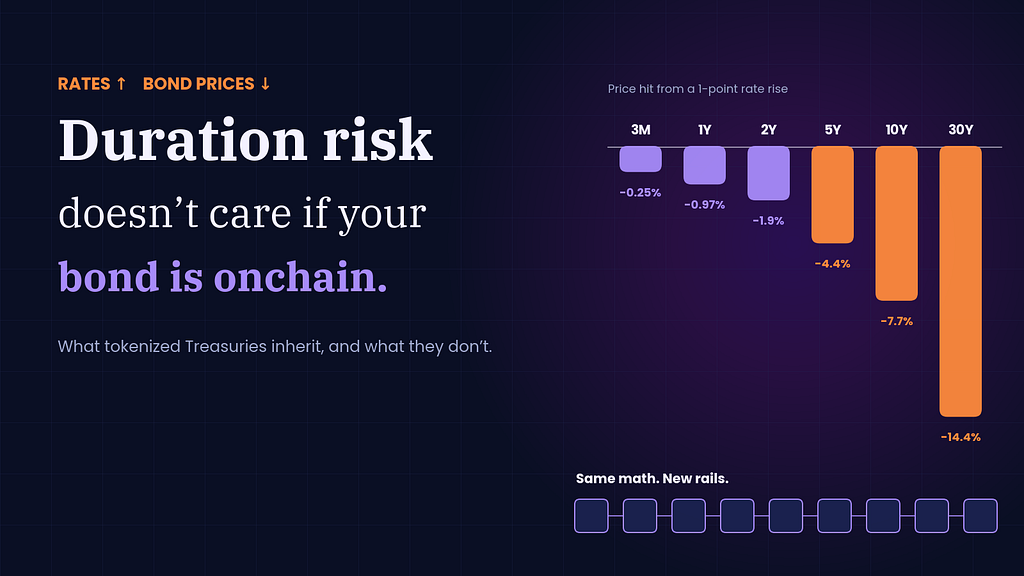
A 1-point rate rise barely moves a 3-month bill but cuts a new 30-year bond by about 14%.
A 3-month bill barely notices a hike. It matures in weeks and rolls into the new rate. A 30-year bond is stuck with its coupon for decades, so it takes the full hit.
Why Duration Risk Is Back in the 2026 Conversation
On September 16, a Fed rate hike took the target range to 3.75% to 4.00%. The first hike since 2023.The median Fed official now sees rates ending 2026 near 4.1%.The 10-year briefly hit 5.34% in early October.The next Fed decision lands October 28.The long end hit a 24-year high in October 2026.
From late July to October 7, the 30-year yield rose about half a point. That alone knocked roughly 7% off a new 30-year bond’s price.
We’ve seen this film. Silicon Valley Bank loaded up on long-dated bonds when rates sat near zero. Rates jumped.
By the end of 2022 it carried $17.7 billion in unrealized securities losses. In March 2023, depositors ran.
Larry Summers called it “one of the most elementary errors in banking.”
No hack. No code bug. Just too much duration at the wrong moment.
Duration risk doesn’t care which ledger your bond lives on.
Does Duration Risk Apply to Tokenized Treasuries?
Yes. Every time.
A tokenized Treasury wraps real government debt. If the fund inside holds 10-year notes, your token behaves like a 10-year note.
Tokenize a 30-year bond tomorrow, and the token carries 30-year risk on day one.
What tokenization changes:
Settlement speedCustody (your wallet, not a broker)Visibility into holdings
What it doesn’t change:
The bond’s rate sensitivityThe issuer’s creditThe maturity of what’s inside
The market is big enough for this to matter now. Tokenized Treasury products, one of the largest slices of real-world assets onchain, held about $14.9 billion across 117 funds in mid-October 2026, per RWA.xyz.
At the start of 2025, the figure was roughly $4.0 billion, according to CoinGecko.
Tokenized Treasuries grew about 3.7x since early 2025, mostly in short-term bills.
The good news? Most of that money sits in short-term bills. Short maturity means short duration. That’s why these tokens usually hold a steady price while yield accrues.
Price Risk vs. Rate Risk: The Part Most Explainers Miss
Rates can hit you in two places.
Price risk (duration): the value of what you hold moves. Big for long bonds. Tiny for short bills.Rate risk (yield sensitivity): the income you earn moves. Big for short bills, because they keep rolling into new rates.
So short duration isn’t immunity. You just feel rates as a changing yield instead of a falling price.
Fed hikes? Your T-bill token’s price barely flinches, and its yield climbs. Fed cuts? The price holds steady, and the yield drops. That second dial is the one most people forget to check.
Price risk and rate risk are two different dials.
Once you see the two dials, onchain yield gets much easier to compare.
Does sUSDS Have Duration Risk? Where the Sky Savings Rate Fits
This is where I see the most confusion, so let’s be precise.
sUSDS isn’t a tokenized Treasury. It’s a yield-generating stablecoin that gives access to the Sky Savings Rate (SSR). The SSR is a variable rate funded from Sky Protocol’s aggregate surplus.
On the two dials:
No maturity date, no lockups. You can redeem sUSDS for USDS anytime.No markdown when bond prices fall. sUSDS accrues the SSR continuously, so each sUSDS becomes redeemable for more USDS over time.The rate is the moving part. SKY holders can raise or lower it through public onchain votes. It isn’t set by borrowing demand, and it isn’t guaranteed.No claim on a specific pool. You hold no claim on any collateral pool, borrower or strategy. You’re accessing the rate itself.
It’s built for predictability and risk-adjusted yield, not the biggest number on your screen.
The scale is real:
About $4.86 billion in sUSDS was outstanding in late October 2026.Roughly $900,000 in yield accrues to holders each day, per BA Labs data.Cumulative yield paid to sUSDS holders passed $250 million by June 2026.USDS, an overcollateralized stablecoin, had about $10.02 billion in supply against $16.24 billion in collateral.The infrastructure has run since 2017 with no exploits.
Fixed Yield: Duration Risk You Choose on Purpose
Now flip it. Fixed Yield on Sky.money locks today’s rate until a set maturity date, through a third-party Pendle integration.
Hold to maturity, and you get your entry rate. Leave early, and you sell at market price, which can land above or below your entry. The app shows that exit cost before you decide.
That’s duration risk in plain sight. You trade flexibility for certainty.
Sky’s public rulebook, the Atlas, files these fixed-term tokens under “bond-like instruments” with duration risk, and sets capital rules for holding them. I like that. The system names the risk out loud.
sUSDS keeps you flexible. Fixed Yield makes you patient. Neither pretends rates don’t exist.
How Sky Measures Risk Out Loud
In bond markets, duration is a shared language. A 7-year duration means the same thing in New York or Mumbai. Onchain, common risk yardsticks are still rare.
On October 7, 2026, Moody’s gave Sky Protocol a B3 rating. It was Moody’s first rating on any stablecoin protocol.S&P Global rates it B-. No other stablecoin protocol holds both ratings.In Q2 2026, Sky Protocol posted $107.35 million in gross protocol revenue and $33.29 million in net protocol surplus. Its fifth positive quarter in a row.
Neither rating is investment grade yet. Both agencies published what would lift them, and investment grade is Sky’s stated long-term goal. Honestly? I trust a public scorecard more than any “trust us” banner.
Risk, measured out loud. Figures as of October 2026.
A 5-Question Duration Risk Checklist for Onchain Yield
Before you put stablecoins to work anywhere, ask:
Is there a maturity date? No date usually means no price-duration risk on the position.What’s inside, and for how long? Short bills and long bonds behave very differently.Can the price move before maturity? If yes, you’re carrying duration risk.Is the rate fixed or variable? Fixed protects income. Variable protects flexibility.What stacks on top? Smart contract, peg and liquidity risk. Tokenization removes none of them.Run this before you put stablecoins to work.
Two good reads on the backing side: What Backs a Stablecoin? and What Makes a Stablecoin Reliable?
Quick FAQ
Q. Are tokenized Treasuries risk-free?
A. No. Short-duration products carry low duration risk, plus credit, liquidity and smart contract risk.
Q. Does a Fed hike move the Sky Savings Rate automatically?
A. No. The SSR changes only through Sky Governance votes.
Q. Fixed or variable stablecoin yield?
A. Fixed suits money with a date attached. Variable suits money that might need to move.
· · ·
The Bottom Line
Duration risk followed bonds onchain. It was always going to. And rates will keep moving. October 28 is just the next test.
The smart move isn’t avoiding it. It’s knowing where you carry it, and choosing it on purpose.
Want flexible, variable yield? sUSDS is the simplest place to start. Want a locked rate and can wait for the date? Fixed Yield is there too.
You can convert USDC to USDS 1:1 through the Peg Stability Module, then explore both in the Sky.money app.
So, after this October: would you rather lock a rate or keep your flexibility? Tell me in the comments. I read every one.
This article is for education only and isn’t financial advice. Rates are variable and not guaranteed.
Duration Risk in Tokenized Treasuries: Does Onchain Save You? was originally published in Coinmonks on Medium, where people are continuing the conversation by highlighting and responding to this story.