
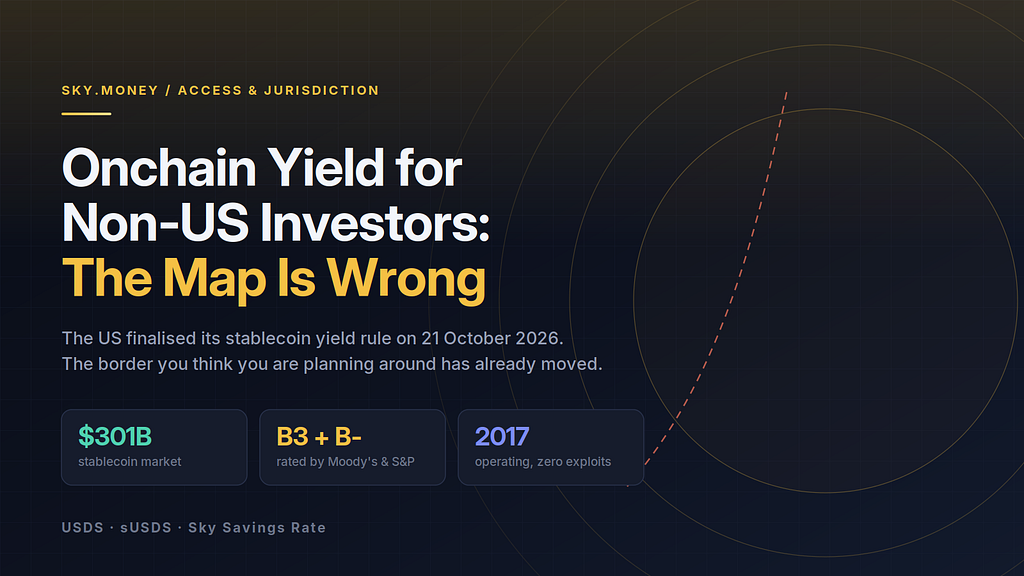
The US finalised its stablecoin yield rule on 21 October. The real border is not where you think, and the UK proves it.
The US closed the door on issuer-paid stablecoin yield on 21 October 2026. For everyone outside America, the map just changed.
On 21 October 2026, the US Office of the Comptroller of the Currency finalised its rules under the GENIUS Act.
One line did most of the work: a permitted payment stablecoin issuer cannot pay a holder interest or yield simply for holding, using or storing the coin.
Most outlets filed that under American news.
It is not. It quietly redrew the map for everyone else.
Because “non-US investor” is not a category. It is roughly 190 different answers wearing one label.
If you are planning around a US border, you are planning around a line that has already moved.
Can Non-US Investors Access Onchain Yield? The Short Answer First
Yes. In most jurisdictions, and often through fewer gates than a US retail investor now faces.
Onchain yield is produced by smart contracts on public blockchains. Those contracts do not read your passport. That is the design, not a loophole.
But three things sit between “the contract will accept you” and “you should proceed”:
Your local law. Some countries restrict or ban holding cryptoassets. Some require a licence you do not hold.The interface you use. A website is a company. Companies have regulators, lawyers and a registered address.Tax. Access is not permission, and it is never a tax ruling.
Two routes exist in practice.
The first is permissionless DeFi yield, reachable with a wallet and nothing else.
The second is tokenized real-world-asset products built specifically for non-US investors under securities exemptions.
Those are aimed at you and still gated, usually with KYC, wallet allowlisting, minimums and lockups.
So the honest picture is split. One route is open. The other was designed for you and still asks for papers.
Permissionless at the protocol layer does not mean permitted at the personal layer.
Hold that, because the rest of this depends on it.
Why the US Border Stopped Being the Real Line for Stablecoin Yield
Here is what the “escape the US” takes keep missing.
The EU got there first. Under MiCA, interest on e-money tokens and asset-referenced tokens is already prohibited.
The US arrived at the same place with the GENIUS Act in July 2025, and this week’s final rule confirmed it.
Two of the world’s largest regulatory blocs now agree: the issuer of a payment stablecoin does not pay you for holding it.
So the interesting question is no longer whether you sit inside or outside America.
It is this: where does the yield actually come from, and who is paying it?
A rate funded by a protocol’s own surplus and set by token holder vote is a structurally different object from an issuer passing along reserve interest. That distinction now does real work.
Some scale for context. The total stablecoin market sat near $301 billion on 21 October 2026.
Most of those dollars are idle. Not because people chose idleness, but because the route to anything else was unclear.
The protocol does not check your passport. The front end does. That is where access actually breaks for non-US investors.
Protocol vs Interface: The Two Layers That Decide Your Access
This part surprises people.
The protocol layer is permissionless. Open-source smart contracts, deployed on Ethereum and other public chains. No gatekeeper. Reachable directly, or through any independent front end.
The interface layer is not. A front end is operated by a legal entity, and that entity geo-restricts.
Take a real example instead of a hypothetical. Sky.money publishes its prohibited jurisdiction list in its Terms of Use, version 2.0, updated 1 September 2026.
Thirty-five countries and regions are named. China, Hong Kong, Russia, Iran, Venezuela.
It also names the United Kingdom.
It does not name the United States.
Read that again. Meanwhile the UK’s Financial Conduct Authority published fresh DeFi consultation papers on 21 October 2026, with its full cryptoasset regime due in force from October 2027.
The border is not America versus the world. It is drawn country by country, by lawyers, and it moves.
So much for “non-US access.”
Roughly $1.62 of collateral value behind every $1 of USDS obligation, published live rather than attested once a quarter.
What Actually Crosses Borders? Measurement, Not Tokens
Tokens move freely. Trust does not.
An allocator in Singapore, a founder in Lagos and a saver in Sao Paulo share no vocabulary for “is this safe.” That gap is the real barrier to global onchain yield. Not geography.
Which is why two announcements this year matter more than they look.
On 7 October 2026, Moody’s assigned Sky Protocol a B3 counterparty risk rating with a stable outlook.
It was the first rating Moody’s has issued on any stablecoin protocol. S&P Global had already assigned a B- in August 2025, the first credit rating ever given to a DeFi protocol, and affirmed it this year.
Sky Protocol is currently the only stablecoin protocol formally rated by both.
Neither rating is investment grade. Nobody is pretending otherwise, and both agencies published what would need to improve. That is the point of a scale. A rating is not a compliment.
A credit rating is the one document that reads the same in Singapore, Sao Paulo and Lagos.Two agencies, two separate processes, one scale that institutional allocators already use in every market.
Then the backing, which anyone can check without asking permission:
USDS supply across USDS and DAI: around $10.02 billionCollateral backing the system: around $16.24 billionsUSDS supply: around $4.86 billionOperating since 2017, across every market cycle, with no exploits
That is roughly $1.62 of collateral value behind every $1 of USDS obligation, visible in real time rather than attested once a quarter.
If you want the mechanics, Sky.money has a plain-English explainer on what actually backs a stablecoin.
The protocol underneath is not running on fumes either. Sky Protocol generated $107.35 million in gross revenue in Q2 2026, its second consecutive quarter above $100 million and its fifth straight quarter of surplus.
Trailing twelve-month net protocol revenue stood at $159.63 million, and protocol collateral climbed 45.5% year over year.
Those are numbers a rating agency can audit. Which is exactly why one did.
In September 2026, Galaxy Digital put $100 million of sUSDS on its corporate balance sheet and approved it as collateral across its institutional trading business. Institutions do not do that on vibes.
Four steps from a stablecoin in your wallet to the Sky Savings Rate. No lockups, no maturity date, no claim button.
How Non-US Investors Reach the Sky Savings Rate Through USDS and sUSDS
The mechanics are deliberately boring.
Convert USDC to USDS at 1:1 through the Peg Stability Module. No fees, no slippage.Supply USDS and receive sUSDS, the world’s largest yield-bearing stablecoin.Your sUSDS accrues the Sky Savings Rate continuously. No lockup, no maturity date, no claim button.Redeem back to USDS whenever you want.
What separates the Sky Savings Rate from most stablecoin yield:
It is governance-set, not demand-set. SKY holders vote it up or down onchain, in public, before it takes effect.It is funded from aggregate protocol surplus, not one lending market or one borrower.It is not paid from token emissions.You hold exposure to the rate itself, not to any single Agent, pool, strategy or asset manager.
The rate is variable and can change. Check it live on the sUSDS page rather than trusting a number in an article.
For anyone who wants something other than the baseline, there is Fixed Yield, where the rate is fixed only if you hold to maturity, Vaults curated on Morpho, stUSDS for advanced risk capital, and Sky Ecosystem Rewards. Different risks, different reasons. sUSDS stays the baseline.
Access is not permission. Six things to confirm before you supply anything, anywhere.
The Jurisdiction Checklist Before You Supply a Single Dollar
Run this first:
Check your own country’s rules. Not the protocol’s. Yours.Read the prohibited jurisdictions clause. Two paragraphs, usually decisive, and it changes without a press release.Never use a VPN to pass a geo-block. Sky.money treats misrepresenting your location as a material breach of its terms. Most interfaces do the same.Confirm whether you get the full app or a limited version. Feature-level restrictions are common and rarely advertised.Understand where the yield comes from. Reserve interest, borrowing demand and protocol surplus are three different risks.Assume tax applies. It is your filing, in your country.
So What Is the Honest Answer?
Non-US investors can access onchain yield. Many have more routes open than US retail does right now.
But the useful question was never “am I non-US.”
It is: is my specific jurisdiction served, by this specific interface, for this specific product, today?
The protocol does not care where you live. The front end does. Your tax authority definitely does.
What makes any of this work at global scale is not permissionlessness on its own. It is measurement. Published collateral. Rates voted onchain.
Two independent credit ratings on the same scale a pension fund already uses. A shared language for capital that reads the same whatever the jurisdiction or currency.
That is the part that actually crosses borders.
This is informational only. Not legal, tax or financial advice. Yields are variable and not guaranteed.
Now tell me where you are reading this from. Which jurisdiction are you in, and has an interface ever geo-blocked you out of something you were perfectly entitled to hold? I want to see how wide the gap really is. Comments are open.
Onchain Yield for Non-US Investors: The Map Is Wrong was originally published in Coinmonks on Medium, where people are continuing the conversation by highlighting and responding to this story.