
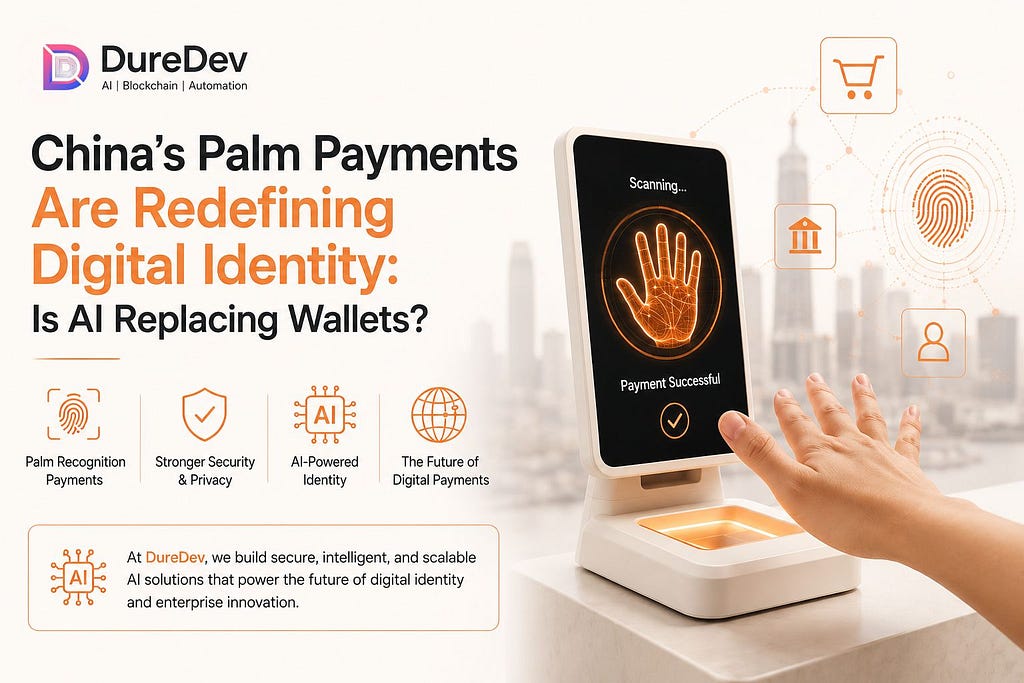
China’s Palm Payments Are Redefining Digital Identity: Is AI Replacing Wallets?
For decades, wallets, bank cards, and passwords have been the foundation of digital payments. Every transaction depended on something we carried or something we remembered.
Today, that model is beginning to change.
In parts of China, palm recognition technology is already being used for payments, building access, and other everyday services. Instead of reaching for a phone or wallet, users can simply scan their palm to verify their identity and complete a transaction. Similar technologies are also expanding globally, with solutions like Amazon One demonstrating how biometric identity can simplify everyday experiences.
At DureDev, we closely follow innovations like these because they represent the next generation of AI-powered digital transformation, where intelligent identity, security, and automation work together to create smarter enterprise solutions.
This is more than a payment innovation. It represents a significant shift in how Artificial Intelligence, biometric authentication, digital identity, and enterprise security are shaping the future of business.
Why Palm Recognition Is Gaining Global Attention
Digital payments have evolved rapidly over the past decade. Cash gave way to cards, cards gave way to smartphones, and now biometrics are becoming the next step.
Unlike passwords or PINs, biometric authentication uses unique physical characteristics to verify identity. Whether it’s a fingerprint, facial recognition, iris scan, or palm recognition, the goal is the same: making authentication faster, more secure, and more convenient.
Palm recognition is attracting particular attention because it is contactless, difficult to duplicate, and designed to provide a seamless user experience. As organizations continue investing in digital transformation, technologies that reduce friction while strengthening security are becoming increasingly valuable.
The Real Opportunity Goes Beyond Payments
Most people see biometric payments as a faster checkout experience.
Businesses see something much bigger.
A secure digital identity can simplify customer onboarding, strengthen fraud prevention, improve workplace access, enhance healthcare authentication, and support secure financial transactions across multiple industries.
Instead of managing dozens of usernames, passwords, access cards, and verification methods, organizations can build unified identity systems that improve both operational efficiency and user experience.
This is where Enterprise AI begins creating measurable business value.
The Biggest Challenge Is Trust
Every new technology creates new opportunities.
It also creates new responsibilities.
If biometric identity becomes the future of authentication, protecting that identity becomes one of the biggest cybersecurity challenges organizations will face.
Unlike passwords, biometric data cannot simply be changed after a security breach.
That means businesses need stronger encryption, intelligent fraud detection, continuous monitoring, responsible AI governance, and privacy-first system design.
Building secure digital identity isn’t only about recognizing a person.
It’s about protecting that identity throughout its entire lifecycle.
How Enterprise AI Strengthens Digital Identity
Artificial Intelligence plays a much bigger role than simply recognizing someone’s palm.
Modern AI systems continuously evaluate authentication attempts, identify suspicious behavior, detect fraud patterns, improve verification accuracy, and support compliance requirements across regulated industries.
As organizations process millions of digital interactions every day, AI becomes the intelligence layer that helps protect users while keeping digital experiences simple and frictionless.
This combination of AI, automation, cybersecurity, and digital identity will define the next generation of enterprise applications.
Building The Future With AI
At DureDev, we believe Enterprise AI is about solving real business problems rather than simply deploying new technology.
Our teams build AI-powered applications, intelligent automation platforms, blockchain solutions, enterprise software, and secure digital systems that help organizations innovate with confidence while maintaining security, scalability, and compliance.
Whether businesses are exploring AI-powered identity verification, intelligent automation, or next-generation enterprise applications, success depends on building technology that users can trust from day one.
The Future Of Digital Identity
The future of payments isn’t simply becoming cashless.
It’s becoming intelligent, biometric, and AI-driven.
As biometric technologies continue expanding across banking, retail, airports, healthcare, and enterprise environments, organizations that invest in secure AI infrastructure today will be better prepared for tomorrow’s digital economy.
The question is no longer whether digital identity will evolve.
The real question is how securely, responsibly, and intelligently businesses will build it.
If your organization is planning its next AI initiative, now is the time to start building secure, scalable, and future-ready solutions.
China’s Palm Payments Are Redefining Digital Identity: Is AI Replacing Wallets? was originally published in Coinmonks on Medium, where people are continuing the conversation by highlighting and responding to this story.