
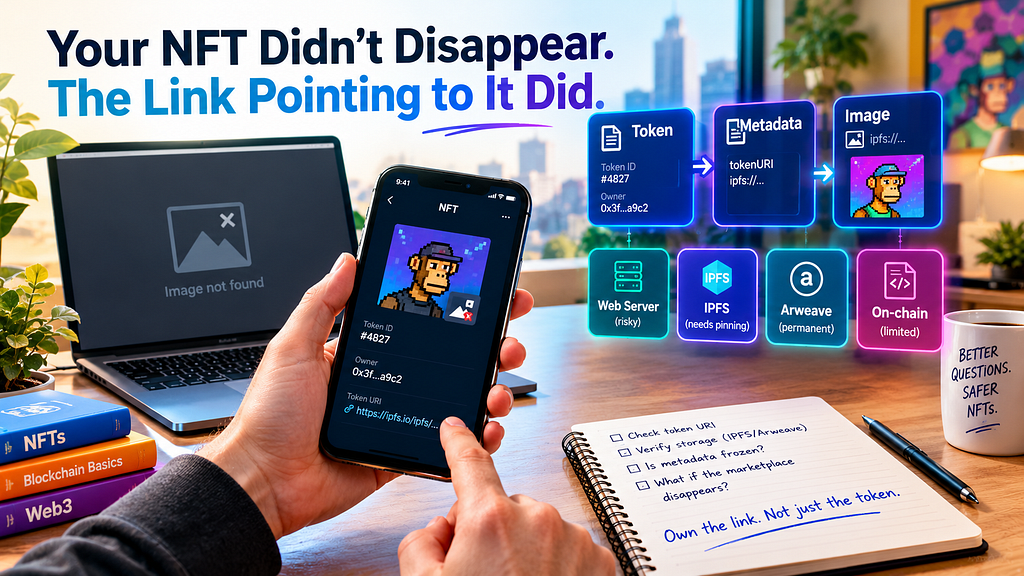
I opened my wallet last month to show a friend something I’d bought a while back, and the picture was gone. Just a grey square with that little broken-image icon in the corner.
The token was still there. Contract, token ID, my address as owner, all of it. The blockchain didn’t forget a thing. But the thing the token was supposed to be had quietly left the building, and I’d had no idea.
I’ve been thinking about it ever since, because I don’t think this is a me problem. I think most people holding NFTs have no clue what they’re actually holding. I didn’t, and I’d been in this space for years.
So let me explain what I wish someone had told me before I clicked buy.
Image Generated by ChatGpt
The chain doesn’t hold your picture
This is the part that blew my mind when I finally understood it. An NFT doesn’t contain the image. Putting an image on a blockchain is absurdly expensive, so nobody does it, or almost nobody.
What sits on the chain is a number and an owner, plus a small pointer called the token URI. That pointer says “go look over there for the details.” Over there is a little metadata file, and inside that file is another pointer to the actual image.
So you’ve got a token pointing to a file pointing to another file. Any link in that chain can snap, and when one does, nobody gets a notification. It just shows up broken some Tuesday.
People call this link rot. It’s boring and it’s everywhere.
So where does the file live?
Honestly, this is the question that matters more than the art, the roadmap, the Discord vibes, all of it. And the answers fall into roughly three camps.
Some projects just use a normal web server. A regular URL, same as any website. Cheap, easy, and a terrible idea, because if the team stops paying the hosting bill, or changes their mind, or disappears, so does your file. You never really owned the thing. You owned a pointer to somebody else’s server.
Others use IPFS or Arweave, which are decentralized storage networks. Instead of saying “the file is at this address,” they say “the file is whatever has this exact fingerprint,” so it can’t be quietly swapped. Much better. But people skip a detail here, and I did too: on IPFS the file only sticks around if somebody keeps hosting it. They call that pinning. If nobody’s pinning, the fingerprint is still valid and there’s nothing to fetch. Arweave works differently, you pay once up front to have it kept long-term, which is why a lot of careful projects prefer it.
And then there’s fully on-chain, where the image (usually as SVG code) lives right inside the contract. It’s limited and it costs more, and the art is often pretty minimal because of that. But it’s the one setup that doesn’t depend on anyone’s server, anyone’s goodwill, or anyone’s credit card. If the chain’s alive, your art is alive.
If you only take one thing from this, check which camp your NFT is in before you buy. Takes five minutes. Hardly anybody does it.
The metadata can change under you
There’s a sneakier problem than a dead server, and it took me a while to even notice it. Some contracts let the creator change the token URI after you’ve bought.
Now, that isn’t always shady. A game item that levels up needs to change. A “reveal” drop needs to change. Fine. But it also means whatever you paid for can be swapped for something completely different, and you’d have no say.
You can usually see this on the contract itself. Look for a function that lets an admin update the base URI, or a flag saying the metadata is frozen. If it’s frozen, the team has tied their own hands, which means something. A promise on Twitter costs nothing. A locked contract costs them the ability to change their mind.
Marketplaces are the thin part of the stack
Most people never touch a contract. They use a marketplace, and the marketplace is one more thing that can go wrong. It might change how it renders things, or delist a collection, or shut down entirely. Then your NFT looks dead in the one place everybody checks, even though nothing actually happened to it on-chain.
I think a lot of the “NFTs are worthless” panic comes from exactly this. People see a broken screen and assume the asset died, when sometimes the asset’s fine and the window broke. Contract, storage, indexer, front end: four separate layers, and you can lose any one without losing the rest. Most owners only ever look at the last one.
What the sensible builders do now
The teams that seem to be doing okay in 2026 have mostly stopped acting like it’s launch day forever. They store the media in more than one place. They treat their website as replaceable, because it is. They write down, in plain language, what’s permanent and what isn’t, which is rarer than it sounds, honestly.
And they plan for year five. Anybody can ship something exciting. The real question is whether the hosting bill still gets paid when nobody’s tweeting about you anymore.
Before you buy anything
Open the token URI and see what kind of address it is. If it’s IPFS, find out who’s pinning it and whether it’s more than one party. Check whether the metadata is frozen. Ask yourself what happens to the thing if the marketplace and the website both vanish tomorrow. If you can’t answer those, you don’t have an asset yet. You’ve got a hopeful receipt.
How mine actually died
I went in expecting a hack or a rug. Some villain. There wasn’t one. The team just stopped paying for a server and didn’t tell anyone, and the file got deleted, and nobody noticed for months.
That’s how it usually goes, I think. Not a big dramatic collapse. Somebody forgot to renew something.
We spent years arguing about whether these things were worth millions or nothing, and we were all staring at the price. The better question was never about price. It was: what does this point to, who controls it, and how long will it last?
Your wallet will happily display a token for a hundred years. Whether anything’s behind it is a different question, and now you know to ask.
Your NFT Didn’t Disappear. The Link Pointing to It Did. was originally published in Coinmonks on Medium, where people are continuing the conversation by highlighting and responding to this story.