
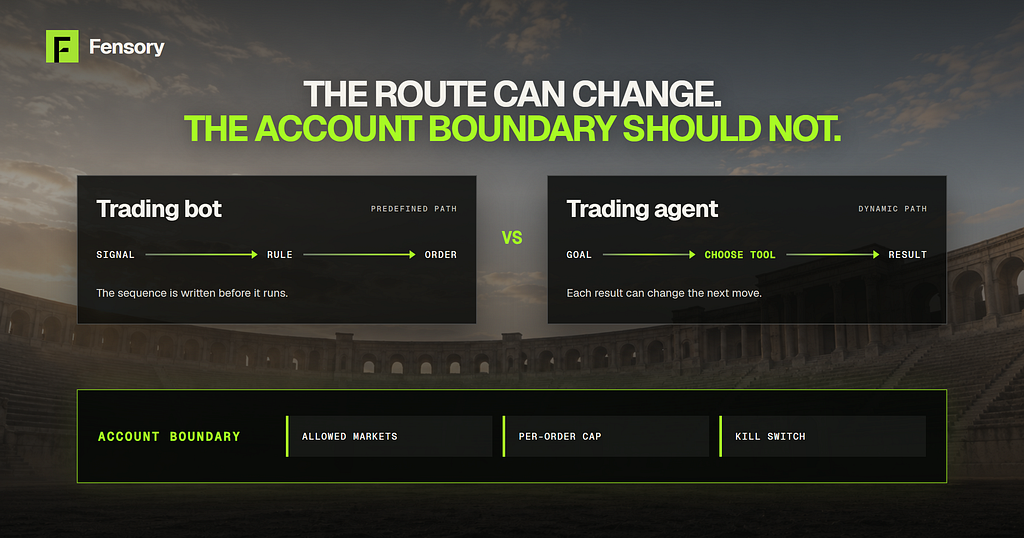
A bot follows a path written in advance. An agent can choose its next tool after seeing what happened. That changes where the safety controls need to live.
“Trading bot” and “AI trading agent” are often used as if they describe the same thing with different branding. They do overlap. Both can read market data, make a decision and submit an order.
The important difference is not whether one uses AI. It is who decides the next step.
A conventional trading bot follows logic written in advance. If a condition is met, it performs a known action. An agent can interpret a broader goal, choose a tool, inspect the result and then decide what to do next.
That flexibility can make an agent useful in situations that do not fit neatly into one fixed script. It also makes the system less predictable. The controls that were once buried inside one code path now need to hold across many possible paths.
A trading bot follows a route
Consider a simple rule: buy when a moving average crosses above another moving average, then sell when it crosses back below.
The developer chooses the data, the thresholds, the order type and the sequence. The bot runs that logic repeatedly. If the rules stay the same, the path stays the same.
This does not mean every bot is simple. Some use large models, adaptive parameters or several strategies. The useful distinction is structural. The workflow is still defined in code before it runs.
Anthropic describes this as the difference between a workflow and an agent. A workflow follows predefined code paths. An agent directs its own process and tool use while it works toward an objective.
An agent chooses what to do next
Give an agent a goal such as, “Check my BTC position and reduce the risk if funding turns sharply against it.”
The agent may need to:
Read the current position.Check the market and funding data.Decide whether the condition has been met.Calculate an order within the account’s limits.Submit the request.Read the result before doing anything else.
The result of one tool call changes the next choice. If there is no position, the agent should stop. If the order is rejected, it should report that result rather than pretending the position changed. If the first order fills only partially, the next step may be different again.
This loop is what makes the system agentic. The model is not only generating an explanation. It is selecting and sequencing actions against live systems.
Model Context Protocol gives an AI application a standard way to discover and call tools. In a trading setup, those tools might read balances, positions, prices and open orders, or request a trade. MCP does not decide which tools an agent should receive. It supplies the interface. The application and the account still need to define the authority behind it.
Trading bot vs AI trading agent
AI trading agents and trading bots are not the same. Learn how they differ in decision-making, execution, account access and risk controls.
An agent is not automatically smarter, safer or more profitable. It may be slower, more expensive and harder to test than a fixed bot. If the task is stable and the conditions are clear, a conventional bot may be the better design.
An agent becomes useful when the job needs interpretation, several tools or decisions that depend on fresh results.
The safety boundary has to survive a changing path
With a fixed bot, a developer can inspect the exact path from signal to order. An agent may reach the same order through several different routes. That is why a prompt such as “be careful” is not a control.
The safer design separates the agent’s reasoning from the authority of the account.
Read tools and trade tools should be distinct
Reading a balance is not the same permission as placing an order. An agent should receive only the tools required for the job. A research assistant may need prices and positions without any ability to trade.
Account limits should sit outside the prompt
The account can decide which markets are available, how large one order may be and whether agent trading is enabled at all. A model should not be able to rewrite those limits because a prompt told it to.
A per-order cap is useful, but it answers only one question: is this individual order too large? A system that can act repeatedly may also need limits on cumulative activity, time or loss. Those controls depend on the product and the strategy. They should not be left to the model’s judgment.
Every action needs an observable result
The agent should know whether an order filled, remained open, filled partially or failed. Otherwise it can make its next decision using an account state that no longer exists.
Anthropic recommends that agents gain ground truth from the environment at each step and stop under clear conditions. In trading, the order response and the new account state are part of that ground truth.
Where Fensory fits
Fensory provides two ways to use the same trading account. The terminal gives the user a direct interface. Fensory MCP lets a compatible AI assistant read the account, inspect markets and request trades through tools.
The agent does not set its own authority. The account owner chooses the allowed markets, sets a maximum value for each order and can turn agent trading off.
This does not turn every strategy into an agent, and it does not guarantee a good trade. It gives an agent a bounded route from an instruction to a real account.
That is the practical difference worth watching. A trading bot automates a route. A trading agent can choose the route. The more freedom the system has to choose, the more important it becomes to keep the limits outside that choice.
Fensory provides software and market access. Nothing in this publication is investment advice. Trading involves risk, including possible loss of capital. Geofencing applies at the access layer.
AI trading agent vs trading bot: what actually changes? was originally published in Coinmonks on Medium, where people are continuing the conversation by highlighting and responding to this story.