
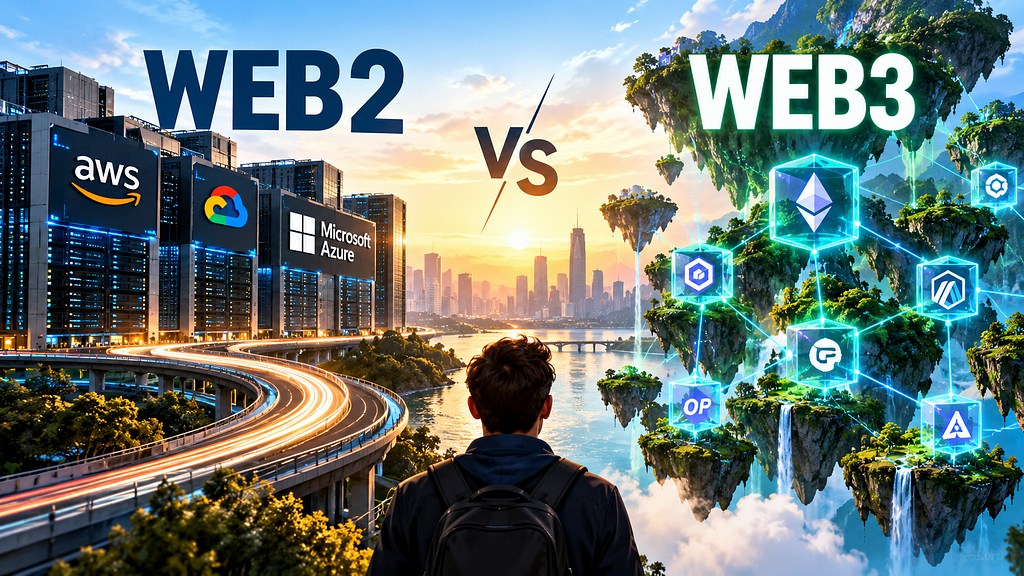
Most of the “decentralisation” debate is really a debate about who gets to press the off switch.
Ask a developer where their app runs and watch their face.
Web2 people answer fast. AWS, probably. Maybe Google Cloud. Postgres for the database, Cloudflare in front, done. Web3 people hesitate, because the honest answer is messier than the pitch. “On Ethereum” is the slogan. The reality is usually a few smart contracts, a frontend sitting on a regular server, and an RPC provider that, if it went down, would take half the “decentralized” app with it.
I’m not saying that to dunk on anyone. I’m saying it because the gap between what we say and what we run is the most interesting thing in this whole space.
Image Generated by ChatGpt
What Web2 actually is
It’s rented computers. That’s it. That’s the whole secret.
You pay a company, they give you servers, storage and a network, and you build on top. It’s fast because one organization controls the whole path from your user’s phone to your database. It’s cheap at scale because those organizations buy hardware by the warehouse. And it’s forgiving, which people underrate. Pushed a bad migration? Restore the backup. Shipped a bug? Hotfix it before lunch.
Twenty years of tooling sits on top of that. Monitoring, logging, debuggers, forums full of people who hit your exact error in 2016. If you’ve ever Googled a cryptic stack trace and found the answer in the first result, you’ve benefited from Web2 infra without noticing.
The downside is that you’re a tenant. The landlord sets the price, sets the rules, and can change either one. Plenty of businesses have learned this when an API got pricier overnight or an account got suspended with no human to appeal to. Nobody planned for it. It just happened on a Tuesday.
What Web3 is trying to be
Take away the landlord. That’s the pitch, anyway.
Instead of one company running your backend, you’ve got a network of machines that don’t know each other and don’t have to trust each other. They agree on the state of things through consensus. Your code lives as a smart contract, and once it’s deployed, the rules are out in the open for anyone to read. Users sign in with a wallet rather than an email. They hold their own assets and nobody can freeze them with a support ticket.
Around the chain there’s a whole supporting cast. Layer 2s like Arbitrum, Base and Optimism exist because the main chain got crowded and expensive. IPFS and Arweave store files without one company owning the disk. Indexers like The Graph exist because reading raw chain data is miserable. And node providers like Alchemy and Infura let you skip running your own node, which, yes, reintroduces a little centralization. The irony isn’t lost on anyone.
The strengths are real. Open rules. Ownership that doesn’t depend on a company staying friendly. Apps that can plug into each other because the data is public.
The weaknesses are just as real, and I’d rather say them plainly. Writing to a chain is slow and you pay per operation, so nobody’s building a “like” button on-chain. Mistakes are brutal. A flaw in a deployed contract can stay a flaw forever, and people have lost eye-watering amounts of money that way. Onboarding is awful too. Handing a normal person a twelve-word seed phrase and telling them “don’t lose this, ever” is a design failure, whatever the whitepaper says.
[Add one real moment here from your own work or experience. Two or three sentences about a time something broke, or a tool surprised you. This is the single biggest thing that will make the piece read as yours.]
The question I actually care about
People ask “which is better?” and I think that’s a bad question. A better one: what in your product needs to be trustless, and what just needs to be fast?
A food delivery app doesn’t need a blockchain. Users want their dinner. They already trust the company to handle the order, and a ledger adds cost and delay for nothing. Web2, no contest.
But if you’re building something where the rules themselves can’t be allowed to change, like ownership records, open financial systems, or anything where “just trust us” is the exact thing you’re trying to remove, then the clunkiness of Web3 starts to look like a fair price.
Most products sit somewhere in the middle, which brings me to what’s really happening out there.
The quiet hybrid
Look at what working teams build and it’s rarely pure anything. The interface, search, notifications and analytics run on ordinary infrastructure, because they need to be quick and fixable. The pieces that need neutral ground, meaning settlement, ownership and verification, go on-chain.
Nobody announces this on a stage. It doesn’t make a good slogan. But it’s just sensible engineering: put each part where it works best, and don’t let ideology pick your database.
I’ll admit I used to think the hybrid approach was a cop-out, a way of avoiding commitment to the real vision. I’ve changed my mind. The internet itself was never one idea winning. It was layers, each one patching what the last one couldn’t do. TCP/IP didn’t kill the telephone network overnight. It just kept growing around it until the old thing was a piece of the new thing.
If you’re deciding what to learn
Learn both. I know that’s the unexciting answer.
Someone who understands cloud architecture and also gets how smart contracts behave under pressure is rarer than either kind of specialist, and I’d bet that gap stays open for a while. Security is the part worth taking most seriously on the Web3 side, because the stakes are lopsided: a bug in a normal app costs you an apology, and a bug in a contract can cost someone their savings.
And if you’re a founder, ask yourself the uncomfortable pair of questions early. What breaks if my users have to trust me? What breaks if they don’t? Those two answers will pick your infrastructure better than any trend report.
Where I land
Web2 gave us speed and scale, and it earned its place. Web3 is an ongoing experiment in ownership and neutrality, with plenty of failures along the way and a few results that are hard to dismiss.
I don’t think either one “wins.” I think the next version of the internet quietly borrows from both, and most users will never know which parts came from where.
Which, honestly, is probably how it should be.
Web2 vs Web3 Infrastructure: I Think We’ve Been Arguing About the Wrong Thing was originally published in Coinmonks on Medium, where people are continuing the conversation by highlighting and responding to this story.