
The defining bottleneck of the next decade is not intelligence or hardware. It is the ability to synchronize distributed compute, capital, and institutional trust at scale.
People assume the primary bottleneck to the next era of technological dominance is raw scientific capability.
The prevailing narrative suggests that once we construct more stable qubits, train multi-trillion parameter AI models, or finalize advanced cryptography proofs, the surrounding infrastructure will naturally absorb the breakthroughs.
What is actually happening is a structural collapse of coordination.
Frontier technologies: AI, quantum computing, and decentralized networks are accelerating at a velocity that traditional, centralized resource allocation can no longer support. The science is succeeding, but the infrastructure coordinating it is beginning to fracture under the pressure of real-world scale, institutional fragmentation, and liquidity constraints.
We are not facing a science problem. We are facing a coordination layer crisis.
The Geography of Compute and Synchronization Debt
To understand how infrastructure behaves under real-world pressure, you have to observe where the operational friction accumulates. Currently, that friction is entirely concentrated in compute routing.
The market structure of AI and deep-tech compute is deeply centralized. A handful of hyperscalers control the hardware, dictate the pricing, and manage the routing of global intelligence generation.
The concentration dynamics are already visible. NVIDIA has effectively become the geopolitical choke point of AI acceleration, while frontier model developers increasingly depend on a narrow cluster of hyperscale cloud providers for training and inference capacity. GPU shortages are no longer isolated supply-chain anomalies; they are symptoms of a coordination architecture struggling to allocate compute under exponential demand growth.
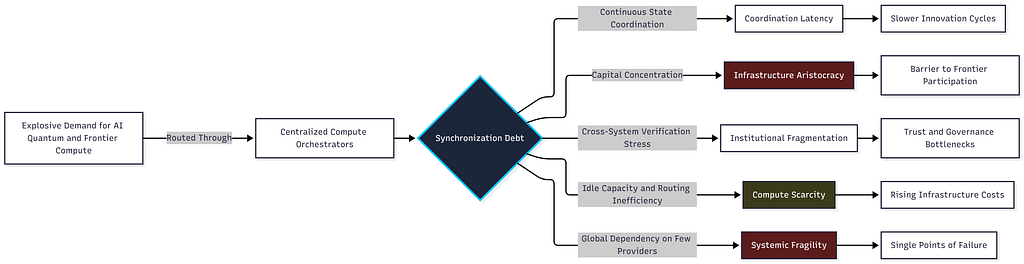
This creates massive dependency chains. When you force globally distributed, high-velocity demand through centralized infrastructure bottlenecks, the system inevitably generates Synchronization Debt.
Synchronization Debt is the hidden operational cost of keeping fragmented hardware, data, and models unified under centralized orchestration. It manifests as compute scarcity, capital inefficiency, and coordination latency.When coordination mechanisms fail to scale dynamically, hardware accumulation becomes a defensive strategy. Institutions hoard GPUs not just for immediate use, but to hedge against routing uncertainty. The technical limitation of centralized routing mutates into an economic force: compute concentration.
This infrastructure constraint immediately becomes a structural power dynamic. If you do not control the routing, you do not control the commercialization of the science.
The consequence is visible across the frontier AI stack. OpenAI, Anthropic, and similar model laboratories are not merely competing on intelligence capability; they are competing on privileged access to compute routing infrastructure. As compute dependency deepens, strategic leverage migrates away from model architecture alone and toward the entities controlling the orchestration layer beneath it.
Programmable Coordination: The Gensyn Prototype
If centralized orchestration is the bottleneck, the necessary transition is toward market-based, dynamically routed compute. This is where systems like Gensyn cease to be mere crypto projects and reveal themselves as prototypes for the next generation of distributed industrial infrastructure.
Gensyn operates at the exact convergence of AI compute, decentralized coordination, and marketplace design. But to understand its strategic weight, we must look past the technical specifications of decentralized machine learning and observe the economic consequences.
In a decentralized compute network, the core mechanism is cryptographic verification of work. You must mathematically prove that a distributed node actually performed the computation it claims to have performed.
When you solve this technical verification problem, it immediately translates into an economic reality: trust is removed as an institutional dependency and replaced by cryptoeconomic coordination.
When compute verification is automated and trust is programmatic, computation itself is transformed into a highly liquid, dynamically routed asset.
We then enter the era of compute financialization.
You are no longer renting static server time from a centralized authority; you are interacting with a continuous market that prices latency, proximity, and execution risk in real time.
This introduces a fundamentally different economic topology from traditional cloud infrastructure. In centralized cloud markets, pricing power and routing decisions remain administratively concentrated inside hyperscaler monopolies. In dynamically coordinated compute systems, latency itself becomes an economic variable. The geographical proximity of computation, bandwidth constraints, and verification overhead begin influencing market pricing in real time.
This shifts the coordination burden from administrative human layers to algorithmic, programmable incentive layers.
This introduces the concept of Routing Sovereignty: the capacity for an ecosystem to route its computational and economic energy without requiring permission from an inherited infrastructure aristocracy.
Consider a near-future AI training market operating across Europe, Asia, and North America simultaneously. A pharmaceutical model training pipeline requires GPU clusters in Frankfurt, low-latency inference verification in Singapore, and quantum-assisted optimization loops routed through specialized research infrastructure in Amsterdam.
In a centralized coordination architecture, every routing dependency introduces operational friction: compute scarcity, cloud pricing volatility, jurisdictional latency, and cross-border trust bottlenecks. But inside a dynamically coordinated compute marketplace, these variables become programmable economic signals. Compute is no longer statically allocated through institutional hierarchy; it is continuously orchestrated through verification, pricing, and incentive alignment in real time.
Under centralized orchestration, synchronization costs scale exponentially as coordination complexity increases. Dynamically coordinated infrastructure attempts to flatten this curve by converting coordination friction into programmable economic routing.
The infrastructure challenge therefore shifts from raw compute accumulation toward synchronization efficiency across globally distributed systems.
The Convergence and The Institutional Collision
As we scale toward hybrid infrastructure , where quantum processors, AI agents, and decentralized validation networks must interact , this coordination pressure will escalate.
The systems required to integrate these technologies cannot rely on legacy institutional trust. Regulatory bodies, traditional banking rails, and centralized cloud providers are fundamentally mismatched to the speed and topology of networked research systems.
The pressure is already reshaping geopolitical infrastructure strategy. Europe’s increasing focus on sovereign compute initiatives reflects a growing recognition that dependency on external cloud and AI infrastructure creates strategic vulnerability. As frontier technologies become economically critical, compute routing, data locality, and cross-border infrastructure control evolve from technical considerations into questions of national coordination capacity.
This is where the visible narrative breaks down. The market assumes that integrating AI and quantum computing is a purely technical engineering challenge.
In reality, it is a complex marketplace design problem.
How do you coordinate verification across sovereign borders? How do you price the latency of a hybrid quantum-classical compute loop dynamically? How do you ensure that the governance of this infrastructure cannot be captured by the entities that provide the initial capital?
Every technical mechanism in this stack eventually becomes a governance pressure. If a decentralized routing protocol handles the global execution of AI training, whoever governs the protocol’s parameter updates effectively controls the global supply chain of intelligence.
Economics affects governance, and governance dictates decentralization.
The New Strategic Reality
We are watching the rapid financialization of infrastructure. Compute, synchronization, and verification are becoming base-layer commodities governed by cryptoeconomic systems.
For builders, protocol teams, and infrastructure decision-makers, the mandate is clear: optimizing raw scientific output is insufficient if the underlying coordination architecture is brittle. The leverage is migrating from those who build the hardware to those who design the economic architectures that synchronize it.
The decentralization debate is no longer about stake. It is about proximity to the fastest coordination paths through the network.
This is why the future infrastructure race is no longer purely about hardware supremacy. The strategic advantage increasingly belongs to ecosystems capable of coordinating compute, capital, verification, governance, and institutional trust with minimal synchronization friction.
The next great technological challenge may not be intelligence itself, but the coordination systems required to distribute intelligence, computation, and trust across increasingly decentralized civilizations.
The Coordination Layer Crisis: Why Frontier Technologies Fail Long Before the Science Does was originally published in Coinmonks on Medium, where people are continuing the conversation by highlighting and responding to this story.