
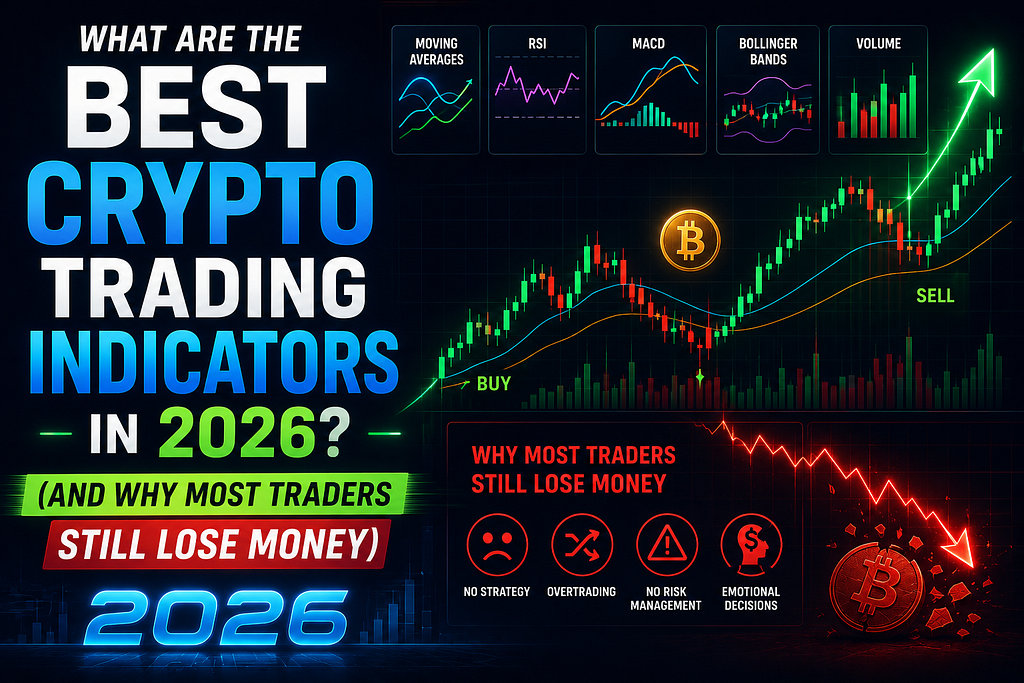
Most crypto traders misuse RSI, MACD, and moving averages — here’s what actually works in 2026.
What Are the Best Crypto Trading Indicators in 2026?
Every crypto trader starts the same way. You open a chart. You add RSI. Then MACD. Maybe Bollinger Bands. A moving average or two. Before long, your screen looks like the cockpit of a fighter jet — and somehow, you’re still losing money.
Meanwhile, someone on X claims they turned $500 into $250,000 using “one simple indicator strategy.”
So what’s the truth?
Are crypto trading indicators actually useful in 2026? Or are most traders using them completely wrong?
Here’s the uncomfortable reality: indicators are not predictive magic tools. They are decision frameworks. And most traders fail because they expect indicators to tell them what will happen, instead of helping them understand what is happening.
That distinction changes everything.
In this guide, we’ll break down the best crypto trading indicators in 2026, how professional traders actually use them, why beginners consistently misuse them, and how to combine indicators into a strategy that survives modern crypto volatility.
Whether you trade Bitcoin, Ethereum, meme coins, AI tokens, or altcoins, this guide will help you stop chasing signals and start reading the market like a professional.
Why Most Crypto Traders Fail with Indicators
Before discussing the best indicators, it’s important to understand why most traders lose money with them. The issue usually isn’t the indicator itself. It’s how people use it.
Here are the biggest mistakes traders make in 2026:
1. Using Too Many Indicators at Once
This is called indicator overload.
One indicator says buy. Another says sell. A third says “wait.”
You freeze. Or worse, you cherry-pick the signal that confirms what you already want to do.
Professional traders usually rely on only 2–4 core indicators because simplicity improves execution.
2. Ignoring Market Structure
Indicators should support price action — not replace it.
If Bitcoin is clearly in a strong downtrend, blindly buying because RSI is “oversold” is dangerous.
Context matters more than signals.
3. Trading Low Timeframes Emotionally
Most retail traders lose money scalping noisy 1-minute and 5-minute charts. Indicators become unreliable when market noise dominates price movement.
Higher timeframes generally produce cleaner signals.
4. Expecting Indicators to Predict the Future
Indicators are lagging or reactive tools. Even the best trading indicators in crypto do not guarantee outcomes.
Their purpose is to improve probability and risk management.
That’s it. And honestly, that’s enough.
Most traders never realize indicators only work in the right market conditions. We made a free downloadable Crypto Indicator Cheat Sheet breaking down exactly when RSI, MACD, VWAP, and Bollinger Bands actually work in live markets.
The Best Crypto Trading Indicators in 2026
Let’s break down the indicators that continue to dominate crypto trading in 2026 — and why they still work.
1. RSI (Relative Strength Index)
The RSI remains one of the most powerful momentum indicators in crypto.
It measures the speed and strength of price movement on a scale from 0 to 100.
Why RSI Still Works in 2026
Crypto markets are heavily driven by emotion.
Fear and greed create overextended moves, especially in altcoins and meme coins.
RSI helps traders identify when assets may be overheated or oversold.
Common RSI Levels
Above 70 = potentially overboughtBelow 30 = potentially oversoldAround 50 = neutral momentum
But here’s where most traders fail:
They treat RSI signals as automatic reversals.
That’s not how professionals use it.
Smart RSI Usage
Experienced traders combine RSI with:
Trend directionVolume confirmationSupport and resistance zonesHigher timeframe structure
For example:
An RSI oversold signal during a strong bull market often creates excellent dip-buying opportunities. But an oversold RSI during a market crash can stay oversold for weeks.
That’s a major difference.
2. Moving Averages (EMA & SMA)
Moving averages remain foundational for crypto trading strategies. They smooth out price data and help identify trends.
The most popular moving averages in crypto trading are:
20 EMA50 EMA100 SMA200 SMA
Why Traders Love Moving Averages
They provide:
Trend directionDynamic support and resistanceMarket momentumEntry and exit structure
The 200-day moving average remains especially important in Bitcoin trading. Many institutional traders view it as the line between bullish and bearish macro conditions.
EMA vs SMA
EMA (Exponential Moving Average)
Reacts faster to price changesBetter for swing trading and active trading
SMA (Simple Moving Average)
Slower and smootherBetter for long-term trend analysis
One of the Most Popular Crypto Strategies
The EMA crossover strategy remains effective in 2026.
For example:
Bullish signal: 20 EMA crosses above 50 EMABearish signal: 20 EMA crosses below 50 EMA
While no crossover is perfect, they help traders avoid emotional decision-making.
3. MACD (Moving Average Convergence Divergence)
The MACD is one of the most widely used trend-following indicators in crypto.
It helps traders identify:
Momentum shiftsTrend reversalsBullish and bearish divergence
Why MACD Remains Powerful
Crypto trends often move aggressively once momentum shifts.
MACD helps traders spot those shifts early. The indicator combines moving averages and momentum into one visual framework.
Key MACD Signals
Bullish Crossover
When the MACD line crosses above the signal line.
Bearish Crossover
When the MACD line crosses below the signal line.
Divergence
When price and momentum move differently. This is especially powerful.
For example:
If Bitcoin makes a higher high, but MACD makes a lower high, momentum may be weakening.
Professional traders pay close attention to divergence. Retail traders often ignore it.
4. Volume Profile
In 2026, volume analysis is becoming more important than ever. Because institutional participation in crypto continues growing.
Volume Profile shows where the most trading activity occurred at different price levels.
This helps traders identify:
Major support zonesResistance zonesLiquidity clustersFair value areas
Why Volume Matters More Than Indicators Alone
Price can move temporarily. Volume reveals conviction.
A breakout with weak volume often fails. A breakout with strong volume has a higher chance of continuation.
This is one reason professional traders prioritize volume over flashy oscillators.
5. Bollinger Bands
Bollinger Bands remain highly effective for volatile crypto markets.
They consist of:
A middle moving averageAn upper bandA lower band
Why Bollinger Bands Work Well in Crypto
Crypto experiences frequent volatility expansions and contractions.
Bollinger Bands help traders identify:
Volatility squeezesPotential breakout conditionsMean reversion opportunities
Common Strategy
When the bands tighten significantly, volatility compression occurs. This often precedes major moves.
Traders call this the “Bollinger Squeeze.”
In crypto, these squeezes can lead to explosive breakouts.
6. Fibonacci Retracement
Some traders swear by Fibonacci levels. Others think they’re nonsense.
The truth? Fibonacci works because traders collectively watch the same levels.
That creates self-fulfilling reactions.
Key Fibonacci Levels
Common retracement levels include:
0.3820.50.6180.786
Why Fibonacci Remains Relevant
Crypto markets are heavily psychological. Many traders place buy and sell orders around these levels. This creates real liquidity reactions.
The 0.618 “golden pocket” remains especially popular among swing traders.
7. Open Interest & Funding Rates
This category has become critical in modern crypto trading. Especially for perpetual futures markets.
Open Interest
Open Interest tracks the total number of active futures contracts.
Rising open interest often indicates:
Increased participationPotential volatilityStrong trend continuation
Funding Rates
Funding rates reveal market positioning.
If funding becomes excessively positive:
Too many traders are longA long squeeze becomes possible
If funding becomes heavily negative:
Fear dominatesShort squeeze potential increases
Smart traders use funding data as a sentiment indicator.
This is one of the biggest edges in crypto trading today.
8. VWAP (Volume Weighted Average Price)
VWAP is increasingly popular among institutional and algorithmic traders.
It calculates the average price weighted by volume.
Why VWAP Matters
Institutions often execute trades around VWAP benchmarks. This creates important market behavior around the line.
Price above VWAP:
Bullish intraday bias
Price below VWAP:
Bearish intraday bias
VWAP is especially effective for day traders and scalpers.
Which Indicator Is Best for Bitcoin Trading?
If you only trade Bitcoin, focus on:
Market structureMoving averagesVolumeRSIOpen interest
Bitcoin is heavily liquidity-driven.
That means:
Volume mattersMacro trends matterSentiment matters
Simple systems often outperform complex indicator combinations.
Which Indicator Is Best for Altcoin Trading?
Altcoins behave differently from Bitcoin.
They’re usually:
More volatileMore emotionalMore momentum-driven
That makes these indicators especially useful:
RSIBollinger BandsMACDVolume spikes
Momentum and hype dominate many altcoin moves.
Timing becomes critical.
The Best Indicator Combination Strategy in 2026
The best traders do not rely on one indicator. They build confluence.
Here’s a powerful modern setup:
Step 1: Identify Trend
Use:
200 SMA50 EMA
Step 2: Confirm Momentum
Use:
RSIMACD
Step 3: Confirm Participation
Use:
VolumeOpen Interest
Step 4: Time Entries
Use:
Support/resistanceVWAPFibonacci retracements
This layered approach dramatically improves trade quality.
Why Simpler Strategies Usually Win
This may surprise beginners. But professional traders often use fewer indicators than amateurs.
Because trading success comes from:
Risk managementPosition sizingEmotional controlConsistency
Not from discovering a “secret indicator.”
The best traders focus on execution. Not prediction.
The Hidden Truth About Crypto Trading in 2026
AI trading bots are everywhere now. Algorithmic systems dominate liquidity.
Retail traders compete against:
Quant firmsHigh-frequency tradersAutomated market makersInstitutional capital
That means random indicator signals are less effective than ever.
The edge now comes from:
DisciplinePatienceContextual analysisRisk management
Indicators are tools. Not shortcuts.
How to Actually Become Profitable with Indicators
If you want to improve your trading results, focus on this process:
1. Master One Strategy
Stop jumping between systems.
Choose:
One setupOne timeframeOne market condition
Then master it.
2. Journal Every Trade
Track:
EntryExitEmotionsMistakesMarket conditions
Most traders never review their own behavior. That’s why they stagnate.
3. Risk Small
Professional traders survive losing streaks. Beginners often blow up trying to get rich quickly.
Risk management is the real holy grail.
4. Trade Less
More trades do not equal more profits. High-quality setups matter far more than constant action.
Sometimes the best trade is no trade.
The Most Overrated Crypto Indicators
Not every indicator deserves your attention.
Here are some commonly overhyped tools:
Lagging Signal Systems
Indicators that react too slowly often fail in fast crypto environments.
“Secret” AI Indicators
If someone claims:
95% win rateGuaranteed profitsNo losses
Run away. Most are marketing gimmicks.
Social Media Signal Groups
Many influencers profit more from engagement than trading.
Always verify strategies yourself.
What Professional Crypto Traders Actually Focus On
Here’s what consistently matters in real-world trading:
Liquidity
Where are stop losses likely sitting?
Market Structure
Higher highs? Lower lows?
Sentiment
Is the market euphoric or fearful?
Risk-to-Reward
Is the potential upside worth the downside risk?
Indicators support these decisions. They do not replace them.
Final Thoughts: The Best Crypto Trading Indicator Is Probably Not What You Think
Most beginners search for the perfect indicator. Professionals search for consistent execution.
That’s the difference.
The best crypto trading indicators in 2026 are still:
RSIMACDMoving averagesVolumeVWAPBollinger BandsOpen interest
But the real edge comes from understanding:
When to use themWhen to ignore themHow to combine themHow to manage risk around them
Indicators alone will never make you profitable. Discipline however will.
Most traders fail because of lack of discipline. If you can master emotional control, risk management, and structured decision-making, indicators become incredibly powerful tools instead of expensive distractions.
In crypto trading, that shift changes everything.
What Are the Best Crypto Trading Indicators in 2026? (And Why Most Traders Still Lose Money) was originally published in Coinmonks on Medium, where people are continuing the conversation by highlighting and responding to this story.