
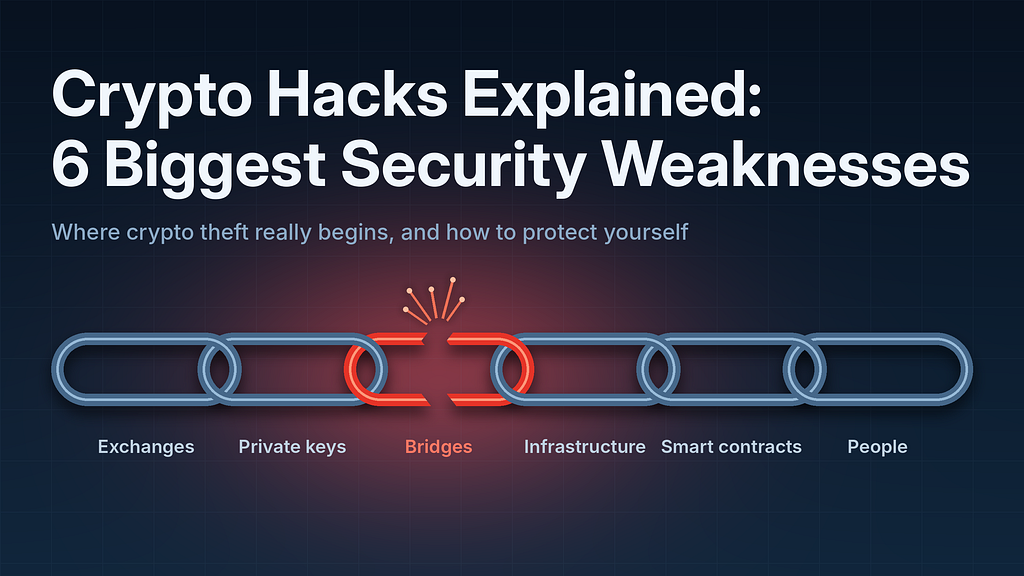
Most cryptocurrency theft doesn’t start with someone cracking your wallet. It starts somewhere you never thought to look.
Crypto Hacks Explained — 6 Biggest Security Weaknesses
On October 29, 2026, roughly $6.3 billion left Binance, the world’s largest crypto exchange, in the biggest crypto heist on record. No one cracked a user’s wallet, and the blockchains kept running exactly as designed. According to Binance, the attack began with a compromised laptop, which gave an attacker access to a service container and let them submit unauthorized withdrawals. Blockchain analytics firms, including TRM Labs and Chainalysis, have linked the theft to North Korea-linked hackers, though North Korea has denied involvement.
It was not the first time the weak point sat somewhere unexpected. The previous record, about $1.5 billion stolen from Bybit in February 2025, began when attackers compromised a developer’s machine at a wallet-software provider and quietly altered what the signers saw on their screens. The approvals looked normal, and the money left anyway.
That is the uncomfortable truth about crypto hacks: the weakest point is rarely the one investors are watching. You can use a strong password, hold your own keys, and still lose funds because of a link in the chain you never knew existed.
This guide breaks down the main attack surfaces behind cryptocurrency security breaches, explains how each one works, and shows what individual investors can do to reduce their exposure.
What Are the Biggest Crypto Security Weaknesses? (Quick Answer)
The six main attack surfaces in blockchain security are:
Exchange breaches, where centralized platforms holding customer funds are compromisedPrivate-key compromises, where attackers steal the credentials that control your assetsBridge exploits, where cross-chain protocols are drainedCompromised infrastructure, including front-ends, wallets, and software supply chainsSmart-contract vulnerabilities, meaning flaws in the code that runs DeFiSocial engineering, where people are tricked into handing over access
Blockchains themselves are rarely “hacked.” What gets attacked is the human, software, and business layer built around them. Chainalysis estimated that roughly $2.2 billion was stolen in 2024, and the industry’s own tracking has consistently shown billions in annual losses.
1. Exchange Breaches: When Someone Else Holds Your Keys
When you leave coins on a centralized exchange, you don’t hold the private keys. The exchange does. That makes exchanges a concentrated target: one successful attack can reach thousands of customers at once.
The history is long. Mt. Gox, once the world’s dominant Bitcoin exchange, collapsed in 2014 after hundreds of thousands of BTC went missing. Coincheck lost about $530 million in NEM tokens in 2018. Bybit’s 2025 loss shows that even well-resourced platforms with multi-signature setups are not immune.
Why it happens: hot wallets (internet-connected wallets used for withdrawals) are convenient but exposed. Internal access controls fail. Employees get phished. Security audits miss gaps.
The deeper risk is not only hacking. The FTX collapse in 2022 showed that custodial risk includes mismanagement and fraud, not just outside attackers. The core lesson holds: “not your keys, not your coins” is a security principle, not just a slogan.
2. Private-Key Compromises: The Single Point of Failure
Your private key or seed phrase is the only thing that proves ownership of your crypto. Anyone who has it can move your funds, with no support line and no reversal.
Private-key theft is the most common route behind individual crypto theft. Attackers get keys through:
Malware and clipboard hijackers that swap the wallet address you pasteFake wallet apps and browser extensions that harvest seed phrasesCloud storage leaks, such as screenshots of seed phrases synced to a photo libraryPoor key management at organizations, including keys stored on a single laptop
Large-scale attacks often come down to key compromise too. The Ronin Network breach in 2022, linked by U.S. authorities to North Korea’s Lazarus Group, reportedly involved attackers gaining control of enough validator keys to approve fraudulent withdrawals worth over $600 million.
The takeaway: if one device, one person, or one file can authorize a transfer, that is your point of failure.
3. Bridge Exploits: The Most Dangerous Place in DeFi
Cross-chain bridges let you move assets between blockchains, say from Ethereum to another network. They typically work by locking tokens on one chain and issuing a representation on another. All that locked value sits in one place, which makes bridges one of the richest targets in crypto.
The record is sobering:
Poly Network (2021): about $611 million drained, later largely returned by the attackerWormhole (2022): roughly $320 million lost through a signature-verification flawRonin (2022): over $600 million via compromised validator keysNomad (2022): about $190 million lost after a faulty upgrade let almost anyone copy the exploit and drain fundsHarmony Horizon (2022): around $100 million lost
Why bridges fail: they combine complex code, trusted validator sets, and enormous pooled funds. A bug or a compromised key is enough.
What investors can do: use bridges sparingly, prefer well-audited and long-running ones, avoid leaving funds in wrapped tokens longer than necessary, and never treat a bridged asset as equal in safety to the original.
4. Compromised Infrastructure: The Attack You Can’t See
Sometimes the code is fine, the keys are safe, and the attack happens in the tools around them. This category is growing, and it is the one most investors overlook.
Front-end and DNS hijacks: Attackers compromise a protocol’s website or domain so users see a legitimate-looking interface that sends approvals to a malicious contract. The smart contract is untouched. The page you clicked on is the weapon.
Software supply-chain attacks: In December 2023, a malicious version of a widely used library connected to Ledger’s Connect Kit was briefly published, putting users of apps that relied on it at risk. The same principle sits behind the Bybit incident: compromise the tooling and you compromise everyone who trusts it.
Hardware and wallet vulnerabilities: Tampered devices, counterfeit hardware wallets, and customer-data leaks (which later fuel targeted phishing and even physical threats) all fall here.
Key lesson for investors: security is a chain. A hardware wallet doesn’t help if you sign a malicious transaction that your screen described as something harmless. Always verify transaction details on the device itself.
5. Smart-Contract Vulnerabilities: When Code Is the Weakness
DeFi runs on smart contracts, self-executing programs on a blockchain. They are powerful, but they are immutable once deployed and hold real money, so a single bug can be catastrophic.
The classic example is The DAO in 2016, where a reentrancy flaw let an attacker repeatedly withdraw funds before balances updated, draining about $60 million worth of ETH. The pattern keeps repeating in new forms:
Reentrancy bugs, which allow repeated withdrawals within one transactionFlash-loan attacks, where attackers borrow huge sums for a single block to manipulate pricesOracle manipulation, which feeds a protocol false price dataAccess-control errors, where functions meant for admins are left openFaulty upgrades, where new code introduces old problems
An audit is not a guarantee. Many exploited protocols had been audited. Audits reduce risk but cannot eliminate it, and they say nothing about the team’s operational security or admin-key practices.
What DeFi participants can do: favor protocols with a long track record, multiple independent audits, bug bounties, and time-locked upgrades. Never put more into a single protocol than you can afford to lose, and be skeptical of unsustainable yields. High returns often mean hidden risk.
6. Social Engineering: Hacking the Human
Social engineering doesn’t break technology. It breaks trust, and it quietly powers a large share of all crypto theft.
Common tactics include:
Phishing emails and fake support messages impersonating exchanges or walletsWallet drainers, malicious sites that trick you into signing an approval giving attackers token accessAddress poisoning, where scammers send dust transactions from look-alike addresses, hoping you copy the wrong one from your historyImpersonation on Telegram, Discord, and X, including fake admins and fake “airdrops”Romance and “pig-butchering” investment scams, where trust is built over weeks before a fake platform takes your depositsFake recruiters and job offers used by state-linked groups to deliver malware to crypto developers
The pattern is always the same: urgency, authority, and a request for access. Real exchanges and wallet providers will never ask for your seed phrase.
How to Reduce Your Exposure: A Practical Security Checklist
You can’t eliminate risk, but you can shrink your attack surface dramatically.
Protect your keys
Store long-term holdings in a hardware wallet bought directly from the manufacturerWrite your seed phrase on paper or metal, never in photos, notes apps, or cloud storageNever type your seed phrase into a website or share it with anyone
Limit exchange risk
Keep only what you actively trade on exchangesUse unique passwords, an authenticator app, or a hardware security key, not SMS-based 2FAEnable withdrawal address allowlists
Be careful with DeFi
Use a separate “hot” wallet with limited funds for experimentingReview and revoke old token approvals regularlyBookmark official sites instead of clicking links from search ads or social posts
Verify before you sign
Read the transaction details on your hardware device screenTest with a small amount before sending large transfersDouble-check the full address, not just the first and last characters
Diversify your risk
Spread holdings across wallets and platforms so one failure isn’t fatalTreat every bridge, new protocol, and “guaranteed return” as a risk to be sized, not a certainty
What to Do If You’ve Been Hit or Targeted
If you suspect a hack or scam, act quickly. Move any remaining funds to a fresh wallet, revoke approvals, secure your accounts, document everything (transaction hashes, wallet addresses, screenshots, messages), and report it to the exchange and to authorities such as the FBI’s IC3 in the U.S.
Be careful afterward. Victims are often targeted again by fake “recovery services” that promise to retrieve stolen funds for an upfront fee. They are frequently scams themselves.
One resource worth knowing about is ScamBrokerCheck (SBC). They operate an investment-scam database where you can look up platforms, brokers, and schemes before you send money. SBC also offers free consultations for people dealing with investment scam cases or incidents, and states that it operates on a zero-upfront-payment policy. That is the key difference from the fake recovery outfits that demand fees first. As a general rule, anyone asking for payment before doing any work on a recovery case deserves serious suspicion. Whatever service you use, never share your seed phrase or grant wallet access to anyone.
Frequently Asked Questions About Crypto Hacks
Can the blockchain itself be hacked?
Major blockchains like Bitcoin have never had their core protocol broken. Losses almost always come from exchanges, keys, smart contracts, bridges, or users being tricked.
What is the most common way people lose crypto?
Social engineering and private-key compromise account for a large share of individual losses, through phishing, malware, and wallet-drainer approvals.
Are hardware wallets completely safe?
They are far safer than leaving funds on an exchange or a hot wallet, but they can’t protect you if you approve a malicious transaction or expose your seed phrase.
Is DeFi safe?
DeFi carries real smart-contract and infrastructure risk. Using established protocols, limiting exposure, and checking approvals reduces it but does not remove it.
Can stolen crypto be recovered?
Sometimes, particularly when funds move through exchanges that can freeze them, and recovery can be possible if reported quickly. Be wary of anyone who asks for an upfront fee to get your money back.
The Bottom Line
Crypto hacks don’t come from one place. They come from exchanges, keys, bridges, tools, code, and people. The investors who stay safe aren’t the ones who found a perfect defense. They’re the ones who understand that every link in the chain is a potential weak point and plan accordingly.
Security isn’t a one-time setup. It’s a habit.
If this article helped you see crypto security differently, give it some claps and share it with someone who holds crypto. One repost could reach the person who is about to click the wrong link. Follow for more plain-English breakdowns of crypto security, scams, and risk.
Crypto Hacks Explained: The Biggest Security Weaknesses Every Investor Should Understand was originally published in Coinmonks on Medium, where people are continuing the conversation by highlighting and responding to this story.