
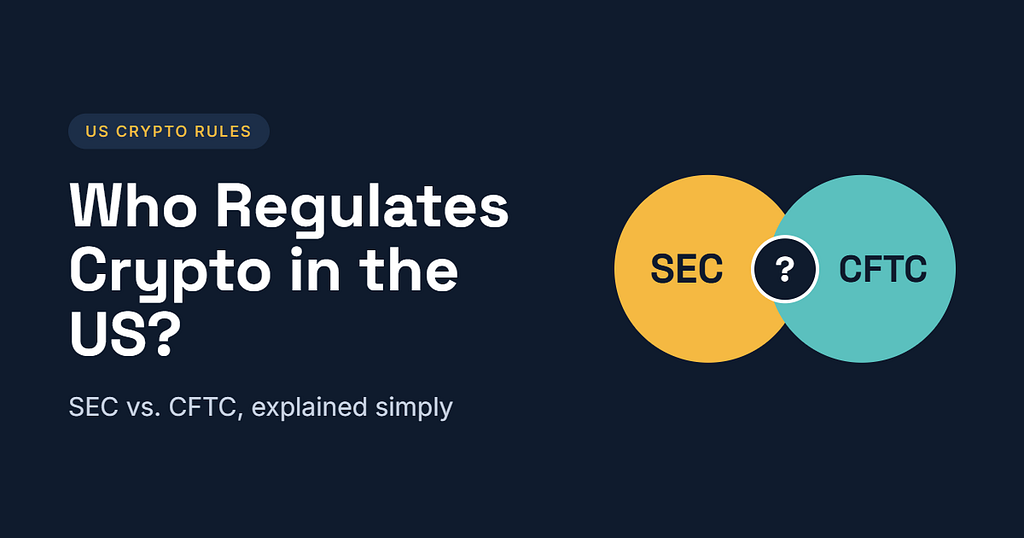
Why two government agencies keep showing up in the same crypto headlines, and what it means for you.
One week the headline says the SEC is going after a crypto company. The next week it’s the CFTC. If you’re new to crypto, it’s easy to wonder: which one is actually in charge?
That’s a fair question, and even people who work in the industry have been asking it for years. The short answer is that both agencies have a say, and the US still hasn’t fully decided where one’s job ends and the other’s begins. Let’s break it down in plain English.
Meet the two agencies
The SEC (Securities and Exchange Commission) watches over investments like stocks and bonds. Its main job is protecting investors. It wants companies to be honest about what they’re selling, so people can make informed choices.
The CFTC (Commodity Futures Trading Commission) oversees markets for commodities, things like oil, gold, and wheat, along with the futures contracts built on them. Its focus is keeping those markets fair and free from fraud and price manipulation.
Neither agency was created with crypto in mind. Both were built decades ago, long before Bitcoin existed. So when crypto showed up, each one had to ask the same question: does this fit under our rules?
Why two agencies seem to argue over the same coins
If you’re wondering why two agencies seem to argue over the same coins, it’s because the US never passed one clear law saying who is in charge. Congress’s big crypto bill didn’t pass the Senate in September 2026, so the SEC and CFTC have been filling the gap with their own rules. A month-by-month look at how USA crypto regulation played out this year makes the overlap easier to see. For you as a user, the practical point is that the label on a coin, such as “security” or “commodity,” decides which agency’s rules apply.
How the label decides everything
Here’s a rough way to think about it:
Security: a coin sold as an investment, where buyers expect to make money mainly from the work of a company or a team. This usually falls under the SEC.Commodity: a coin that works more like a raw good, with no single company running it. This usually falls under the CFTC.
Bitcoin is generally treated as a commodity, because no company controls it. Many other tokens sit in a grey area, and that’s where most of the arguments happen. A project might call its token a “utility” and say it isn’t an investment, but regulators can look at how it was sold and promoted and decide differently.
So don’t take a project’s word for it. A founder saying “this isn’t a security” doesn’t settle anything.
What has been changing lately
Since the big bill stalled, the agencies haven’t just waited around. The SEC has been working on a proposed framework often called “Regulation Crypto Assets,” which aims to spell out how crypto offerings should work. The CFTC has also been looking at how crypto trading fits under its rules.
Meanwhile, one piece of the puzzle is already law. A separate US law for stablecoins, which are coins designed to hold a steady dollar value, is set to take effect in January 2027. Stablecoins got their own law first because they’re simpler to regulate than most other tokens.
A quick caution: details like timelines and proposals can shift, so it’s worth checking the agencies’ own websites for the latest.
It’s not just two agencies
The SEC and CFTC get the most headlines, but they aren’t the only ones involved. Several others touch crypto in everyday ways:
The IRS treats crypto as property, so selling or spending it can create a tax bill.FinCEN, a Treasury unit, handles anti-money-laundering rules. That’s why exchanges ask for your ID.Banking regulators decide how banks can deal with crypto businesses.State regulators have their own licensing rules, and some states are stricter than others.
That’s a lot of rule-makers, which is part of why crypto can feel confusing.
What this means for you
You don’t need to memorize every agency. A few simple habits go a long way:
Use platforms that follow US rules. Check whether an exchange is registered or licensed before you deposit money.Be careful with big promises. If someone claims a coin is exempt from the rules or guarantees profits, treat that as a red flag.Read the risk warnings. Regulated companies are usually required to explain the risks. If you can’t find any, ask why.Keep records. Save dates, amounts, and prices of your trades. You’ll need them at tax time.Expect change. Don’t assume today’s rules will stay the same next year.
Quick answers
Is Bitcoin a security? Generally no. It’s usually treated as a commodity.
Can both agencies go after the same company? Yes. If a company’s activities touch both areas, both agencies can get involved.
Will there be one clear law soon? Nobody knows for sure. The main bill didn’t pass, but lawmakers could try again. Until then, expect agencies to keep setting the rules.
The bottom line
The SEC and CFTC aren’t really fighting. They’re each doing their job with rules written long before crypto existed, and the gaps between them are what make the news so noisy. For everyday users, the useful takeaway is simple: what a coin is called, and how it’s sold, decides who watches over it.
Once you understand that, the headlines get much easier to follow.
This article is for general information only and is not legal, tax, or financial advice. Rules change often, so check official sources before you make decisions.
Who Regulates Crypto in the US? SEC vs. CFTC, Explained Simply was originally published in Coinmonks on Medium, where people are continuing the conversation by highlighting and responding to this story.