
What Is Crypto Prop Trading, and How Does a Funded Challenge Work?
Plenty of traders can read a chart and manage risk, and still can’t trade for a living. The reason is usually capital. A 5% month on a $500 account is $25, and no amount of skill changes that maths.
Crypto prop trading is one answer to that problem. This article explains what it is, how a funded challenge works, what it costs, and who it does and doesn’t suit. I use Mubite as the worked example because it’s the firm I know best.
What crypto prop trading is
A proprietary trading firm, or prop firm, gives traders access to an account far larger than they could fund themselves. The trader does the trading, and the two split whatever profit the trader makes.
The firm doesn’t hand that account to everyone. You first have to show that you can make a profit while staying inside its risk limits. That test is usually called a challenge or an evaluation.
In crypto prop trading, the instruments are crypto pairs such as BTC and ETH perpetuals, not forex or stocks. Mubite, for example, offers accounts of up to $200,000 and a profit share of up to 90% for the trader.
One detail is worth understanding early. At most prop firms, including Mubite, the funded account is a simulated account that tracks live market prices. Your payouts are real money, but you are not placing the firm’s cash on an exchange yourself.
How a funded challenge works
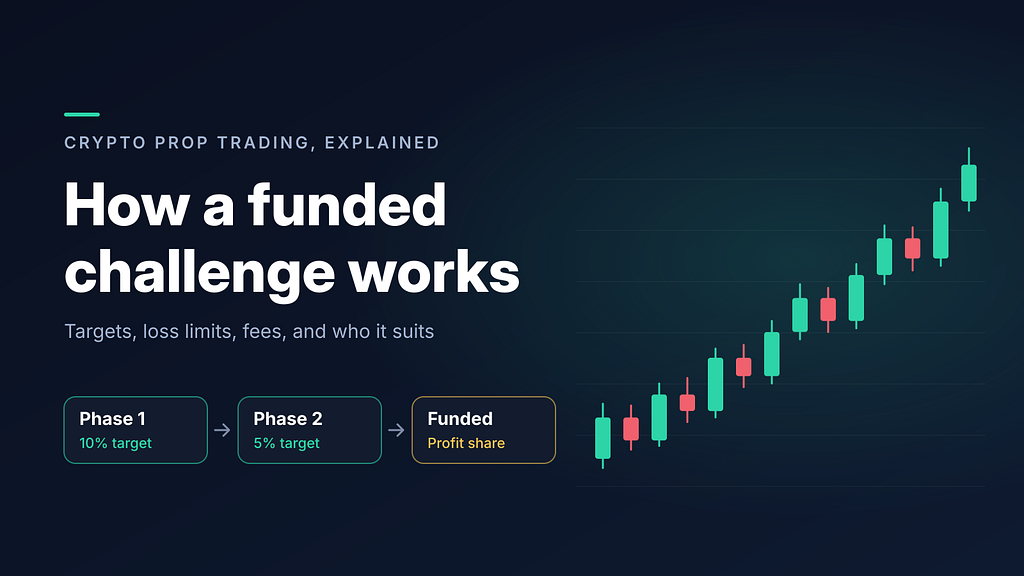
A typical two-step challenge has two phases, each with a profit target. You pass Phase 1, then Phase 2, and then you receive a funded account.
Mubite’s two-step challenge uses these targets:
On a $10,000 challenge account, the standard targets mean making $1,000 in Phase 1 and $500 in Phase 2.
The targets aren’t there to see who can gamble their way to 10%. They test whether you can grow an account steadily, with discipline, while someone else’s rules apply. That is the same job you’ll be doing once you’re funded.
Some firms, Mubite included, also offer one-step challenges and instant funding, where you skip the evaluation and pay more upfront. The two-step route is the most common starting point, so it’s the one covered here.
The rules that decide whether you pass
Many traders who fail a challenge never get close to missing the profit target. They break a loss limit first. Two limits matter most:
Daily drawdown: the most you may lose in a single day. If the limit is 5% on a $10,000 account, your account can’t drop more than $500 in one day.Maximum loss: the most the account may fall overall. Break it once and the challenge is over, however well you were doing before.
These limits change how you have to trade. One oversized position on a volatile day can end a challenge that took two weeks to build. Smaller size, a stop on every trade, and walking away after a bad morning matter more here than finding the perfect entry.
Every firm sets these numbers differently, and some calculate them from your balance while others use your equity. Read the firm’s rules page before you pay for anything, and reread it before your first trade.
What it costs and what you risk
You pay a one-off fee to take a challenge. The fee depends on the account size you choose: a larger account costs more. Some firms refund the fee once you pass and take your first payout, so check for that before you buy.
The fee is the real risk. If you break a rule, the challenge ends and the fee is gone. You don’t owe the firm anything for losses on the simulated account, because the fee is the most you can lose.
Who it suits, and who it doesn’t
Prop trading tends to suit you if:
You already have a strategy you’ve tested over months, not daysYou can follow a stop-loss rule even when you’re sure the market will turnYou’re short of capital, not short of skill
It’s probably not for you yet if:You’re still learning the basics of crypto tradingYou’re hoping a funded account will fix inconsistent resultsYou can’t afford to lose the challenge fee
A prop firm doesn’t make anyone a better trader. It gives a trader who is already consistent a bigger account to be consistent with. If you’re not there yet, a demo account and a trading journal will do more for you than a challenge.
Disclosure: I work with Mubite on community content. The figures above come from Mubite’s own published material and were correct when I wrote this. Check the firm’s website for current rules before you sign up. Nothing here is financial advice.
What Is Crypto Prop Trading, and How Does a Funded Challenge Work? was originally published in Coinmonks on Medium, where people are continuing the conversation by highlighting and responding to this story.