
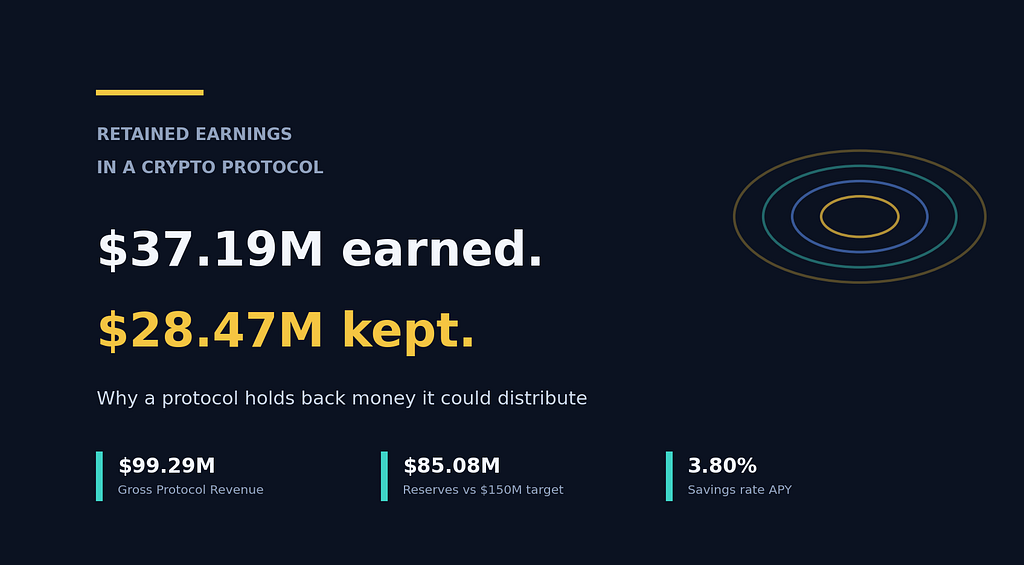
Sky Protocol booked $37.19M in Net Revenue last quarter. Most of it never reached token holders. That was the point.
Q3 2026: Sky Protocol earned $37.19M in Net Revenue and remitted $28.47M of it to Sky Reserves.
In the third quarter of 2026, Sky Protocol earned $37.19 million after expenses.
It sent $28.47 million of that straight to reserves.
Token holders got what was left.
Now compare that with the rest of the market. Crypto projects spent roughly $640 million on token buybacks in the first nine months of 2026, up 17% on the year before.
One camp is paying out. The other is holding back.
So here is the argument worth having. When a protocol makes money, who has the stronger claim on it? The token holder this quarter, or the system that has to survive the next one?
Retained earnings used to be the most boring line on a corporate balance sheet. In crypto it has quietly become the most contested decision in governance.
What Does “Retained Earnings” Mean for a Crypto Protocol?
Answer first. Retained earnings in a crypto protocol is revenue the protocol keeps on its own balance sheet instead of distributing to token holders.
In Sky Ecosystem, that retained slice has a name. It is called Sky Reserves.
Three terms, then we can move:
Gross Protocol Revenue: everything Sky Protocol earns before expensesNet Revenue: what is left once expenses are paidSky Reserves: the portion of Net Revenue the protocol keeps, sitting first in line to absorb a loss
A company would call that retained earnings. A risk team would call it a capital buffer.
Same mechanic either way. Money that could have walked out the door, parked where it takes the first hit instead.
The $99.29M Quarter Where Most of the Money Stayed Home
Sky Frontier Foundation published the Q3 2026 report on 29 October. The scoreboard:
Gross Protocol Revenue: $99.29M, up 14.2% year over yearTotal Expenses: $62.10M, down 16.0% from Q2Net Revenue: $37.19M, up 11.8%, the sixth straight positive quarterNet Revenue margin: widened from 31.0% to 37.5%Remitted to Sky Reserves: $28.47MSky Reserves at quarter close: $85.08M
Here is the part most recaps skipped. Gross revenue actually fell 7.4% from Q2. Expenses fell faster. The margin widened anyway, and the reserve build never paused.
That is what a rules-based retention policy looks like in a soft quarter. It just keeps going.
Gross revenue fell quarter on quarter. Expenses fell harder. The retained slice held.
Why Crypto Protocol Reserves Are the Equity Line, Not a Rainy Day Fund
Read Sky Protocol like a balance sheet and this gets much easier:
Collateral: $12.73B backing the stablecoin supply, as shown on skyeco.com in mid-November 2026Claims outstanding: 8.43B of stablecoin supplyReserves: $85.08M, the layer that absorbs a loss before a holder does
Then October happened. On 7 October, Moody’s assigned Sky Protocol a B3 rating with a stable outlook, the agency’s first rating of any stablecoin protocol.
S&P had affirmed B- on 1 October. Sky Protocol is currently the only stablecoin protocol carrying a rating from both.
Moody’s then did the arithmetic in public. Roughly $90 million of tangible common equity against about $10 billion of managed exposure. Call it a 0.9% capital ratio.
And it named the price of an upgrade: hold that ratio above 2.5%.
That one number turned an abstract governance debate into a target. Reserves stopped being a philosophy. They became a rating input with a published threshold attached.
0.9% today. 2.5% to unlock an upgrade. Retained earnings are the only tool that closes that gap.
How the Stage 2 Split Divides Every Dollar of Net Revenue
Sky Governance ratified Stage 2 of the capital management framework on 13 August 2026. It executed on 17 August. Every monthly settlement cycle now splits Net Revenue four ways:
Up to 50% to Sky Reserves, while reserves sit below target22.5% to SKY buybacks that fund SKY staking rewards22.5% to USDS staking rewards5% to SKY buy and burn
Two details in there deserved more attention than they got.
First, staking rewards moved from treasury-funded to revenue-funded. Rewards now track what the protocol actually earns, not what a treasury happens to be holding.
Second, the framework has an exit condition. Once Sky Reserves reach the $150M target, the buyback allocation adjusts programmatically under current parameters. No fresh vote required.
And retention never meant zero. Q3 still put $5.60M into open-market SKY purchases, and the first burn under Stage 2 removed 2.86 million SKY in October.
Reserves first, token holders second. The split is published, not discretionary.
What Happened Last Time Finance Chose Payouts Over Buffers
This is not theory. There is a case file.
IMF staff calculated that the 30 global systemically important banks distributed around $250 billion in dividends and buybacks in 2019. Then 2020 arrived.
The Federal Reserve suspended large bank buybacks outright and capped dividends. G-SIB buybacks fell roughly 87% for the year.
Go back one crisis further and it reads worse. Through 2007 and into 2008, plenty of institutions held or even raised payouts right up to the moment they needed rescuing.
JPMorgan later cut its dividend 87%. Wells Fargo cut 85%. Citigroup went to nearly zero.
The lesson was never that payouts are bad. It was that a buffer built by choice beats a buffer built under duress.
“All stakeholders will ultimately benefit if banks preserve capital instead of paying out to shareholders.” Kristalina Georgieva, IMF, May 2020
DeFi Spent $640M on Buybacks in 2026. One Protocol Went the Other Way.
The contrast is the whole story:
Crypto token buybacks reached around $640M across the first nine months of 2026Ten protocols capture 87% of all revenue distributed to token holdersHyperliquid alone routes close to 90% of its revenue into buybacksKeyrock research found the median protocol keeps just 7% of its treasury in income-bearing positions
So the field has split into two camps. One maximises what reaches the token this quarter. The other funds the balance sheet first and lets distribution scale into it later.
Sky Protocol picked the second. In public, with a number attached and an exit condition written down.
Same dollar of revenue. Four protocols. Two completely different theories of who it belongs to.
Where the Sky Savings Rate, sUSDS and USDS Fit Into This
Retention is not a tax on savers. This is the part people get wrong most often.
The Sky Savings Rate is a separate governance-set parameter funded from protocol revenue. It is not the leftovers after reserves are filled.
The Sky Savings Rate sits at 3.80% APY as of mid-November 2026sUSDS is how you hold it. Supply reached $4.52B at the Q3 close and $4.72B by 21 October, up 118% year over yearUSDS is the base unit, convertible 1:1 through the Peg Stability Module with no fees and no slippageThe capital is deployed by the Sky Agent Network, independent allocators including Spark, Grove, Keel, Obex and Osero
One data point ties it together. In September, Galaxy added $100 million of sUSDS to its corporate treasury and approved the asset as eligible collateral across its institutional lending business.
Institutions read the reserve line before they read the rate. That is not a slogan. It is a procurement checklist.
$85.08M at the Q3 close. 56.7% of the way to the $150M Solvency Reserve target.
The Honest Counter Argument, Because There Is One
Worth stating plainly, because it is the strongest case on the other side:
Capital parked in reserves is capital not compounding for holderSKY holders hold no direct claim on Sky Reserves“Up to 50%” is a governance decision, and governance can revisit it$150M against $12.73B of collateral is still only around 1.2%Hyperliquid holders got paid every month while this build was running
None of that is settled. Which is exactly why it is worth arguing about.
How to Verify Any of This Yourself
Three places, no trust required:
financial.skyeco.com for the balance sheet, Gross and Net Protocol Revenue, and Sky Reservesinfo.skyeco.com for the live onchain state, collateral composition and the state of USDS and sUSDSinsights.skyeco.com for quarterly reports and the recorded Insights calls
Three things to watch into Q4 and 2027:
Sky Reserves against the $150M target, with $64.92M to go as of the Q3 closeThe capital ratio against Moody’s 2.5% upgrade thresholdWhether the margin holds if Gross Protocol Revenue keeps softening
So, your call.
If you held the token, would you take the $28.47M now, or the rating upgrade later?
And where do you think the line should sit? Drop it in the comments. I read all of them.
Retained Earnings in a Crypto Protocol: Why Sky Kept $28.47M It Could Have Paid Out was originally published in Coinmonks on Medium, where people are continuing the conversation by highlighting and responding to this story.