
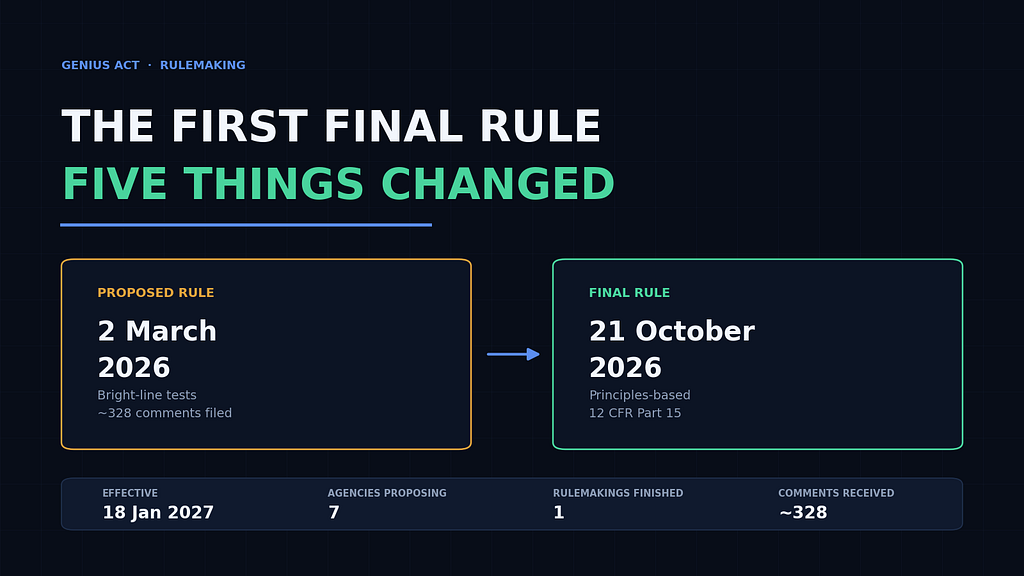
Seven agencies started writing. One finished. The OCC final rule under the GENIUS Act is not the draft the industry read in March.
Seven federal agencies started writing rules under the GENIUS Act.
One has finished.
On 21 October 2026, the Office of the Comptroller of the Currency published its final rule for payment stablecoin issuers.
It becomes 12 CFR Part 15. It takes effect on 18 January 2027, the same day the GENIUS Act does.
Here is the part most of the coverage skipped. This is not the March draft with the typos fixed. The OCC read roughly 328 comments and rewrote five substantive areas.
One of those rewrites deleted the exact provision the entire stablecoin yield argument had been built around.
If you hold stablecoins, allocate them, or build on them, the differences matter more than the headline.
What Is the OCC Final Rule Under the GENIUS Act, in Plain English?
It is the first completed comprehensive rulemaking under the GENIUS Act, and it sets the operating rules for every permitted payment stablecoin issuer the OCC licenses.
What it covers:
Permitted activities, widened from eight in the draft to elevenReserve asset composition, liquidity and concentrationRedemption rights and timingCapital and risk managementCustody, licensing, foreign issuers and revocation
What it does not cover: anti-money-laundering, sanctions and the Travel Rule. Those sit in a separate rulemaking the OCC will run with the Treasury.
Six other federal agencies have proposed and not finalised. The Treasury has still not settled what makes a state regime substantially similar to the federal one. The map is drawn in one corner and blank everywhere else.
The OCC did not soften this rule. It traded bright lines for judgement calls, and judgement calls are harder to plan around.
What Changed Between the Proposed Rule and the Final GENIUS Act Rule?
The five substantive divergences between the OCC proposed rule and the final GENIUS Act rule, published 21 October 2026.
Five areas moved.
Yield. The draft created a rebuttable presumption that arrangements with affiliates and related third parties violated the ban. Deleted.Redemption. The draft auto-extended the window to seven days if requests topped 10% of outstanding issuance in 24 hours. Commenters warned that would accelerate a run. Now the issuer reports to the OCC within 24 hours and any extension sits at the regulator’s discretion.Reserves. Two competing draft options became one hybrid: a 5% liquid floor, a 40% single-counterparty cap, and a brand new stress-testing duty.Capital. The bank-style two-tier structure is gone, replaced by GAAP tangible equity with a $5 million floor that runs for the life of the issuer.White labelling. The OCC asked whether each issuer should be capped at one stablecoin brand. It decided not to.
Why Did the OCC Delete the Rebuttable Presumption on Stablecoin Yield?
Because it would have been wrong in both directions.
The agency said the presumption risked being under-inclusive and over-inclusive at once.
An official put it more plainly to reporters: the draft language was an estimate of how likely evasion was, written before anyone had watched a nascent market operate.
So the presumption is out and case-by-case review is in.
That is not a win for anyone who wanted certainty. The OCC refused every safe harbour requested in the comments.
It kept its anti-evasion authority. And it said that paying another firm to make a payment the issuer could not make directly would clearly evade the Act.
The limiting factor simply moved from the rule text to the licence application.
Is the Stablecoin Yield Prohibition Still in Force? Yes, and It Got Sharper
The ban survives intact. A permitted payment stablecoin issuer still cannot pay a holder interest or yield solely in connection with holding, using or retaining the stablecoin. Retail and institutional holders are treated the same way.
What changed is how the line gets drawn. Instead of a formula, issuers now have to explain themselves.
Clarity will arrive slowly, through published approval letters rather than through regulation.
This is the live wire in the whole debate. The American Bankers Association made stopping stablecoin yield its top policy priority for 2026, arguing payment stablecoins must not become deposit substitutes.
Community bank groups have put the potential deposit drain in the trillions. Exchanges answer that activity-based rewards are not deposit interest.
None of it is settled. The OCC has already said it expects to propose a further rule once it has seen enough real transactions to know what it is regulating.
What Is the New Stablecoin Reserve Stress Testing Requirement?
What the OCC eased, dropped and added on stablecoin reserves. The stress-testing regime is new.
This is the piece almost nobody saw coming, and the most interesting thing in the document.
Issuers are now expected to stress test the reserve portfolio regularly and confirm that reserves still equal or exceed outstanding issuance under stressed conditions. The rule names one scenario outright: a significant positive interest rate move.
Read that against the last two weeks. The Federal Reserve held rates on 28 October by a 10 to 2 vote, and both dissenters wanted a quarter-point rise. A rate shock stopped being theoretical.
A reserve book of short-dated paper marked against par answers that question very differently from a structure that holds surplus collateral on purpose. Which is a fair thing to ask of any dollar you hold.
How Did Reserve Diversification and Capital Requirements Change?
Shorter, and in places genuinely easier.
The minimum held in demand deposits, insured shares or Federal Reserve balances fell from 10% to 5%The 40% single-counterparty cap stayed, with a new carve-out for a qualifying custodian relationshipThe weekly liquidity threshold, the 20-day weighted average maturity rule and the daily concentration sub-limit were all droppedSurplus reserves can be withdrawn at any time after due diligence, rather than once a month
Capital got simpler too. Any instrument qualifying as equity under GAAP counts, less intangibles and deferred tax assets.
The $5 million floor is now permanent. The 12-month operating expense backstop stays, with a waiver available for one-off costs.
Fewer numbers to hit. More judgement to defend.
What Does the OCC Final Rule Mean for Yield-Bearing Stablecoins?
It means the perimeter finally has an edge, and you should know which side of it anything you hold sits on.
The rule governs permitted payment stablecoin issuers licensed by the OCC.
That is a specific legal category with an application, a licence and a supervisor attached.
Not every dollar-denominated token sits inside it, and the category determines the rulebook.
Worth noting what the market did while Washington argued. Yield-bearing stablecoins have been the fastest-growing slice of the category through 2026, outpacing the broader stablecoin market many times over, even as total stablecoin supply slipped under $294 billion at the start of November.
Demand for a return on idle dollars did not wait for the rulemaking.
Where Does a Governance-Set Rate Like the Sky Savings Rate Come From?
Where the Sky Savings Rate comes from. USDS liquidity to the Sky Agent Network, fees back to Sky Protocol, rate set by Sky Governance, accessed through sUSDS.
Different architecture, different question.
Sky Protocol is decentralised liquidity infrastructure. USDS is its fully backed unit of account.
Independent allocators in the Sky Agent Network draw USDS liquidity under risk parameters set in public, deploy it, and pay fees back for that access. Those fees fund the Sky Savings Rate, and sUSDS is how holders access it.
Nobody at a desk sets the number. Sky Governance calibrates it through onchain votes by SKY holders. The rate is variable. It is not fixed, promised or guaranteed.
The reason that belongs in a regulatory post is simpler than it sounds. You can trace it.
Collateral composition, Protocol Collateral, Protocol Surplus and live supply are all published and checkable before you commit a dollar.
What Do the Latest Numbers Behind That Rate Look Like?
Sky Protocol Q3 2026 close, published by Sky Frontier Foundation on 29 October 2026. Every figure is checkable on a public dashboard.
Sky Frontier Foundation published the Q3 2026 report on 29 October.
Net Protocol Revenue of $37.19M, up 11.8% on Q2, the sixth consecutive positive quarterGross Protocol Revenue of $99.29M, up 14.2% year on year, a $397.2M annualised run rateNet Revenue margin widened from 31.0% to 37.5% as expenses fell 16.0%sUSDS supply of $4.52B at the Q3 close, up 118% year on year, and $4.72B on 21 OctoberProtocol Collateral of $11.41B, up 25.3% year on yearSky Reserves of $85.08M against a published $150M medium-term target
On 7 October, Moody’s assigned Sky Protocol its first counterparty risk rating, making it the first stablecoin protocol rated by both Moody’s and S&P Global.
What Should You Check Before 18 January 2027?
Seventy-five days from the final rule to the effective date, and the rulemaking still missing from the picture.
Five questions, whatever you hold.
Which category is the issuer in, and who supervises it?Where does the return actually come from, and who sets it?What happens to the reserve book if rates move up sharply?Can you redeem on demand, and what has that looked like under stress?Can you verify the backing yourself, today, without asking permission?
The last one is the one most people skip.
Existing issuers have a narrow window, roughly two months from publication, to get a substantially complete application in front of the OCC. First decisions are expected in the first or early second quarter of 2027.
The rules are written. The hard part starts now.
If you read the rule text and landed somewhere different on the yield question, say so in the comments. That is the argument worth having.
The First Final GENIUS Stablecoin Rule Just Landed. Here Is What Changed From the Draft. was originally published in Coinmonks on Medium, where people are continuing the conversation by highlighting and responding to this story.