
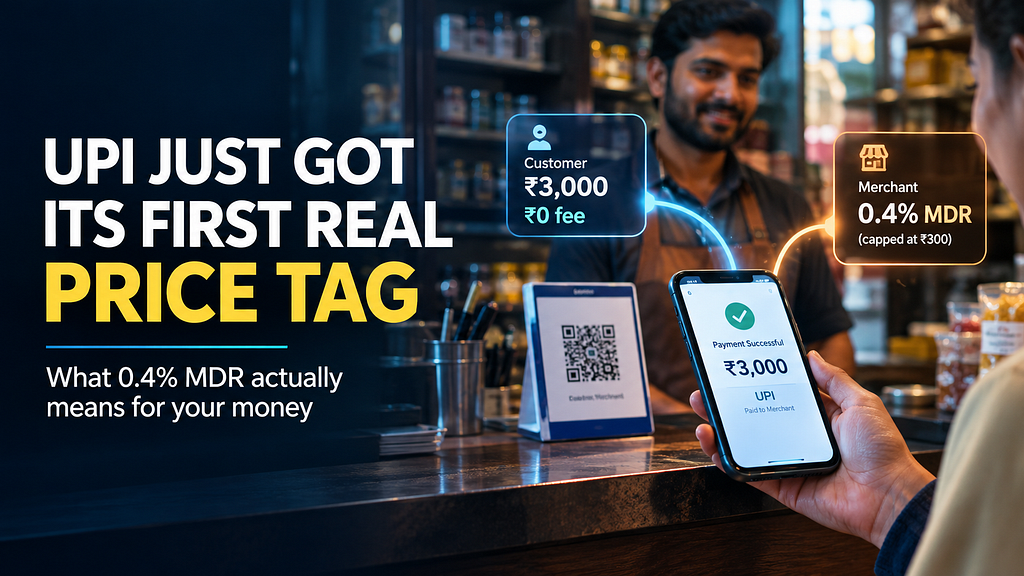
Every rupee you send is still free. But your favourite shopkeeper’s next UPI payment? That’s a different story.
For six years, “UPI is free” wasn’t just a marketing line; it was practically gospel in India. No MDR, no hidden cut, no surprise fee buried in your bank statement. That era just ended, at least partially, and almost nobody outside finance Twitter noticed until the headlines hit this week.
Here’s the real story behind the numbers, minus the panic and the WhatsApp forwards.
Image Generated by Chatgpt
The Announcement Nobody Was Ready For
The National Payments Corporation of India introduced a new Merchant Discount Rate framework for selected UPI person-to-merchant transactions, with a 0.4% MDR applying to eligible UPI merchant transactions above ₹2,000 starting October 15, 2026. That single sentence triggered a wave of confusion, because most people immediately assumed one thing: “So now I get charged every time I pay for chai?” Vajiram & Ravi
Not quite. Let’s slow down.
Who Actually Pays This 0.4%?
This is the part that got lost in the noise. The 0.4% MDR applies to P2M UPI transactions above ₹2,000 collected by large merchants, capped at ₹300 per transaction consumers pay nothing, and UPI stays free to use, with merchants barred from surcharging customers for it. Calc Guru
Read that again. The fee sits on the merchant’s side of the counter, not yours. If you tap “Pay” on a ₹3,000 shopping bill, your money leaves your account exactly as it does today full amount, zero deduction. The retailer, not you, absorbs the cut on the back end.
For scale: a ₹3,000 eligible transaction would attract ₹12 in standard MDR, while a ₹50,000 eligible transaction would attract ₹200, and transactions of ₹75,000 and above are capped at ₹300 per transaction. Vajiram & Ravi
That’s it. No sliding scale nightmare, no unpredictable math just a flat 0.4%, capped so it never runs wild on big-ticket payments.
Small Shops Are Protected On Purpose
If your local kirana store or the guy who fixes your phone screen is worried about this eating into thin margins, there’s genuinely good news. A single payment above ₹2,000 does not automatically make a small merchant liable for MDR the merchant’s account category and overall monthly collections determine the fee, and a merchant receiving more than ₹1 lakh through UPI for three consecutive months can be moved to the regular P2M category. Gizmo Times
In plain terms: casual sellers, small vendors, and anyone under that monthly threshold keep riding the zero-MDR wave. Small merchants classified under the P2PM category, who receive up to ₹1 lakh a month through UPI QR, remain outside the MDR entirely. And you don’t need to be GST-registered to qualify for that protection either — GST registration is not required merely to qualify for the P2PM zero-MDR benefit. Business Today, Gizmo Times
There’s also a softer landing built in for certain categories. Several essential-service and thin-margin merchant categories will pay a flat ₹5 MDR on qualifying UPI payments above ₹2,000 instead of the standard 0.4% rate, and that ₹5 is still charged to the merchant not tacked on as a customer-facing fee. Capital-market players get an even gentler rate: payments to mutual funds, securities platforms, stockbrokers and dealers will carry a lower MDR of 0.02%, capped accordingly. Gizmo Times Gizmo Times
And your recurring payments? Untouched. Recurring UPI payments such as utility bills, OTT subscriptions and mutual fund instalments will not attract the 0.4% MDR merely because their transaction value crosses ₹2,000. Business Today
Now, About That GST Rumour
This is where things got genuinely messy online. The moment “MDR” and “GST” appeared in the same sentence, half the internet decided the government was about to tax every UPI transfer. It wasn’t the first time this rumor made the rounds eitherback in April 2025, the Finance Ministry had to publicly label claims of GST on UPI transactions as false and misleading, clarifying that GST applies only to charges like MDR related to certain payment instruments, and that since no MDR existed on UPI at the time, no GST applied either. newsonair
Fast forward to now, with an actual MDR in place, and the picture is more nuanced but still far less scary than the headlines suggest. Merchants will have to pay 18% GST on the Merchant Discount Rate charges for UPI payments above ₹2,000, but they can claim input tax credit, which eases the overall tax burden according to tax experts. Business Standard
The government went out of its way to shut down the “hidden UPI tax” narrative directly. The government rejected suggestions that GST on UPI MDR was a new “tax on UPI,” clarifying that the MDR itself will be set off through input tax credit for eligible businesses. Business Today
So functionally, for a GST-registered merchant, that 18% on the MDR isn’t a sunk cost — it flows back through ITC, meaning the real economic hit stays close to the 0.4% headline figure, not 0.4% plus tax on top.
The Fine Print That Actually Matters Long-Term
Buried under the rate talk is a compliance detail businesses shouldn’t skip. Section 269SU still requires every business with turnover above ₹50 crore to offer prescribed low-cost electronic payment modes, including UPI, with a penalty of ₹5,000 a day under Section 271DB for non-compliance. Translation: no large business gets to quietly drop UPI acceptance just because the economics shifted slightly. The obligation to offer it stands only the cost structure around it has changed. CalcGuru
So What Should You Actually Do?
If you’re a customer: nothing changes for you. Keep tapping “Pay,” keep splitting bills with friends, keep paying rent through UPI — all of that stays free, always has, always will under this framework.
If you run a business processing serious UPI volume above the small-merchant threshold, this is the moment to actually read your payment aggregator’s fine print, check which category you fall under, and talk to your accountant about how ITC applies to your specific setup — because the difference between “0.4% plus unrecoverable tax” and “0.4% with ITC offset” is the difference between a real cost and a paperwork line item.
The UPI-is-free story isn’t over. It just got a footnote and now you know exactly what it says.
Want this formatted and ready to publish straight to Medium?
UPI Just Got Its First Real Price Tag Here’s What It Actually Means For Your Money was originally published in Coinmonks on Medium, where people are continuing the conversation by highlighting and responding to this story.