
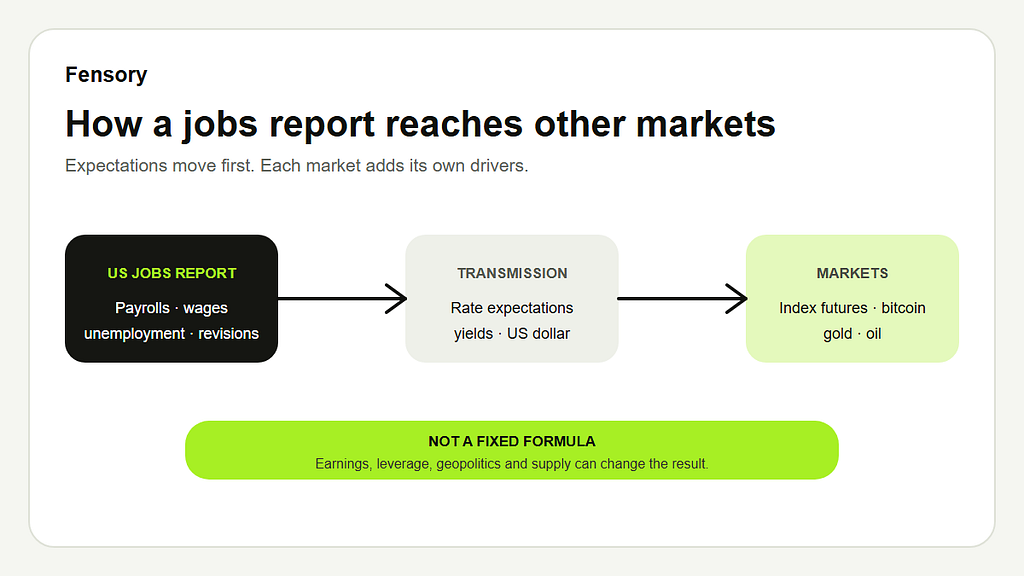
The jobs report moving through rate expectations and the dollar into index futures, bitcoin, gold and oil
One employment report can move several markets at once, but not through one simple rule.
The report changes what traders expect about growth, inflation and Federal Reserve policy. Those expectations can move interest rates and the dollar. Stock index futures, bitcoin, gold and oil then react through their own market structures and current positioning.
The useful skill is not predicting one universal direction. It is tracing the path.
What the report actually contains
The US Employment Situation is produced by the Bureau of Labor Statistics from two separate surveys.
The household survey measures employment and unemployment among people. The establishment survey measures payroll employment, hours and earnings across nonfarm businesses and government agencies.
That is why the release contains several signals rather than one number:
change in nonfarm payrollsunemployment ratelabour-force participationaverage hourly earningsrevisions to earlier months
Markets compare these figures with expectations and with each other. A strong headline payroll number can sit beside weaker prior-month revisions. Faster wage growth can matter even when employment growth slows.
Step 1: the surprise changes expectations
The first market question is not whether the report is good or bad.
It is whether the report is stronger or weaker than expected, and which part of it created the surprise.
A stronger-than-expected labour report may suggest more demand and more wage pressure. A weaker report may suggest slower growth. Neither conclusion is automatic because revisions, participation and the inflation backdrop can change the interpretation.
The same payroll number can therefore produce a different reaction in two different months.
Step 2: expectations reach interest rates
The Federal Reserve’s mandate includes maximum employment and stable prices. Employment data matters because it changes the evidence available to policymakers and to markets pricing the likely path of policy.
If the report makes tighter policy look more likely, expected short-term rates can rise. If it strengthens the case for easier policy, expected rates can fall.
Longer-term yields respond to more than the next policy meeting. They also reflect expectations for growth, inflation and future short-term rates.
This is the first bridge from a labour report to markets that do not look like labour markets at all.
Step 3: rates and the dollar change financial conditions
The Federal Reserve describes several transmission channels from policy expectations into financial conditions.
Interest rates change the relative appeal of bonds, equities and other assets. They affect borrowing costs and valuation assumptions. Changes in the attractiveness of US assets can also move exchange rates and the dollar value of assets priced in other currencies.
That creates a working chain:
Employment surprise → policy expectations → rates and the dollar → market-specific repricing
The arrows are not promises. They show where to look next.
How stock index futures can react
Stock index futures can respond to both the growth signal and the discount-rate signal.
A strong labour report may support expectations for company revenue because employment and income remain firm. The same report may also push yields higher, increasing the rate used to value future earnings.
Those forces can pull in opposite directions.
Growth-sensitive sectors may respond differently from companies whose valuations depend more heavily on distant future cash flows. The index move also depends on what was already priced before the release.
How bitcoin can react
Bitcoin trades continuously, so it can respond the moment the data arrives.
The transmission often runs through liquidity expectations, the dollar, yields and general risk appetite. Higher expected rates can tighten financial conditions. Lower expected rates can loosen them.
But bitcoin is not a mechanical inverse of yields or the dollar. Crypto-specific news, leverage, liquidations and weekend positioning can dominate the macro signal.
Read the rates and dollar move as context, not as a trading formula.
How gold can react
Gold does not pay interest. Changes in real and nominal yields can therefore alter the opportunity cost of holding it.
The dollar matters too because gold is commonly quoted in dollars. A stronger dollar can make the same ounce more expensive in other currencies.
Safe-haven demand can complicate both relationships. A weak jobs report that raises concern about the economy may support gold even if other markets focus on slower growth. A stronger report can pressure gold through yields while geopolitical demand pushes the other way.
How oil can react
Oil has a different first-order driver: expected demand for physical energy.
A strong labour report can support the view that economic activity and fuel demand remain firm. A weak report can do the opposite.
The dollar is another channel because oil is priced globally in dollars. Yet supply decisions, inventories, sanctions, shipping disruptions and conflict can overwhelm the macro signal.
Oil should not be treated as a simple rate trade.
Why the first move can reverse
The first seconds after the release are often dominated by the headline number and automated reactions.
The market can then reprice as participants read:
wage growthunemployment and participationrevisions to prior monthsthe response in Treasury yieldsthe response in the dollarexisting positions and nearby liquidation levels
A reversal does not mean the data changed. It can mean the interpretation changed.
A five-minute cross-market checklist
Use the same sequence every time:
1. Record the release and timestamp
Use the official BLS release, not a screenshot or recycled headline.
2. Compare the components with expectations
Check payrolls, unemployment, participation, earnings and revisions.
3. Read rates and the dollar
They show how the market is translating the report into financial conditions.
4. Compare market reactions at the same timestamp
Check stock index futures, bitcoin, gold and oil together. Do not compare one live price with another price captured several minutes earlier.
5. Name the competing driver
For each market, write down what could be stronger than the jobs signal. It might be earnings, crypto-specific leverage, geopolitical risk or oil supply.
A research prompt for a connected assistant
Show the latest US employment report, including payrolls, unemployment, participation, average hourly earnings and revisions. Then compare the immediate moves in Treasury yields, the dollar, Nasdaq 100 futures, bitcoin, gold and WTI using matching timestamps. Separate what is observed from what is inferred. Do not place an order.
The prompt asks for a cross-market read, not a trade call. The distinction matters because the same data can support more than one interpretation.
The map is more useful than the prediction
Employment data matters because it can change expectations about growth, inflation and policy. Rates and the dollar transmit part of that change. Each market then adds its own drivers.
So the right question is not, “Does a strong jobs report make bitcoin go down?”
Ask instead:
What surprised the market?How did rate expectations and the dollar respond?Which market-specific driver could alter the result?
That framework remains useful even when the final price move looks contradictory.
Open Fensory Intelligence and compare the current market context
Sources
US Bureau of Labor Statistics: Employment Situation technical noteUS Bureau of Labor Statistics: Employment Situation release scheduleFederal Reserve: monetary policy goals and transmission
Educational market mechanics only. Not financial advice. Cross-market relationships can change, and no economic release guarantees a particular price direction.
How One Jobs Report Can Reach Bitcoin, Gold, Oil and Stock Index Futures was originally published in Coinmonks on Medium, where people are continuing the conversation by highlighting and responding to this story.