
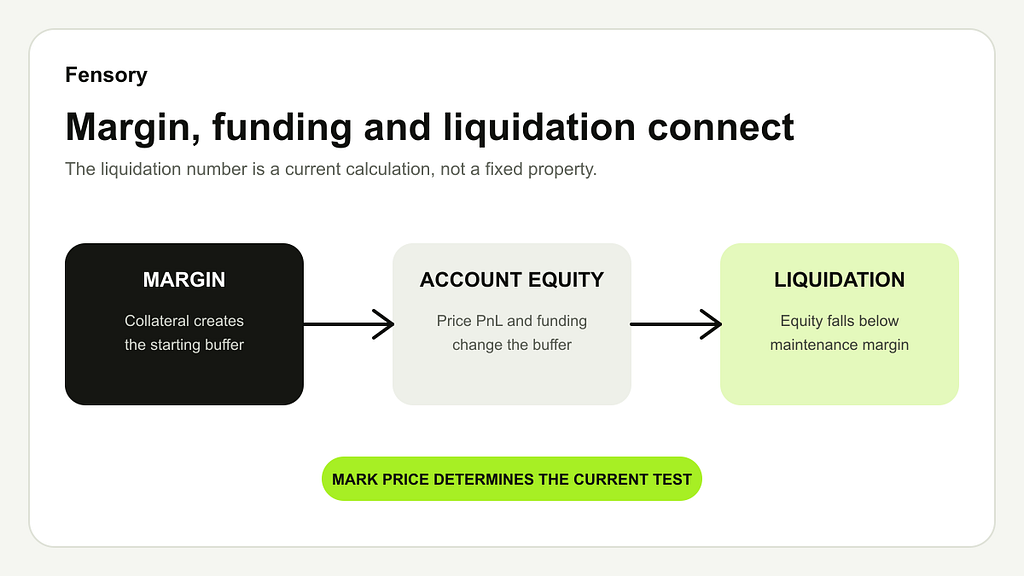
Margin supports the position, funding changes account equity over time and liquidation begins when the account falls below the venue’s maintenance requirement.
Liquidation price, margin and funding often appear as separate fields. They describe one connected system.
Margin is the collateral supporting a leveraged position. Funding transfers value between long and short holders over time. Liquidation begins when account equity falls below the venue’s maintenance requirement, usually based on a mark price rather than the last trade.
Reading only the liquidation number misses how it can change.
Margin creates the collateral buffer
A perpetual-futures position represents market exposure larger than the collateral assigned to it.
The initial margin lets the position open. Maintenance margin is the minimum equity the venue requires to keep it open. The gap between current equity and maintenance margin is the position’s buffer.
Leverage changes that buffer. Higher leverage generally means less initial collateral relative to position size, leaving less room for an adverse move.
The margin mode determines which collateral is available.
Isolated margin assigns collateral to one position. The loss is contained to that position’s allocated collateral under the venue’s rules.
Cross margin allows eligible positions to share an account-level collateral pool. Profit, loss and margin use in one cross position can affect the room available to others.
Funding changes equity without changing position size
Funding is a periodic payment between long and short holders.
When funding is positive, longs pay shorts. When it is negative, shorts pay longs. On Hyperliquid, funding is paid hourly.
The position size does not need to change for the account balance to change. A trader who pays funding loses some account equity. A trader who receives it gains some, before fees and price movement.
Over one interval the amount may look small. Across a large position or many intervals, the cumulative effect can become meaningful.
This is one reason a displayed liquidation price can move while the market price barely changes.
Liquidation uses maintenance margin and mark price
Liquidation is triggered when the account no longer meets the venue’s maintenance-margin requirement.
Hyperliquid documents the condition as account equity falling below maintenance margin. It uses mark price in the calculation. This reduces the chance that one isolated trade triggers liquidation, but it does not remove liquidation risk.
For an isolated position, the relevant equity is tied to that position’s assigned collateral and unrealized profit or loss.
For cross margin, the calculation uses the cross account’s equity and maintenance requirements across eligible positions. A second position, a withdrawal or accumulated funding can therefore change the liquidation context for the first position.
A worked example
Consider an illustrative isolated long position:
position notional: $10,000initial margin allocated: $2,000leverage at entry: 5xfunding paid over several intervals: $20
Assume no margin is added and ignore trading fees for simplicity.
The funding payment reduces the position’s supporting equity from $2,000 to $1,980 before considering price movement. The position size remains $10,000.
If the mark price then moves against the position, unrealized loss reduces that equity further. Liquidation occurs when the remaining equity reaches the venue’s maintenance threshold, not when the full $2,000 has necessarily disappeared.
This example is deliberately simplified. Real liquidation prices depend on the venue’s maintenance tiers, entry price, mark price, position size, fees, funding and margin mode.
Why the displayed liquidation price can change
The number may move when:
margin is added or removedfunding is paid or receivedthe position size changesanother cross-margin position gains or loses valuethe venue’s maintenance tier changes with position sizethe mark-price relationship changes
Treat the displayed liquidation price as a current calculation, not a permanent property of the trade.
Read the three fields in this order
1. Margin mode and collateral
Is the position cross or isolated? How much collateral is supporting it?
2. Current and cumulative funding
Who is paying whom, how often, and how much has the position paid or received so far?
3. Mark price and liquidation distance
Which price controls the calculation, and how far is that price from the current liquidation estimate?
Then check the rest of the account. A cross-margin liquidation estimate without the other positions is incomplete.
The relationship is the point
Margin, funding and liquidation are not three independent warnings.
Margin defines the buffer. Funding can add to or subtract from that buffer. Price movement changes unrealized profit and loss. The venue compares the resulting equity with its maintenance requirement using the mark price.
Understanding that chain is more useful than memorizing one liquidation number.
Open one perpetual market and identify margin mode, funding and liquidation context
Sources
Hyperliquid Docs: marginingHyperliquid Docs: fundingHyperliquid Docs: liquidationsHyperliquid Docs: contract specifications
Educational mechanics only. Not financial advice. The worked example is illustrative and omits venue-specific details.
Liquidation Price, Margin and Funding: How the Three Fit Together was originally published in Coinmonks on Medium, where people are continuing the conversation by highlighting and responding to this story.