
Security remains one of the biggest challenges facing cryptocurrency exchanges. As trading platforms handle significant volumes of digital assets and sensitive user information, they continue to attract cybercriminals seeking vulnerabilities in wallets, APIs, smart contracts, and internal systems.
A successful cyberattack can result in stolen funds, compromised customer data, interrupted trading activities, and long-term reputational damage.
However, recovering from a crypto exchange hack involves more than fixing the vulnerability that caused the incident. It requires a coordinated approach to incident response, asset protection, infrastructure recovery, and future risk prevention.
Whether an exchange operates as a centralized trading platform or a decentralized protocol, understanding how to respond to a security breach is essential for maintaining operational resilience.
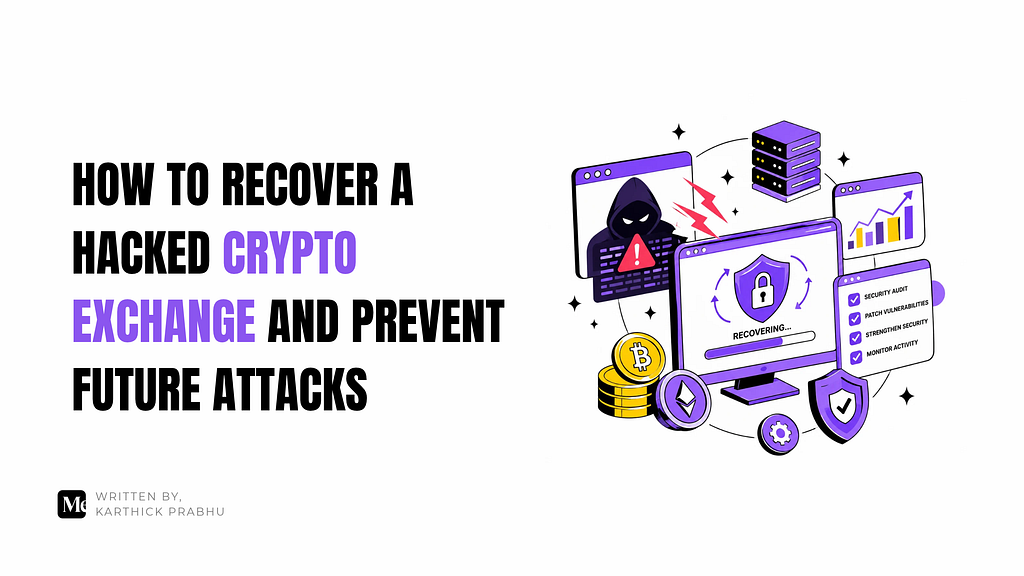
How to Recover a Hacked Crypto Exchange and Prevent Future Attacks
1. Identify the Breach and Contain the Threat
The first priority after detecting suspicious activity is to identify the affected systems and prevent further unauthorized access.
Security teams should immediately investigate unusual withdrawal patterns, unauthorized API requests, unexpected wallet transactions, and changes to administrative accounts.
Immediate actions include:
Temporarily suspend withdrawals or affected services when necessary.Disable compromised API keys and administrative credentials.Isolate affected servers without destroying forensic evidence.Review system logs, authentication records, and wallet activity.Activate the exchange’s incident response procedures.
Containment decisions should be based on the scope of the incident. Suspending all trading operations may not always be necessary, but protecting customer funds must remain the priority.
Preserving logs, system snapshots, and other evidence is equally important for understanding how attackers gained access.
2. Secure Crypto Wallets and Protect Remaining Assets
Wallet infrastructure is among the most sensitive components of a cryptocurrency exchange.
If attackers compromise private keys, withdrawal permissions, or wallet management systems, customer funds may be exposed to immediate risk.
Exchange operators should determine whether the incident involves hot wallets, cold storage, signing infrastructure, or internal fund transfer mechanisms.
Recommended recovery measures include:
Identify compromised wallets and associated addresses.Transfer unaffected assets to newly secured wallets when safe.Revoke exposed signing permissions and access credentials.Replace compromised private keys through a controlled rotation process.Review multisignature authorization and withdrawal approval policies.Monitor blockchain transactions associated with suspicious addresses.
Where appropriate, exchanges can coordinate with blockchain analytics providers, law enforcement, and relevant service providers to trace stolen assets.
However, blockchain transactions are generally irreversible. Identifying stolen funds does not guarantee their recovery.
3. Investigate the Root Cause of the Attack
Restoring exchange operations without understanding the original vulnerability creates a significant risk of another breach.
A detailed security investigation should identify the attacker’s entry point, affected infrastructure, compromised accounts, and methods used to move through the system.
Common attack vectors include:
API vulnerabilities: Weak authentication, exposed API credentials, and insufficient access controls can allow unauthorized trading or withdrawal requests.
Private key compromise: Insecure key storage, exposed secrets, or compromised signing environments can provide attackers with access to digital assets.
Phishing and social engineering: Attackers may impersonate employees, administrators, or service providers to obtain privileged credentials.
Smart contract vulnerabilities: Decentralized exchanges and platforms using on-chain contracts may face risks associated with faulty access controls, contract logic, and external integrations.
Infrastructure misconfigurations: Exposed databases, outdated dependencies, and incorrectly configured cloud services can create additional attack surfaces.
Working with an experienced crypto exchange development company can help exchange operators assess architectural weaknesses, review trading and wallet integrations, and implement necessary security improvements.
The investigation should result in a documented explanation of what happened, how the attack progressed, and which controls failed.
4. Restore Exchange Infrastructure Safely
Once the immediate threat has been contained and the affected systems have been investigated, the next step is restoring the exchange’s technical infrastructure.
However, bringing services back online too quickly can expose the platform to further attacks.
Before restoring operations, exchange operators should:
Rebuild compromised servers from verified, trusted images.Patch identified vulnerabilities and update affected dependencies.Rotate credentials, API secrets, and administrative access tokensVerify the integrity of databases and transaction records.Review trading engine, order book, and wallet service connections.Test deposit, withdrawal, and settlement processes.Validate monitoring and security alert mechanisms.
Special attention should be given to balance reconciliation.
Exchange operators must verify that internal account balances accurately reflect customer liabilities, completed transactions, and available assets.
For centralized exchanges, this includes checking the consistency of trading records, internal ledgers, and custody systems.
Services should resume only after security teams have verified that the exploited vulnerability has been addressed and critical systems are safe to operate.
5. Communicate Transparently with Users
A crypto exchange hack is not only a technical incident. It is also a serious customer trust issue.
Poor communication can increase uncertainty, encourage misinformation, and damage an exchange’s reputation.
Exchange operators should communicate confirmed information clearly while avoiding speculation about the attack.
Important updates should explain:
Which platform services are affected.Whether customer funds or personal information may be at risk.Which temporary restrictions have been introduced.What security and recovery measures are underway.When users can expect further updates.
Where required, exchanges must also notify regulators, affected customers, and relevant authorities according to applicable laws and reporting deadlines.
Communication should remain consistent throughout the recovery process, even when the investigation is ongoing.
Avoid promising specific recovery dates or reimbursement outcomes until they can be supported by verified information.
6. Strengthen Security Before Resuming Full Operations
A security breach provides an opportunity to identify weaknesses that may have existed across the exchange’s architecture.
Rather than applying temporary fixes, operators should establish stronger security controls throughout the platform.
Implement stronger authentication
Multi-factor authentication should be enforced for administrative accounts and other privileged operations.
Role-based access control, session monitoring, and restricted permissions can reduce the impact of compromised credentials.
Improve wallet security
Exchanges should minimize funds held in hot wallets and implement appropriate cold storage procedures.
Additional controls may include multisignature approvals, hardware security modules, withdrawal limits, and transaction monitoring.
Secure APIs and internal services
API security should include strong authentication, authorization checks, request validation, rate limiting, and monitoring.
Internal services should follow least-privilege access principles to prevent attackers from moving freely between systems.
Conduct regular security assessments
Penetration testing, dependency scanning, infrastructure reviews, and independent security audits help identify vulnerabilities before attackers exploit them.
For businesses planning major infrastructure improvements, consulting a crypto exchange development company with experience in secure wallet architecture, trading systems, and API integrations can support a more comprehensive security modernization process.
7. Establish a Long-Term Incident Prevention Strategy
Preventing future attacks requires continuous security management rather than occasional technical assessments.
Cryptocurrency exchanges should maintain an incident response plan that defines responsibilities, escalation procedures, communication protocols, and recovery priorities.
A long-term security strategy should include:
Continuous monitoring: Detect suspicious account activity, abnormal transactions, and infrastructure changes.Regular security audits: Review applications, smart contracts, APIs, and cloud environments.Employee security training: Reduce phishing, credential theft, and social engineering risks.Disaster recovery planning: Maintain tested backups and documented service restoration procedures.Third-party risk assessments: Evaluate custody providers, KYC services, liquidity integrations, and external technology vendors.Incident response simulations: Conduct periodic exercises to test how effectively teams respond to security threats.
Security should also be integrated into the software development lifecycle.
New features, third-party integrations, and infrastructure updates must undergo appropriate security testing before production deployment.
How Long Does Crypto Exchange Hack Recovery Take?
There is no universal recovery timeline for a compromised cryptocurrency exchange.
A minor incident involving exposed API credentials may be resolved relatively quickly if attackers have not gained deeper system access.
However, incidents involving stolen private keys, compromised infrastructure, manipulated balances, or customer fund losses can require weeks or months of investigation and remediation.
Recovery timelines depend on several factors, including:
Severity and scope of the security breach.Number of affected wallets and accounts.Availability of reliable backups and forensic evidence.Complexity of the exchange’s technical infrastructure.Regulatory and legal obligationsResults of independent security verification.
The objective should not be to restore services as quickly as possible, but to restore them safely and prevent additional losses.
Final Thoughts
Recovering a hacked cryptocurrency exchange requires a combination of technical expertise, operational coordination, transparent communication, and long-term security planning.
The process begins with containing the threat and protecting remaining assets, followed by identifying the root cause, rebuilding compromised infrastructure, and validating system integrity.
More importantly, exchanges must treat security as an ongoing responsibility.
Strong wallet protection, secure APIs, continuous monitoring, regular audits, and well-tested incident response procedures can significantly reduce exposure to future attacks.
A successful recovery is not simply about bringing an exchange back online. It is about restoring operations with stronger safeguards, verified systems, and renewed user confidence.
How to Recover a Hacked Crypto Exchange and Prevent Future Attacks was originally published in Coinmonks on Medium, where people are continuing the conversation by highlighting and responding to this story.