
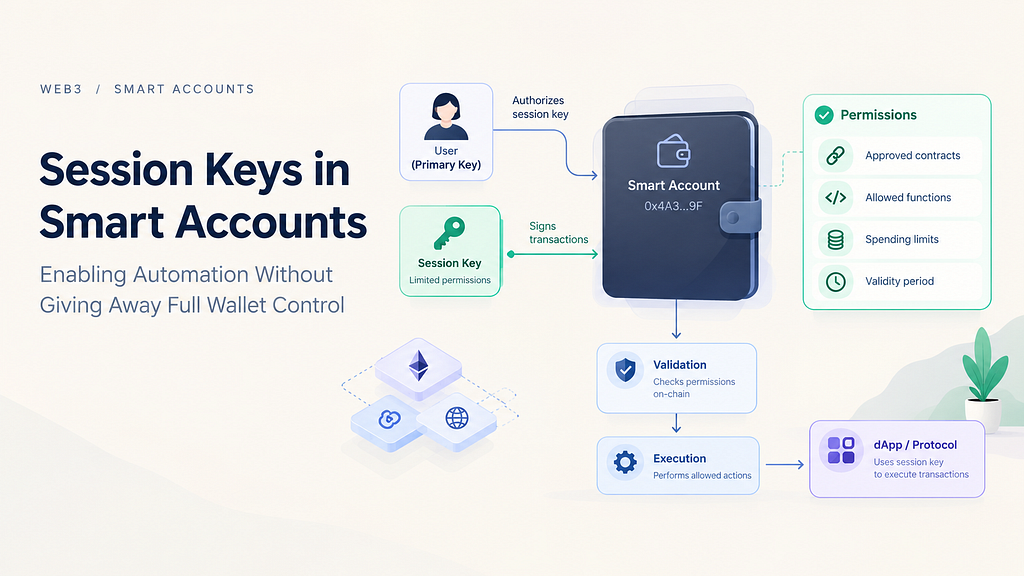
Web3 applications are becoming more automated. Users want to execute recurring trades, interact with DeFi protocols, claim rewards, and participate in blockchain games without approving every transaction manually. But automation creates a security challenge: how can an application act on a user’s behalf without receiving unrestricted control over their wallet?
Traditional wallets generally require users to sign transactions with their private keys. Giving an application access to that key creates significant risk, while requiring approval for every action undermines the user experience.
Session keys offer a middle ground: they let users authorize specific actions for a limited period, under predefined conditions, without exposing their primary wallet key.
For founders building automated Web3 products, understanding session keys is essential to designing a wallet experience that balances convenience, security, and user control.
What Are Session Keys in Smart Accounts?
A session key is a temporary cryptographic key that receives limited permission to perform actions on behalf of a user’s smart account. Unlike a wallet’s primary signing key, which may authorize broad account operations, a session key is intended for a narrower purpose. Its permissions can restrict which contracts it interacts with, which functions it calls, how much value it can transfer, and how long it remains valid.
For example, imagine a user connecting their smart account to an automated trading application. Instead of approving every swap, the user could authorize a session key to:
Interact only with an approved decentralized exchange.Execute swap transactions up to a defined spending limit.Call permitted functions, such as swap, but not transferOwnership.Remain valid for one hour.Stop working when the authorization expires or is revoked.
The application can then submit eligible transactions without asking the user to sign each one individually.
The important distinction is that the session key does not automatically gain wallet control. The smart account’s authorization logic determines what the key is allowed to do.
How Session Keys Work: From Authorization to Execution
Session keys are commonly implemented with smart accounts using programmable authorization rules. Account-abstraction systems, including those built around ERC-4337, can support this architecture, although session keys themselves are not mandated by ERC-4337.
1. The user creates a restricted authorization
The user first approves a set of permissions using their normal wallet authentication method. The smart account records or verifies an authorization policy describing the session key’s permitted actions. Depending on the implementation, this policy may be stored on-chain, represented through signed data, or evaluated by a validation module.
A useful permission policy defines:
Session public key: Identifies the temporary signer.Allowed targets: Contracts the session can interact with.Allowed functions: Permitted operations or contract selectors.Spending limits: Maximum value per transaction or over a defined period.Validity window: When the session starts and expires.Revocation rules: How the user or account disables the session.
These controls turn a broad authorization into a constrained one.
2. The application signs transactions with the session key
Once authorized, the application can use the corresponding private session key to sign eligible transactions. This key should be generated and stored separately from the user’s primary wallet key.
For example, a trading interface might retain the session key in a protected client-side environment or use a suitable secure signing component. A server-managed key can also be used in certain architectures, but it increases the importance of key isolation, access controls, and operational security.
The session key signs a transaction request; it does not independently decide whether that request is valid.
3. The smart account validates permissions
Before execution, the smart account or its authorization module checks the request against the active policy. Validation may include verifying the session signature, checking the target contract and function, confirming the validity window, and enforcing spending limits. If the request exceeds its permissions, validation should fail.
For example, a key authorized to swap tokens through one approved exchange should not be able to send assets to an arbitrary external address simply because it possesses a valid signature.
This distinction is central to the security model: a valid signature proves that a key signed a request; the account’s policy determines whether that request is authorized.
4. The account executes the permitted action
If validation succeeds, the smart account executes the transaction. In an ERC-4337 architecture, this may involve a UserOperation processed through an EntryPoint and a bundler. The smart account’s validation logic determines whether the operation is acceptable before execution.
The exact flow depends on the account implementation. Some systems use modular validators, while others use custom account logic or separate permission-management contracts.
Designing Session-Key Permissions That Actually Protect Users
Session keys are only as secure as the restrictions enforced by the account. A policy that looks narrow in the user interface may still grant excessive authority if its on-chain checks are incomplete.
Restrict both the destination and the operation
Allowlisting a contract address alone is not always sufficient. An approved contract may expose several functions, including administrative or asset-transfer operations.
A safer policy checks both the destination contract and the function being called. Where necessary, it should also validate transaction parameters, such as the recipient, token address, trade route, or maximum amount.
For example, permitting a swap function does not automatically make every possible swap safe. The account may also need to constrain token approvals, recipients, and spending amounts.
Enforce limits at the authorization layer
Spending limits should be enforced by the smart account or its trusted authorization module, not merely by the frontend. A client-side check can improve usability, but a compromised application could bypass it. The account must independently reject transactions that violate the policy.
Developers should also distinguish between per-transaction limits and cumulative limits. A key restricted to spending 100 USDC per transaction could potentially spend far more through repeated transactions unless the policy tracks aggregate usage.
Treat expiry and revocation as security controls
An expiry timestamp limits how long a session remains valid. Revocation allows the account owner to disable it before expiry, such as when a device is lost or an application is compromised.
Revocation must be enforced by the authorization system. Simply deleting a key from the application’s local storage does not invalidate a copy held by an attacker.
Where Session Keys Create Business Value
Session keys are most useful when repeated approvals create friction but unrestricted wallet access would be unacceptable.
DeFi applications: Users can authorize constrained swaps, liquidity operations, or other predefined interactions.Blockchain games: Players can approve gameplay actions for a limited period instead of signing every move.Automated agents: An agent can perform approved tasks while the account restricts its available contracts, functions, and spending authority.Consumer Web3 applications: Repeated in-app actions can feel closer to a familiar Web2 experience without requiring users to surrender their primary wallet credentials.
For founders, this can reduce transaction friction and make automated features more practical. However, session keys do not eliminate gas costs, smart-contract risk, or the need for user consent. Their value depends on the quality of the permission design and the workflows they enable.
Production Challenges Developers Must Address
A production-ready implementation needs more than key generation and an expiry timestamp.
Secure key storage: Protect session private keys from malicious scripts, device compromise, server breaches, and accidental logging. Browser-based applications must account for the limitations of client-side key protection.Policy composition: Multiple permissions can interact in unexpected ways. Developers should define how spending limits, contract allowlists, and function restrictions combine, and ensure that one permission cannot bypass another.Replay protection: Signed requests should be bound to the intended chain and account context, with appropriate nonce or replay protections. Otherwise, a valid authorization may be misused in an unintended context.Token approval safety: Broad ERC-20 allowances can outlive a session or permit transfers beyond the intended workflow. Approval management must be considered separately from session-key expiry.Monitoring and recovery: Record authorization creation, failed validation attempts, revocations, and suspicious activity. Provide users with a clear way to inspect and disable active sessions.
Testing should cover not only permitted actions but also boundary cases: expired sessions, exceeded cumulative limits, unauthorized function calls, revoked keys, malformed requests, and attempts to reuse signed operations.
Conclusion: Automate Actions, Not Unlimited Authority
Session keys make wallet automation more practical by separating the user’s primary account authority from the permissions needed for a specific task. But the key itself is not the security boundary. That boundary is the policy enforced by the smart account: which actions are allowed, under what conditions, for how long, and with what limits.
For Web3 founders, the opportunity is to reduce repetitive approvals without asking users to trust applications with unrestricted wallet access. For developers, the responsibility is to make those restrictions enforceable, testable, and understandable.
The goal is not simply to make wallets more automated. It is to make automation possible without making user control weaker.
Session Keys in Smart Accounts: Enabling Automation Without Giving Away Full Wallet Control was originally published in Coinmonks on Medium, where people are continuing the conversation by highlighting and responding to this story.