
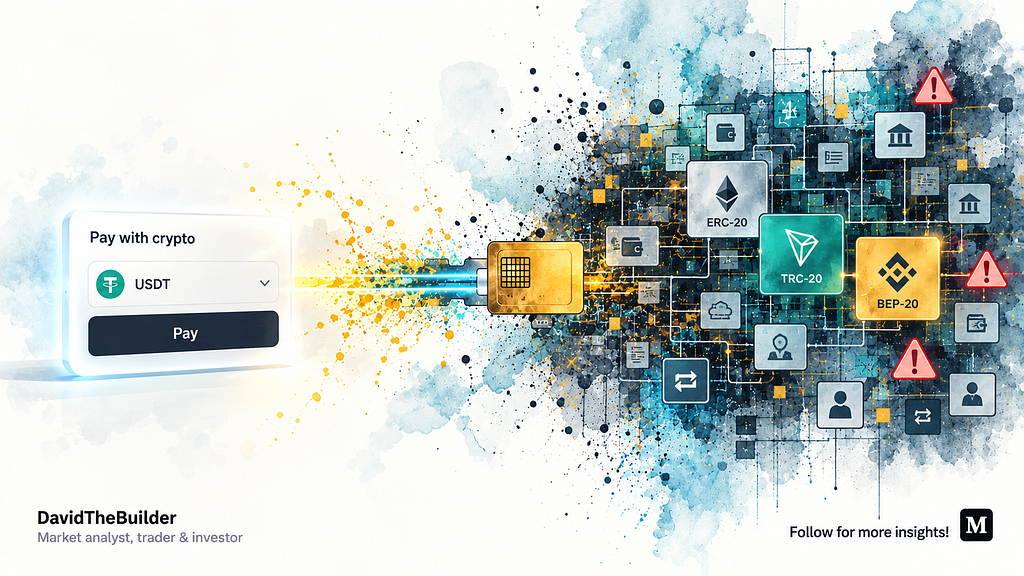
AI image created by author using ChatGPT
Crypto is no longer just for crypto apps. In a Fireblocks survey of 638 executives, 89% of banks said they’re funding digital asset infrastructure in 2026. This isn’t a random trend: interest in crypto keeps growing, and companies want to offer it right where their customers already are.
Most of them are
🔹 banks
🔹 neobanks
🔹 fintech apps with a mostly non-crypto audience
When a Customer Pays With Crypto at Checkout
Let’s take a simple example for better understanding: an online store adds crypto payments. A customer picks a pair of sneakers, goes to checkout, and chooses to pay in USDT. And here the store faces a question: should the customer see what happens behind the scenes — networks like Ethereum, TRON, or BSC — or should it stay hidden?
I think it’s a fair question, and here’s why:
➡️ When the same customer pays by card, they never think about whether the money goes through SWIFT, SEPA, or a local system — the bank takes care of it.
➡️ In crypto, networks are split up (ERC-20, TRC-20, BEP-20). If the customer picks the wrong one, the money can get stuck or lost for good. Ask a beginner to figure it out, and fewer purchases make it to the finish line.
Three Questions for the Product Team
Before deciding whether to show networks or hide them, the team building the payment flow should answer three questions:
Do our customers actually understand networks, or will the choice just confuse them?How much time and money go into fixing wrong-network payments?Can our infrastructure accept crypto on one network and send it on another?
The third question is where we can talk about Crypto-as-a-Service: instead of building this layer from scratch, companies can plug into a ready one.
AI image created by author using ChatGPT
Three Platforms Offering CaaS
▶️ WhiteBIT Crypto-as-a-Service answers the third question directly: its multi-network addresses can receive crypto on one network and withdraw it on another. That means users don’t have to guess the “right” network — the infrastructure takes care of it. The service supports 340+ assets across 80+ networks and is built for banks looking to add value and loyalty and for fintechs that want to accept, store, and move assets across borders. WhiteBIT also holds VASP authorizations in several jurisdictions.
▶️Coinbase Crypto-as-a-Service approaches the question through its USDC rails. On Coinbase’s own platform, users buying USDC with fiat don’t pick a network — that choice only appears when funds move to or from an external wallet. Its CaaS offering covers 80+ assets and gives banks custody, trading, USDC on/off ramps, staking, and tokenization on Base.
▶️Crypto. com CaaS takes a different angle. Its offering focuses on the full client journey: account management via API, spot and derivatives trading, flexible funding, staking and custody — so the network question stays mostly on the product team’s side.
The Takeaway
The blockchain is worth showing only when it truly helps the customer. The first question protects against churn, the second shows the real cost of mistakes, and the third tells whether a smooth checkout is even possible.
❗️One honest note: hiding complexity isn’t free. If a platform handles cross-network transfers, it either builds that cost into fees or covers it itself.
Disclaimer: This is not financial or investment advice. DYOR before making any decisions. Use at your own risk.
How Businesses Are Making Crypto Feel as Simple as a Card Payment (The Answer Is Below) was originally published in Coinmonks on Medium, where people are continuing the conversation by highlighting and responding to this story.