
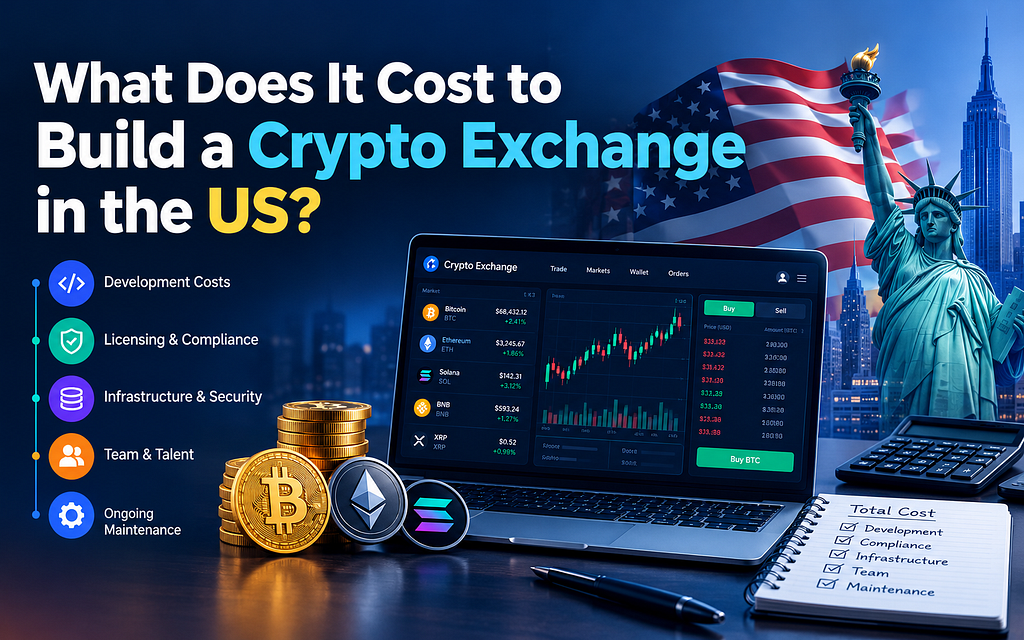
Every founder researching this ends up in the same place: ten browser tabs, ten different numbers, and no clear sense of which one actually applies to them. That’s because “how much does it cost to build a crypto exchange software” doesn’t have one answer — it has three or four, depending on how you build it and where you plan to operate.
Here’s the breakdown, with the US regulatory layer factored in, because that’s the piece most generic cost guides skip entirely.
The Short Answer First
For a US-focused launch, realistic budgets fall into three tiers:
White-label / lean build: roughly $75,000–$300,000 total, covering software, basic licensing, and initial operationsCustom mid-complexity build: roughly $150,000–$500,000+ for the software alone, before licensingFull custom build with institutional-grade infrastructure and broad state licensing: well into the millions
Multiple 2024–2026 analyses put a lean, white-label driven US build at around $75,000–$300,000 in total startup cost, while a custom, heavily engineered exchange with deep liquidity, high-frequency-trading-grade infrastructure, and national licensing runs well into the millions. The gap between those numbers is almost entirely about two things: how much of the software you build from scratch, and how many states you need to be licensed in on day one.
What the Software Actually Costs
Separate from licensing, the engineering itself breaks down roughly like this:
A basic MVP typically runs $15,000–$50,000, a mid-range platform $50,000–$150,000, and an enterprise-grade exchange $150,000–$500,000 or more. Other detailed 2026 breakdowns land in a similar range — a simple app with basic KYC and one or two supported coins costs roughly $25,000–$50,000 and takes 3–5 months, a medium build with multi-coin support and better security runs $60,000–$100,000 over 6–8 months, and a complex build with a custom trading engine and staking features costs $100,000–$200,000+ over 9 months or more.
For fully custom, code-owned platforms with deep liquidity and analytics, a centralized exchange app typically costs between roughly $390,000 and $1.34 million or more, excluding maintenance, with development taking 8–12 months.
The single biggest line item inside any of these ranges is the matching engine — the system that pairs and executes trades in real time. It’s also the piece that’s least forgiving of shortcuts, since performance problems there show up directly as lost trades and lost user trust.
The Part Generic Guides Skip: US Licensing
This is where a lot of cost estimates quietly understate reality, because software cost and regulatory cost are two completely different budgets — and in the US, the regulatory one can dwarf the software one.
Federal registration. Every US crypto exchange needs to register as a Money Services Business (MSB) with FinCEN. This step itself is free, but it’s the entry point into a much larger compliance obligation.
State-by-state money transmitter licenses. Application and filing fees for a standard state money transmitter license generally run in the $12,000–$18,000 range per state, with California around $45,000 and Texas around $35,000. Multiply that across the states you actually want to serve, and licensing alone can run into six figures before you’ve onboarded a single trader.
New York’s BitLicense — in a category of its own. If you plan to serve New York residents, this is the license that changes the entire budget conversation. The BitLicense application fee is $5,000, but obtaining one typically takes 12 to 30+ months and costs an estimated $500,000 to $2,000,000 or more in the first year once legal work, compliance infrastructure, technology, staffing, and the required surety bond are factored in. Some estimates put total compliance costs as high as $350,000 to $1.5 million just to get approved, with ongoing annual compliance costs in a similar range after that.
That’s why a meaningful number of exchanges choose to launch without New York in their initial state coverage, then add it later once the business is generating revenue that justifies the investment.
Why the Range Is So Wide — and What Actually Moves the Number
White-label vs. custom. A white-label build is faster and cheaper but locks you into a vendor’s architecture, while a custom build costs more upfront but gives you full code ownership and control. Most first-time founders start white-label specifically to prove demand before committing to a larger custom build.
How many states you launch in. Launching in five states costs a fraction of launching nationally. Many exchanges start regional and expand their licensing footprint as revenue allows.
Centralized vs. decentralized. DEX builds typically run $95,000 to $310,000 or more, roughly half the cost of a comparable centralized exchange, since they skip fiat on-ramps and custodial wallet infrastructure, though smart contract security spend increases as a trade-off.
What you’re not budgeting for: the ongoing costs. Licensing and compliance alone can consume 15–30% of the first year’s total budget, and liquidity, cloud infrastructure, and compliance upkeep often end up costing more over time than the initial build itself.
A Realistic First-Year Budget Snapshot
For a founder building a regional, compliance-conscious CEX in the US — not a national platform on day one — a defensible first-year number looks something like:
Software development (mid-range custom or heavily customized white-label): $100,000–$250,000MSB registration: effectively free, but requires legal setup timeState money transmitter licenses (5–10 states): $75,000–$150,000+ in fees alone, before legal supportCompliance infrastructure (KYC/AML tooling, legal counsel, surety bonds): $50,000–$150,000Initial liquidity provisioning and infrastructure: highly variable, often $50,000+Ongoing monthly maintenance and compliance: often 15–20% of build cost annually going forward
Add New York to that list, and the budget effectively doubles or more, given the BitLicense’s cost profile above.
The Mistake That Costs Founders the Most
The most expensive mistake isn’t overspending on software — it’s underbudgeting for compliance and discovering the real number mid-build. Banking relationships alone can take three to six months to establish, and it’s not uncommon for teams to spend months building a strong platform only to discover banks won’t work with them without the right licensing already in place. Treating legal and banking as a parallel track from day one — not something to figure out after the product is built — is what separates exchanges that launch on schedule from ones that stall for a year after the code is already done.
Final Thought
There’s no single honest answer to “what does it cost to build a crypto exchange in the US” — but there is an honest range, and it’s almost always higher than the software estimate alone suggests. Budgeting for licensing and compliance with the same seriousness as the engineering is what actually determines whether an exchange makes it to launch day, and whether it’s still operating a year after that.
What Does It Cost to Build a Crypto Exchange in the US? (The Real Numbers, Not the Sales Pitch) was originally published in Coinmonks on Medium, where people are continuing the conversation by highlighting and responding to this story.