
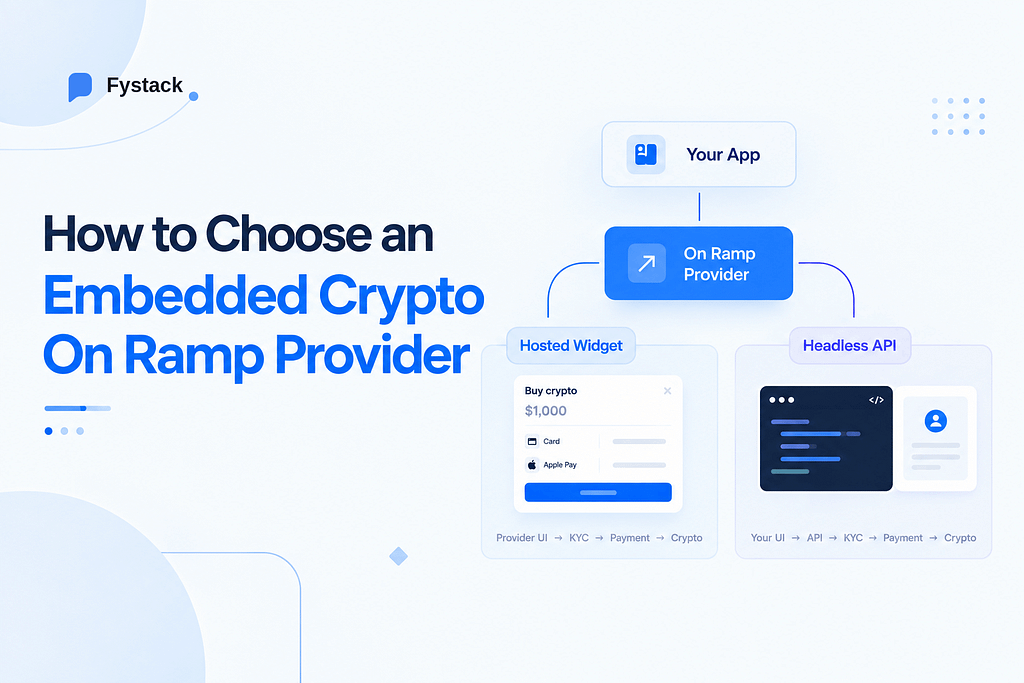
Choosing a ramp provider starts with deciding how much you want to build yourself. Some teams go live in days with a ready made checkout, while others build their own screen and connect through an API. Each option comes with different compliance and legal responsibilities, so it is worth knowing what you are taking on before you sign.
Crypto On Ramp Integration Options Explained
Ramp providers use different names for these options. MoonPay calls them a hosted widget and Headless Ramps, while Transak offers a prebuilt widget and a whitelabel API. The names differ, but the choice is simple: use the provider’s checkout, or build your own on top of their API.
Table 1. Ramp Integration Options
Both options can be delivered through a redirect, iframe, SDK, or native mobile integration. And even with a headless setup, some parts may still belong to the provider. For example, MoonPay says KYC and authentication run through its own single use frames.
Who Is Liable for On Ramp KYC
Running KYC yourself does not necessarily shift regulatory responsibility. Transak’s KYC reliance option uses identity and biometric data from your existing vendor, allowing verified users to purchase up to $20,000 without another check. Transak describes this as reducing workflow without transferring liability.
The same applies to the purchase itself. MoonPay’s European terms state that customers buy crypto directly from MoonPay, and orders are final and non refundable. If a customer wants a refund, the request goes to MoonPay rather than the platform using the ramp.
How Partner Revenue Share Is Paid
Every provider lets partners add a markup on top of its fees. The rate, payout threshold, and payment method vary by provider.
Table 2. Provider’s markup, payout, & paid in summary
Some providers also gate commissions behind volume. Ramp, for example, makes its commission program available only to partners meeting its monthly volume criteria, with quarterly payouts below its threshold. Check what the arrangement pays at your current volume.
How to Check a Ramp Provider Licence
The EU transitional period for MiCA ended on 1 July 2026. From that point, providers offering MiCA services to EU clients generally need to operate through an authorised EU entity. The ESMA register is the place to check which legal entity holds that authorisation.
Searching by brand can come up empty because the authorisation belongs to a specific legal entity. Ramp Network, for example, is listed as Ramp Swaps (Ireland) Limited, while Banxa operates through EU Internet Ventures B.V.
That legal entity matters. It tells you which regulator authorised the service and which EU markets the authorisation covers. So before signing, check the entity named in the contract against the ESMA register.
Check the legal entity behind your on ramp provider to verify its MiCA authorisation.
What to Check in a Ramp Partner Agreement
Transak publishes its partner terms, making them a useful example. Across providers, four clauses deserve a close look.
Fee changes
Transak can revise its fees at any time, so the markup sits on top of a number the provider controls.
Settlement rights
The provider may delay the first settlement, change the payout schedule, or suspend settlement when disputes are pending or anticipated.
Timing commitments
Transak states that it makes no guarantees on transaction processing times or payout schedules.
Payment asymmetry
After termination, money owed to the partner is due within 30 days, while money owed by the partner is due within 10 business days.
Card chargebacks generally stay with the provider when it acts as the payment processor. The fraud and dispute clauses should make clear what happens when they do not.
How On Ramp Crypto Delivery Works
Whichever ramp model you choose, the flow does not end at the purchase. The provider sends the crypto to an address you supply, which means your platform still needs to generate deposit addresses, detect incoming payments, and manage the funds after they arrive.
How Crypto On-Ramps Work
That is the part worth planning for early. A ramp can simplify the purchase experience, but the underlying custody and payment infrastructure still sits with the platform. Fystack provides stablecoin custody and payment infrastructure that runs inside your own environment.
Frequently Asked Questions
What is an embedded crypto on ramp?
It is a fiat to crypto purchase that runs inside another company’s app. The app supplies the user and the interface, and a licensed provider handles payment, identity checks and delivery of the crypto.
Which companies provide crypto on ramps?
The widely integrated names are MoonPay, Transak, Ramp Network, Banxa and Mercuryo, with Onramper routing across several of them.
How do crypto on ramp providers make money?
They charge a transaction fee and earn on the exchange rate applied to the purchase. Partners embedding the ramp add their own markup, which the provider collects and pays out monthly or quarterly.
How to Choose an Embedded Crypto On Ramp Provider was originally published in Coinmonks on Medium, where people are continuing the conversation by highlighting and responding to this story.