
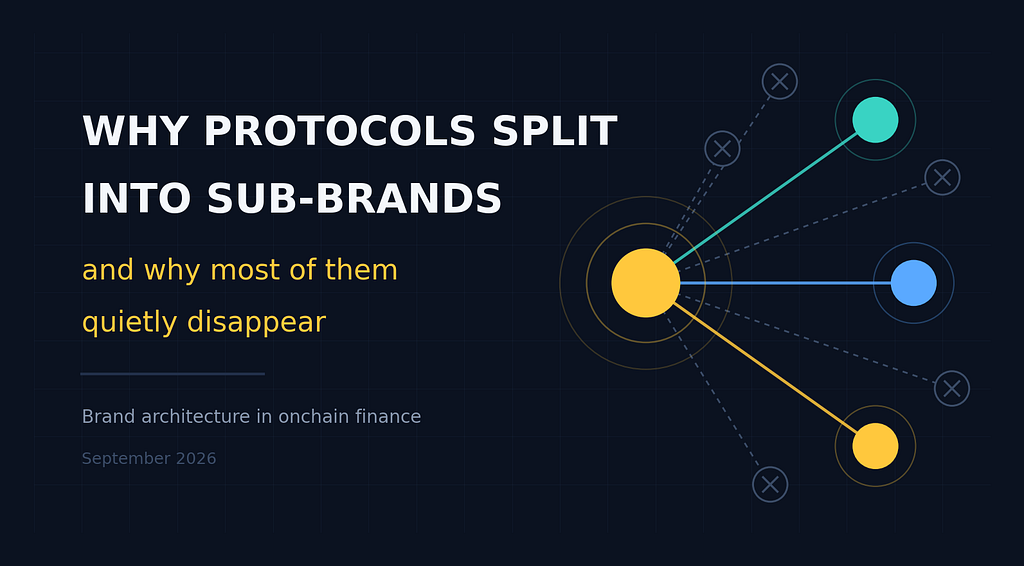
A 27-month umbrella brand, a $40M product that died at $870K, and the one structure that actually holds.
Why protocols split into sub-brands, and why most of them quietly disappear.
In November 2023, one of the largest lending teams in onchain finance announced a new parent brand called Avara.
It would sit above Aave, above Lens, above the GHO stablecoin, above a wallet called Family. The coverage was warm. The identity was sharp.
In February 2026, it was gone. Lens was handed to Mask. Family started winding down. Everything folded back under Aave Labs.
Twenty-seven months, start to finish.
Here is the short answer to why this keeps happening. Crypto sub brands fail when they are treated as a naming exercise instead of a structural one.
A new name is cheap. A new business is not. If a sub-brand has no revenue of its own, no users of its own, and no reason to exist without the parent, it is a logo with a runway.
The protocols that get this right are not better at branding. They are better at plumbing.
Twenty-seven months from launch to sunset. The full life cycle of a crypto umbrella brand.
What are crypto sub brands, and why do protocols keep creating them?
A crypto sub brand is a separately named product, chain, token or entity that sits under a parent protocol but presents itself to the market as its own thing.
Protocols create them for reasons that are genuinely good:
Different audiences. A retail savings interface and an institutional credit desk should not share a homepage.Legal separation. Independent entities carry independent obligations. That separation is structural, not cosmetic.Ownership. Strong operators want to run something. They do not want to steward a feature.Distribution. Five brands can be in five conversations at once. One brand cannot.Governance clarity. Naming who decides what ends a lot of arguments before they start.
None of that is vanity, and the market is big enough to support real specialisation.
Total stablecoin supply sat at roughly $308B in August 2026, up around 14% year over year, after a record first quarter and an all-time high above $322B in May. That is a market with room for more than one kind of company.
So the instinct to split is usually right. The execution is where it falls apart.
Why does most crypto rebranding fail within three years?
Because the sub-brand gets a name, a palette and a social handle, and never gets an income statement.
Sushi is the cleanest case study. At its 2021 peak the protocol held around $8B in TVL and ran a family of separately branded products: Kashi for lending, MISO for launches, and more besides.
By January 2023 the team had shut both down, citing design flaws, running at a loss, and a lack of resources.
Kashi peaked near $40M in TVL. It was switched off at roughly $866K. The parent had fallen to about $393M over the same stretch.
Kashi went from a $40M peak to $866K at shutdown. The parent fell from $8B to $393M over the same stretch.A sub-brand without its own revenue is not a brand. It is a tab in somebody else’s product.
Fragmentation carries a measurable cost too. Brand research cited by Coinbound suggests companies with a unified identity across channels can generate up to 33% more revenue than those with fragmented branding.
Splitting is not free. You pay a tax in attention and clarity, and you need real structure underneath to earn it back.
What are the three failure patterns behind every dead crypto sub brand?
Almost every collapse I have looked at fits one of three shapes.
1. The umbrella with nothing underneath it
A parent brand gets created to signal ambition. It has no customers, no revenue and no product of its own. It exists to hold other things.
When budgets tighten it is the first line item cut, because nobody outside the company can say what it actually does.
2. The sub-brand competing for internal attention, not market share
If a product only grows by winning a quarterly roadmap argument, it is not a business. It is a request.
Sushi’s CTO said it plainly at the time: the team had to prioritise, and the products that were not getting the care they deserved had to go.
3. The brand that cannot fail on its own
This is the quiet one. If a sub-brand blowing up would damage the parent’s balance sheet, its legal position or its users’ trust, then it was never independent. It was exposure wearing a different logo.
Branded house or house of brands: which crypto brand architecture actually scales?
Classic brand architecture offers two options, and crypto has spent five years bouncing between them.
A branded house puts everything under one name. Cheap to run, easy to explain, and it breaks the moment two products serve genuinely different audiences.
A house of brands gives every product its own name. It looks independent. Usually it is not, because one team and one budget still sit behind all of it.
Three ways to structure a crypto brand. Only one gives every sub-brand its own balance sheet.
There is a third model that onchain finance is better positioned to run than any other industry, and almost nobody names it. Call it an allocation network.
Many brands, many balance sheets, one shared set of public rules. The parent does not pick winners. It publishes the parameters and lets performance decide.
How does the Sky Agent Network make crypto sub brands work?
This is the clearest working version I have found. Sky Ecosystem is not a company. It is a label for a network. It has no legal personhood and it publishes nothing on its own.
Formal reports and positions come from Sky Frontier Foundation. Infrastructure and capital claims belong to Sky Protocol.
Votes and parameter changes belong to Sky Governance. That discipline reads as pedantic right up until you notice how many protocols cannot answer the question “who exactly said this?”
Underneath sits the Sky Agent Network: independent capital allocators that draw USDS liquidity from the protocol and deploy it into yield strategies under risk parameters set in public. Each one is a sovereign brand, not a division.
Spark runs lending markets and migrated to its own domain, spark.finance, in August 2026.Grove handles institutional credit and brought its own governance system live, with GROVE holders voting on its direction.Osero shipped its own consumer app on 18 August 2026.Obex runs as an incubator, funding new allocators into the network.
They compete with each other. Better performance means more access to liquidity.
That is the piece most brand architectures are missing: a public, mechanical rule that decides which sub-brand gets resources, instead of a slide deck and a strong opinion.
Six independently branded allocators, six separate institutional relationships, one shared protocol. Figures as of 1 September 2026.
As of 1 September 2026, Sky Agents held roughly $1.23B with Janus Henderson, $618M with BlackRock, $304M with Galaxy, $240M in PayPal USD, $220M with Anchorage and $103M with Securitize.
Six separate counterparty relationships, opened by six separately branded allocators, feeding one shared system.
Where do the Sky Savings Rate, sUSDS and USDS fit in this structure?
This is where the architecture pays for itself.
USDS is the shared base layer. It is the unit of account and the credit facility the agents draw on, backed by a surplus of collateral that anyone can verify onchain.
Agent activity contributes to Gross Protocol Revenue. A portion of that revenue funds the Sky Savings Rate, a variable rate calibrated by Sky Governance rather than set by any single company.
sUSDS is how a holder accesses that rate. Supply USDS, receive sUSDS, and the position accrues programmatically, with no lockups and no exit fees.
So the sub-brands are not marketing surface. They are the engine. Their independence is exactly what makes the shared product diversified instead of concentrated in one strategy run by one team.
The Q2 2026 figures reported by Sky Frontier Foundation: Protocol Collateral up 45.5% year over year to $12.32B, sUSDS up 149% to $5.52B, $107.35M in Gross Protocol Revenue, and a fifth consecutive quarter of Net Protocol Surplus at $33.29M.
Sky Protocol in Q2 2026, as reported by Sky Frontier Foundation. Live figures sit on financial.skyeco.com.
Rates and balances move constantly, so treat any printed number as a snapshot. Current state always sits on the public dashboards.
That is the whole point of the structure. Nobody should have to take a brand’s word for it.
How do you know if your next crypto sub brand will survive?
Run it through five questions before anyone designs a logo.
Five yeses and you have a business. Four or fewer and you have a logo.
Five yeses and you have a business. Four or fewer and you have a naming project with a burn rate.
The protocols that make it through the next cycle will not be the ones with the most brands. They will be the ones where every brand can say, in a single sentence, what it earns and who it serves.
Most protocols do not have a branding problem. They have an accountability problem wearing a branding costume.
Which crypto sub brand do you think disappears next, and which one has genuinely earned its independence? Tell me in the comments. I read all of them.
Why Protocols Split Into Sub-Brands, and Why Most Crypto Sub Brands Fail was originally published in Coinmonks on Medium, where people are continuing the conversation by highlighting and responding to this story.