
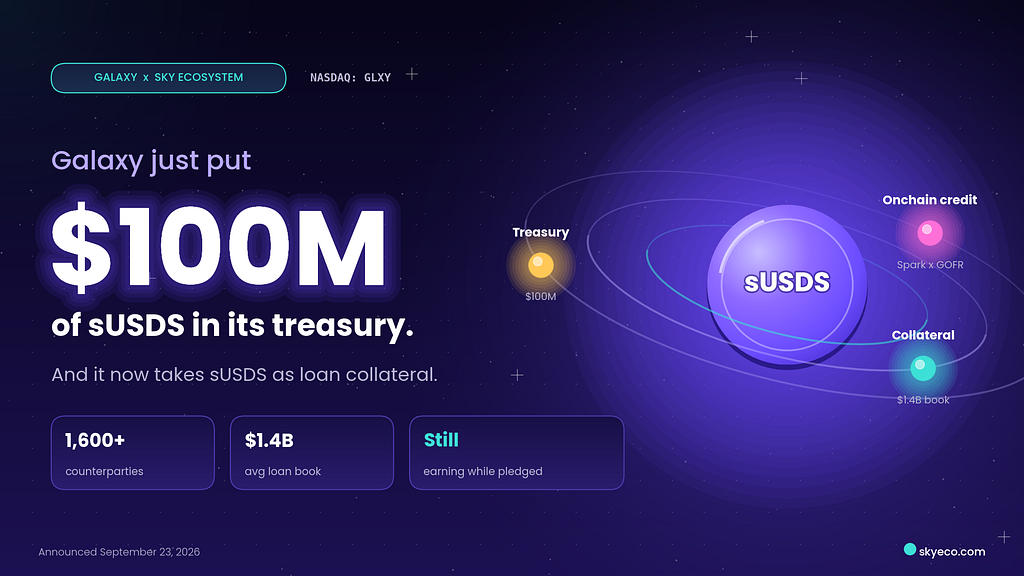
A Nasdaq-listed firm now holds sUSDS on its balance sheet and accepts it as loan collateral. Here’s what the Galaxy x Sky Ecosystem deal means for onchain capital.
Galaxy adds $100M of sUSDS to its corporate treasury and opens its lending desk to sUSDS collateral.
Corporate treasuries are boring by design.
Cash sits. Reports get filed. Nobody gets fired for playing it safe.
So when a Nasdaq-listed company moves $100 million into a yield-bearing stablecoin, people notice.
On September 23, 2026, Galaxy Digital (Nasdaq: GLXY) did exactly that. It added $100M of sUSDS to its corporate treasury.
Then it went a step further and approved sUSDS as eligible collateral across its institutional trading business.
For years, the running joke in crypto was that institutions were always “coming soon.” This one didn’t just show up. It brought its balance sheet.
That collateral part is the one I keep coming back to. Let me show you why.
The Galaxy sUSDS Treasury Move, in 30 Seconds
Here’s the short version:
$100M of sUSDS added to Galaxy’s corporate treasury, funded from its own balance sheet, as The Block reported.sUSDS approved as collateral across Galaxy’s institutional trading business, which carries a $1.4B average loan book.1,600+ trading counterparties are served by the institutional platform where sUSDS is now eligible.SKY purchased. Galaxy also bought an undisclosed amount of SKY.
For scale, Galaxy reported $2.5B in cash and stablecoin holdings as of June 30, 2026, per its Q2 results. The $100M allocation equals roughly 4% of that. Big enough to matter. Measured enough to look deliberate.
It also makes Galaxy one of the first public companies to hold sUSDS on its balance sheet.
What Is sUSDS, and Why Would a Public Company Hold It?
Quick primer, because not everyone lives in DeFi.
USDS is Sky Ecosystem’s fully backed unit of account, redeemable 1:1 through the Peg Stability Module.sUSDS is what you receive when you supply USDS to the Sky Savings Rate. It’s the world’s largest yield-generating stablecoin.The Sky Savings Rate is a variable rate set by Sky Governance and paid from Sky Protocol revenue.
No lockups. No maturity dates. The position stays liquid. You can see how sUSDS works on skyeco.com.
So why did Galaxy add sUSDS to its treasury? Idle cash earns nothing. sUSDS gives treasury capital access to a governance-set rate while staying liquid and onchain.
For a firm already running trading, lending and onchain financing, that isn’t a stretch. It’s a fit.
Collateral That Keeps Earning: The Detail Most People Will Miss
This is the part that deserves more attention.
Clients who post sUSDS against a Galaxy loan keep accruing the Sky Savings Rate on the full position, for as long as the loan runs.
Think about the usual trade-off:
Pledge capital as collateral, and it usually sits there doing nothing.Keep it earning, and you can’t use it to back a loan.
Picture a fund holding $50M of sUSDS that needs a short-term loan to seize a trade. Normally it would have to choose between the rate and the loan.
At Galaxy, it can post the sUSDS, take the loan and keep earning on the full $50M the whole time.
With sUSDS as eligible collateral, a client gets both. The collateral backs the loan. The same position keeps earning. That’s Sky Savings Rate collateral in plain terms.
Your collateral no longer has to take the day off while it backs a loan.
For institutions running large books, that’s capital efficiency they can actually measure. It’s also why sUSDS institutional collateral could become a phrase you hear a lot more.
At Galaxy, sUSDS posted as collateral keeps accruing the Sky Savings Rate on the full position.
$100M Is Just the Latest Chapter in the Galaxy x Sky Ecosystem Story
This didn’t come out of nowhere. The Galaxy Digital and Sky Ecosystem relationship has been building for months.
Galaxy CLO 2025–1. Grove, a Prime Agent in the Sky Agent Network, anchored Galaxy’s tokenized CLO with a $50M position.$500M warehouse facility. In July 2026, Grove and Galaxy announced a $500M warehouse lending facility. Grove commits USDS. Galaxy originates institutional loans secured by BTC and ETH, held by qualified custodians Anchorage Digital and BitGo.Spark and GOFR. Galaxy has since borrowed on Spark, a second Prime Agent, to support the Galaxy Onchain Financing Rate, or GOFR. Galaxy said GOFR generated about $300M in loan originations soon after its prelaunch.Treasury and collateral. Now sUSDS sits on Galaxy’s balance sheet and inside its lending business.
My favorite detail? Through the Grove facility, a $320M loan can move from underwriting to funding over a weekend. Anyone who has waited on a credit committee knows how wild that sounds.
Notice the pattern. First a fund position. Then funding for new loans. Now the treasury itself. Each step moved Sky Protocol closer to Galaxy’s core business.
Each step of the Galaxy and Sky Ecosystem relationship moved closer to Galaxy’s core: its treasury.
The Numbers Behind Galaxy’s sUSDS Bet
Institutions don’t allocate on vibes. Here’s what Sky Protocol reported for Q2 2026:
sUSDS supply hit $5.52B, up 149% from $2.22B a year earlier.Gross protocol revenue reached $107.35M, up 10.5% year over year.Net protocol surplus was $33.29M, the fifth consecutive quarter of surplus.Protocol collateral grew 45.5% to $12.32B.Cumulative Sky Savings Rate distributions crossed $250M.
The capital network Galaxy now connects to is big, too. Sky Protocol entered Q3 2026 with $5.41B supplied through independent allocators and into institutional tokenized funds, including anchor positions in BlackRock’s BUIDL and Janus Henderson’s JTRSY.
Sky Protocol, heir to MakerDAO, has been running stablecoin infrastructure since 2017.
Two recent trust signals stand out. In 2025, S&P Global gave Sky Protocol the first credit rating ever assigned to a DeFi protocol.
And in April 2026, when a roughly $292M bridge exploit rattled DeFi lending markets, Sky Protocol kept running and took no losses.
Want the mechanics? The Sky Protocol page breaks them down.
sUSDS supply grew 149% year over year to $5.52B, alongside five straight quarters of net surplus.
Why Corporate Treasury Stablecoin Allocations Are Picking Up Now
Timing matters here.
Corporate treasuries, funds and allocators have approached onchain savings products cautiously. Most wait for a regulated counterparty to go first and set a precedent.
Galaxy just went first.
The wider market is moving the same way:
Onchain real-world assets, excluding stablecoins, passed $33B in July 2026, per rwa.xyz.That’s up from about $6.6B in March 2025.Tokenized savings and real-world assets now rank among the fastest-growing sources of institutional collateral.The CFO question is shifting from “why onchain?” to “why not yet?”
The Galaxy treasury allocation to sUSDS shows what that shift looks like in practice. A firm earns a savings rate on capital while using that same capital to back loans and trades, entirely onchain.
Tokenized real-world assets onchain grew about 5x in 16 months, right before Galaxy’s $100M sUSDS move.
What to Watch After the Galaxy sUSDS Treasury Deal
A single allocation is a headline. A pattern is a trend. Here’s what I’ll be tracking next:
Copycats. Does another listed company follow with its own corporate treasury stablecoin allocation to sUSDS?Collateral usage. How much of Galaxy’s institutional trading collateral shifts toward sUSDS over the next few quarters?Faster onboarding. Sky Frontier Foundation’s Laniakea framework aims to onboard institutional partners in weeks, not months.The idle pile. More than $300B in stablecoins still sits idle. That’s the real prize.
If even a slice of that capital follows Galaxy’s lead, this announcement will look early, not lucky.
Quick Answers: Galaxy sUSDS Treasury FAQ
Q. Why did Galaxy add sUSDS to its treasury?
A. To put treasury capital to work through the Sky Savings Rate while keeping it liquid, and to deepen an onchain credit relationship that already spans Grove and Spark.
Q. What is sUSDS?
A. sUSDS is the yield-generating stablecoin you receive when you supply USDS to the Sky Savings Rate. It’s the largest of its kind.
Q. How much sUSDS does Galaxy hold?
A. Galaxy added $100M of sUSDS to its corporate treasury, announced on September 23, 2026.
Q. Is sUSDS accepted as collateral at Galaxy?
A. Yes. sUSDS is eligible collateral across Galaxy’s institutional trading business, and it keeps accruing the Sky Savings Rate while the loan is outstanding.
Q. Which companies hold sUSDS in their treasury?
A. Galaxy is one of the first public companies to hold sUSDS on its balance sheet.
Q. What does the Galaxy and Sky Ecosystem partnership include?
A. A $100M sUSDS treasury allocation, sUSDS collateral approval, a SKY purchase, Grove’s $500M warehouse facility and Galaxy’s borrowing on Spark to support GOFR.
Your Turn
I’m curious where you land on this.
Is Galaxy’s $100M sUSDS move the start of a real corporate treasury trend? Or will most CFOs keep watching from the sidelines?
And which public company makes the next move? Drop your take in the comments. I read every one.
Explore Sky Ecosystem and Galaxy to go deeper.
Disclaimer: Galaxy also holds a financial interest in SKY and may regularly engage in buying and selling SKY, including hedging transactions, for its own proprietary accounts and on behalf of its counterparties. Digital asset markets carry risk and no market outcome is assured. Nothing here is investment advice.
Galaxy Just Put $100M of sUSDS in Its Treasury. Here’s Why was originally published in Coinmonks on Medium, where people are continuing the conversation by highlighting and responding to this story.