
Deposit Tokens vs Payment Stablecoins vs Savings Tokens: The Three Onchain Dollars People Keep Mixing Up
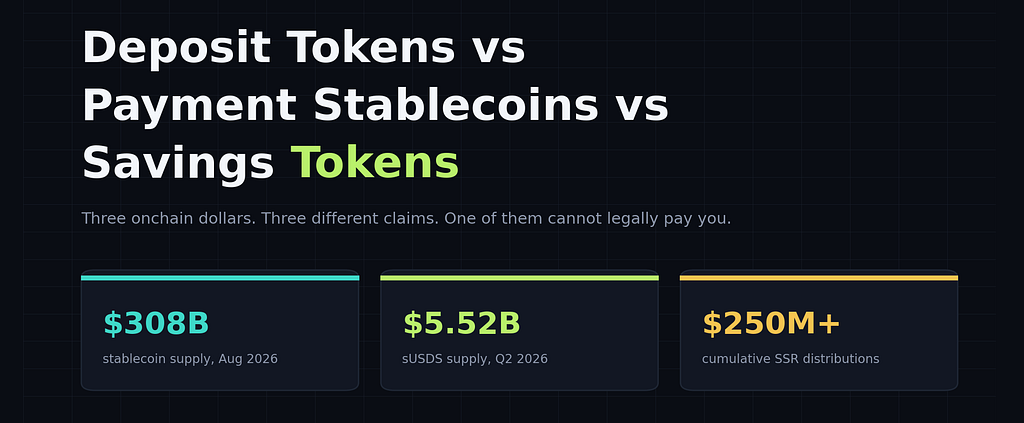
Three onchain dollars. Three different claims. One of them cannot legally pay you, and the third one nobody has named properly.
Three onchain dollars, three different claims. The category you hold decides who can pay you.
Three dollars are sitting onchain right now. In a wallet they look identical. Same dollar sign, same balance, same clean $1.00 on the screen.
One is a claim on a specific bank. One is a claim on a reserve pool. One is a claim on a protocol balance sheet you can audit at 2am without asking anyone.
Those differences are not cosmetic. They decide who is allowed to hold the thing, who is allowed to pay you for holding it, and what you can actually check when something goes sideways.
Most explainers stop at “stablecoins vs tokenized deposits.” That framing is a year out of date. In 2026 there are three categories, not two. And the third one is the one almost nobody has named properly.
It matters more than it sounds. Get the category wrong and you end up holding an instrument built for a job you are not doing.
Let me draw the lines.
What is a deposit token, in plain English?
Answer first. A deposit token is a commercial bank deposit issued as a transferable token on a blockchain. The money never leaves the issuing bank’s books. You hold a claim on that one bank.
That sentence carries the entire category.
Issuer: a chartered bank, not a crypto companyBacking: the bank’s own balance sheet, inside existing capital rulesAccess: permissioned, limited to counterparties the bank already vettedSettlement: onchain, around the clock, no weekend gapInsurance: the FDIC’s April 2026 Federal Register notice states the definition of a deposit includes deposits in tokenized form
The reference case is JPMorgan’s JPMD, rolled out to institutional clients on Base in November 2025 through its Kinexys platform. Kinexys moves well over $7 billion a day.
One detail people miss: the permissioned ring is the product. It is not a limitation the bank is apologising for. It is the reason the deposit stays a deposit.
Can an ordinary person hold one? Not today. Every live deposit token is restricted to KYC-verified institutional clients moving real size between counterparties the bank has already checked.
If you are reading this in a personal wallet, this category is not currently for you.
Deposit token vs tokenized deposit: is there a difference?
Yes, and almost every article blends them.
A tokenized deposit is a digital twin of an existing account balance, usually living on a permissioned bank ledger.A deposit token is built to be native to public blockchain infrastructure.
The FDIC drew that line explicitly in April 2026, noting that deposit tokens are more digitally native, without a credit sitting in a traditional account structure underneath.
Ledger Insights has tracked the same split across the G-SIBs shipping this year.
Small distinction. Big consequences for where the token can travel.
Compared by mechanism rather than by rate: whose balance sheet, who can hold it, and who pays the holder.
Why can’t a payment stablecoin pay you anything?
Because a statute says it cannot.
The GENIUS Act, Section 4(a)(11), codified at 12 U.S.C. 5924(a)(11), bars any permitted payment stablecoin issuer from paying a holder interest or yield solely for holding the token. Signed 18 July 2025. Senate 68 to 30, House 308 to 122.
So a payment stablecoin is, by design, a settlement instrument. The federal framework is built around exactly that:
Reserves held one to one in cash and short-term government debtPermissionless. Anyone with a wallet can receive itEngineered to move, not to sitZero return to the holder from the issuerCongress made a deliberate choice there. Payment instrument, not savings product.
Which left an enormous gap. Stablecoin supply reached roughly $308 billion in August 2026, and the overwhelming majority of that capital earns its holder nothing between transactions.
In traditional markets, yield-generating instruments make up somewhere between 55% and 65% of the total. Onchain the equivalent figure has been sitting closer to 8% to 11%.
A gap that size does not stay empty.
So what is a savings token, and where does sUSDS fit?
A savings token is a token whose only job is to represent a position that accrues, rather than a dollar that sits still.
sUSDS is the scale example. You supply USDS and hold sUSDS. The token accrues in value through the Sky Savings Rate, programmatically, with no lockup and no manual claiming. Convert back whenever you want.
Three categories, three completely different answers to the same question about where a return comes from:
Deposit token: from the bank’s deposit economics, if the bank chooses to pass it onPayment stablecoin: nothing to the holder, by statuteSavings token: from what the underlying capital actually earns
The third one is the only design where the source of the return is a thing you can go and inspect line by line.
A few structural properties are worth naming, because they are what make a savings token usable rather than just clever:
Transferable. It is a token, not a locked account position. It moves.Composable. It plugs into other onchain systems as collateral or liquidity.Multichain. USDS and sUSDS reach beyond Ethereum Mainnet to networks including Solana, Base and Arbitrum.Redeemable on demand. No notice period, no exit queue, no cut-off at 3pm.
Where does the Sky Savings Rate actually come from?
sUSDS supply grew 149% year over year to $5.52B at the end of Q2 2026, with cumulative Sky Savings Rate distributions past $250M.
This is the question that separates a real savings token from a yield wrapper with good branding.
The Sky Savings Rate is funded from revenue that Sky Protocol accrues as independent capital allocators in the Sky Agent Network draw USDS liquidity and deploy it under risk parameters set in public by Sky Governance.
The receipts, from the Q2 2026 Quarterly Report published by Sky Frontier Foundation:
$107.35M in Gross Protocol Revenue, a second consecutive quarter above $100M$33.29M in Net Protocol Surplus, a fifth consecutive quarter in surplussUSDS at $5.52B, up 149% year over year from $2.22BCumulative Sky Savings Rate distributions to holders crossed $250M on 29 June 2026
At the time of writing, Protocol Collateral stands at $14.15B against $11.48B in stablecoin supply.
Here is the part I care about more than any of those numbers. You do not have to believe them. Every figure is checkable on the public dashboards, continuously, by anyone.
That is a different relationship with a balance sheet than waiting for a quarterly PDF.
A savings token is only as credible as the engine behind it. This is the engine, quarter by quarter.
Which onchain dollar should you actually hold?
Depends entirely on the job. They are not substitutes.
Moving size between vetted institutional counterparties? Deposit token. The permissioned ring is exactly what you want.Paying someone anywhere, with no onboarding? Payment stablecoin. Permissionless reach is the whole feature.Holding a dollar balance that should not sit idle? Savings token.Need a liquid base unit inside an onchain system? That is what USDS is for, convertible one to one through the Peg Stability Module with no fees and no slippage.
Nobody is picking one of three. Most serious operators end up holding more than one, for different reasons, on different days.
Pick by the job, not by the label. Most operators end up holding more than one of these.
What happens in 2027, and why the banks are suddenly in a hurry
On 5 June 2026, The Clearing House unveiled a bank-led network to clear and settle tokenized deposits around the clock.
JPMorgan, Bank of America, Citigroup and Wells Fargo are behind it. Target launch: first half of 2027.
Read the motive honestly. Every dollar that moves into a token outside the banking system is a dollar that bank cannot lend against.
History is unkind here. The bank-consortium graveyard is well populated: we.trade went insolvent in 2022, Marco Polo in February 2023, Contour shut down in late 2023 while processing a few dozen transactions a month.
And demand is not obviously screaming. Bank of America’s own payments chief has said clients are not beating down the door for tokenized deposits.
Momentum is real elsewhere, though. HSBC runs a tokenized deposit service across Hong Kong and Singapore.
The Texas Bankers Association is giving roughly 600 member banks structured access to the technology.
Citi and DBS settled a tokenized dollar payment between Singapore and New York in minutes on 5 September 2026.
Three categories. Three sets of builders. All of them shipping at once.
From one bank shipping alone to four banks building a shared rail, in under two years.
The one question worth asking any onchain dollar
Forget the label on the tin. Ask this instead.
Whose balance sheet is this, and how often can I look at it?Deposit token: a bank’s. Audited annually, disclosed quarterly.Payment stablecoin: an issuer’s reserve pool. Attested monthly.Savings token on an open protocol: verifiable continuously, by anyone, without permission.
Transparency cadence is the real dividing line, and it is the one almost nobody puts in the comparison.
That is the argument Sky Ecosystem has been making since well before the taxonomy caught up.
Now the part I actually want to argue about.
I think “deposit token” is going to lose the naming war to “tokenized deposit,” and I think that is a mistake, because the FDIC already treats them as two different objects.
Once a regulator distinguishes two things and the market keeps using one word for both, somebody eventually gets a nasty surprise.
Tell me I’m wrong. Which of the three are you actually holding, and why that one?
Deposit Tokens vs Payment Stablecoins vs Savings Tokens: The Three Onchain Dollars People Keep… was originally published in Coinmonks on Medium, where people are continuing the conversation by highlighting and responding to this story.