
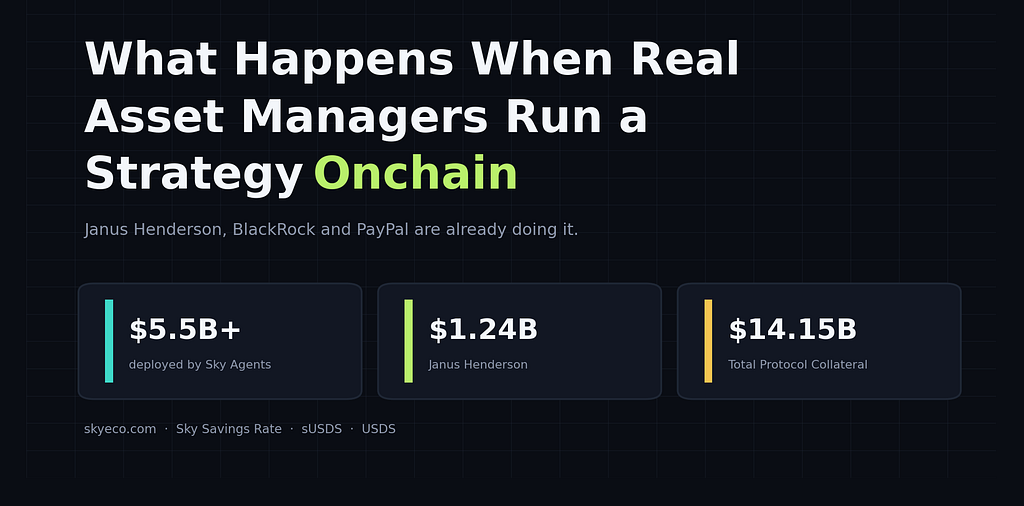
Janus Henderson, BlackRock and PayPal are already doing it. Here is what the ledger actually shows.
Asset managers onchain is no longer a pitch deck line. Over $5.5B is already deployed through Sky Protocol into strategies run by global asset managers.
A $1 billion ticket went into a AAA CLO strategy. That part is ordinary. Collateralized loan obligations absorb billion-dollar tickets most weeks of the year.
Here is the part that was not ordinary.
There was no fund administrator emailing a monthly NAV. No T+2 settlement. No quarterly PDF with a watermark on it.
The strategy sat natively on a public blockchain. And it was run by the same portfolio team behind Janus Henderson’s $21 billion AAA CLO ETF.
That single allocation is the cleanest answer to a question I keep getting asked: what actually happens when asset managers go onchain?
Short version. The strategy does not change. The plumbing does. And the reporting turns into something you can check yourself at 2am without asking anyone’s permission.
Let me show you the receipts.
What does “asset managers onchain” actually mean?
Answer first. It means a regulated asset manager issues or operates a real strategy as a token on a public blockchain, so subscription, settlement, and reporting run through smart contracts instead of a back office.
Three things change. The strategy itself is not one of them.
Issuance. The fund is native to the chain. Not a wrapper around an offchain unit that settles somewhere else.Settlement. Redemptions clear in minutes, around the clock, on weekends too.Transparency. Positions, flows and collateral are public by default. Anyone can audit them.
That is the whole shift. Same credit analysts. Same risk committee. Different rails.
Picture the old version. A subscription form. A wire cut-off at 3pm. A fund administrator reconciling positions in a spreadsheet, then publishing a number you have to believe.
The onchain version replaces belief with a block explorer.
The $1B CLO that made onchain asset management real
Grove, an institutional credit infrastructure protocol, came out of stealth with a $1 billion allocation from Sky Ecosystem into the Janus Henderson Anemoy AAA CLO Strategy, built with Centrifuge.
It was the first CLO strategy available onchain. Not a pilot. Not a sandbox. A billion dollars of working capital.
Janus Henderson and Anemoy built it to sit natively on the blockchain, with no wrapped tokens and no intermediaries in the middle.
One detail I like from the launch materials: Janus Henderson’s AAA CLO strategy had already attracted the most inflows of any actively managed fixed income ETF the prior year.
This was not a struggling product looking for a gimmick. It was a winner testing better infrastructure.
The follow-through matters more than the launch. Grove later moved to deploy up to $250M on Avalanche into JAAA and the Janus Henderson Anemoy Treasury Fund.
That is what real adoption looks like. Boring, incremental, audited.
Six institutional counterparties, one public ledger. Every one of these positions can be checked in real time on the Sky Ecosystem financial dashboard.
Where institutional strategies actually sit inside Sky Protocol
This is the part most coverage skips. Everyone reports the announcement. Almost nobody reports the balance.
As of the June 2026 update, over $5.5B had been deployed through Sky Protocol by the Sky Agent Network into instruments and platforms operated by names you already know:
Janus Henderson: $1.24BBlackRock / BUIDL: $713MAnchorage: $260MPayPal: $236MSecuritize: $102MGalaxy: $27M
Six institutional counterparties. One public ledger. Every position checkable in real time on the Sky Ecosystem financial dashboard.
Sky Agents are independent businesses. They borrow USDS from Sky Protocol under risk parameters set in public by governance, then compete on risk-adjusted performance. Spark runs the largest book. Grove focuses on institutional tokenized credit.
Nobody hands anyone a mandate. Agents earn access by performing.
The backing is spread out on purpose. Every USDS in circulation is overcollateralized, with Protocol Collateral split roughly across the Peg Stability Module, Sky Agent vaults, and overcollateralized crypto vaults, plus Sky Reserves sitting behind all of it as a buffer.
The onchain capital allocation loop. Stablecoin capital becomes USDS, Sky Agents deploy it into institutional strategies, and the returns fund the Sky Savings Rate accessed through sUSDS.
Why the Sky Savings Rate is the number that ties it all together
Here is where it gets interesting for people who are not allocating $500M.
All that institutional strategy work produces revenue. A portion of that revenue funds the Sky Savings Rate, the rate accessible through sUSDS.
The mechanics are simple:
You supply USDS, the foundational stablecoin of Sky EcosystemYou receive sUSDS, which accrues value programmaticallyNo lockups, no exit fees, no active managementYou keep non-custodial control the entire time
The rate is variable and set by governance. At the time of writing, skyeco.com shows the Sky Savings Rate at 3.52% APY, against $14.15B in Total Protocol Collateral and $11.48B in stablecoin supply.
Now the receipts on the payout side. In Q2 2026, $53.91M went to sUSDS holders through the Sky Savings Rate. That was roughly 80% of the quarter’s protocol expenses. Cumulative distributions have crossed $250M.
sUSDS closed Q2 2026 at $5.52B in supply, up 149% year over year, which keeps it the largest rate-bearing stablecoin by supply.
sUSDS supply grew 149% year over year to $5.52B in Q2 2026, with $53.91M paid out through the Sky Savings Rate in the quarter alone.Janus Henderson runs credit. Sky Agents allocate. The Sky Savings Rate is what comes out the other end.
Importantly, sUSDS holders are not exposed to any single agent, strategy or counterparty. That is the structural point of running a network instead of a single desk.
The rate is also becoming a reference point other products build on. PT-sUSDS, the fixed yield position token, can now be posted as collateral on Morpho to borrow USDS.
A Pendle fixed-rate market for sUSDS pulled $44.1M in TVL in its first month.
Two consecutive quarters above $100M in Gross Protocol Revenue, and a fifth consecutive quarter in Net Protocol Surplus. This is what onchain capital allocation looks like on an income statement.
The 2026 numbers behind onchain capital allocation
Sky Frontier Foundation published the Q2 2026 results on 23 July. The headline figures:
Gross Protocol Revenue: $107.35M, up 10.5% year over year, the second consecutive quarter above $100MNet Protocol Surplus: $33.29M, the fifth consecutive quarter in surplusProtocol Collateral: $12.32B at quarter end, up 45.5% year over yearFirst half of 2026: $231.66M in Gross Protocol Revenue at a 43.5% net margin
Q1 2026 was the record quarter, at $123.79M in Gross Protocol Revenue.
There is also a framework behind the counterparty growth. In April 2026, Sky Frontier Foundation introduced Laniakea, a standardized deployment stack designed to onboard institutional partners in weeks instead of months, aimed at the more than $300B in stablecoin capital currently earning nothing.
Tokenized real-world assets nearly tripled in a year to around $33.5B. The concentration underneath that number is the part worth arguing about.
Why 2026 became the year asset managers stopped running pilots
The wider market moved at the same time, and it moved fast.
Tokenized real-world assets hit roughly $33.5B in liquid onchain value by July 2026, nearly tripling from around $11.8B a year earlier. BlackRock’s BUIDL alone sits near $2.5B.
Three specific things pushed traditional managers off the sidelines:
Regulation forced a choice. The GENIUS Act’s no-yield rule for payment stablecoins split payment instruments from yield-bearing ones at the regulatory level. Fidelity and State Street both launched stablecoin reserve money market funds in June 2026 in response.The old guard showed up. New York Life, founded more than 180 years ago, launched one of the first onchain high yield bond offerings with Centrifuge in June 2026.Distribution got easy. Binance completed its DAI to USDS upgrade with automatic one-to-one conversion, and sUSDS became directly accessible in Binance Wallet.
When a 180-year-old insurer and a stablecoin protocol are using the same tokenization partner, the category has stopped being experimental.
The uncomfortable part nobody puts in the deck
I am not going to pretend this is finished.
Concentration is real. Roughly 80% of tokenized RWA value sits in Treasury and cash-equivalent products. The diversification the headline number implies is not there yet.
Sky Protocol has its own honest lines too. Protocol Collateral fell month over month from $12.32B in June to $10.98B in July, with Prime Agent Vaults accounting for $1.21B of that decline. Sky Reserves closed Q2 at $82.40M against a $150M target.
Those numbers are public because the system publishes them. That is the actual argument. Not that onchain allocation never dips. That you can see it when it does.
Seven years of team operations. Solvent through Black Thursday. Zero exposure to UST or FTX, because governance never approved either as collateral. Zero exploits on the core protocol.
What I would watch from here
Three questions I do not have clean answers to yet:
Does tokenized credit break out of the Treasury concentration trap, or does it stay a rounding error?Do more managers issue natively, or keep wrapping offchain funds?Does the Sky Savings Rate hold as a reference rate as more counterparties join?
If you want the full picture of how the pieces connect, Sky Ecosystem publishes the primer at What Is Sky Ecosystem, and every figure above can be verified on the dashboards.
Now the part I actually want to know.
If you run treasury, allocate capital, or just hold stablecoins: would you rather have a rate you can audit line by line, or a rate from an institution you have to take on trust?
I think the answer is changing. Tell me if I am wrong in the comments.
What Happens When Real Asset Managers Run a Strategy Onchain was originally published in Coinmonks on Medium, where people are continuing the conversation by highlighting and responding to this story.