
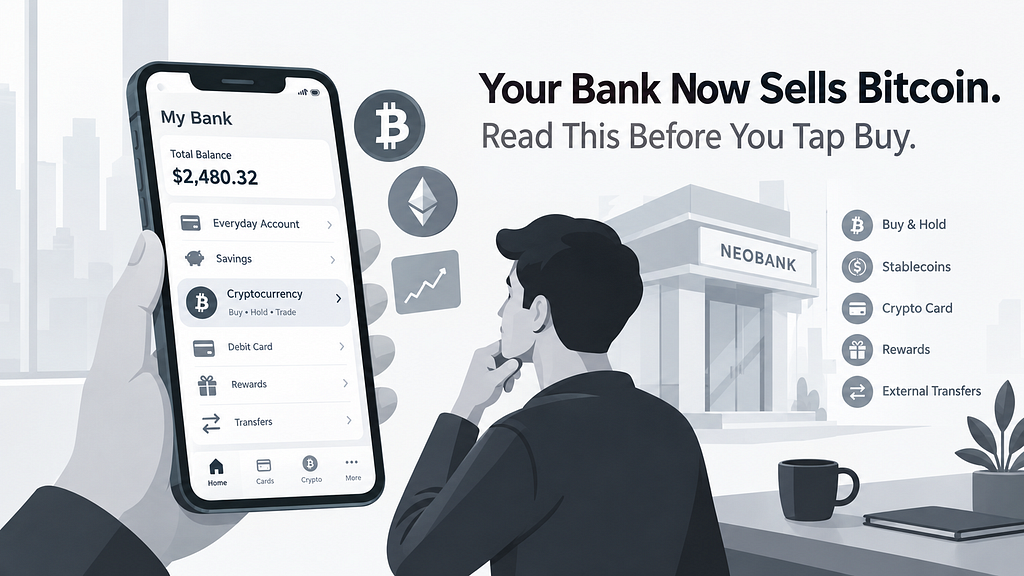
Neobanks keep adding crypto tabs to everyday money apps. The convenience is real, and so are the catches.
Here’s the general picture. Apps like Revolut and Cash App have let people buy crypto next to their everyday balance for a while, and more digital banks are following. You open the app to check whether your salary landed, and there’s a tab offering Bitcoin. Two taps, done.
ChatGPT Generated Imag
That ease is the whole product. It’s also where people get into trouble, because ease makes a decision feel smaller than it is.
What you’ll typically find inside
Every app does it a little differently, but the menu tends to look like this:
Buying and holding big names such as Bitcoin and EtherStablecoin balances pegged to a currency like the dollarDebit cards that convert crypto to cash at the tillRewards paid in crypto rather than pointsTransfers to outside wallets, often with limits
Notice what’s not there: hundreds of tiny tokens. Banks stock a short list, mostly because every extra coin is extra regulatory headache.
Who actually holds the coins
Most neobanks don’t run crypto systems themselves. You tap Buy, the order goes to a licensed partner, and that partner buys the asset and keeps it safe. Your app then shows a number with your name on it.
That number is a claim, though, not necessarily a coin sitting in a wallet you control. In many apps you never see the private keys. For a small experiment that’s fine. For anything larger, you’re relying on two companies instead of one, and you should know what happens if either goes under. The custody section of the terms answers that. It’s dull reading, and it’s the most useful page in the app.
Why banks bother
Not out of generosity. A few practical reasons:
Customers who wanted crypto used to leave for exchanges, taking their deposits along.Trading spreads and card fees bring in money.Clearer rules in some regions, like Europe’s MiCA framework, make the product easier to launch.Ready-made custody and trading providers mean nobody has to build from scratch.
None of this makes the feature bad. It just means the bank’s goals and yours overlap without matching.
What’s genuinely good about it
Quite a lot, for the right person.
One login and one support team instead of threeSmall starting amounts, which suits beginnersStablecoin transfers that can be faster and cheaper than a bank wire, depending on the routeIdentity checks done once, at signup
Freelancers paid by overseas clients probably get the most out of that third point. Waiting days for a wire and losing a chunk to fees is a real irritation, and this is one of the few crypto use cases that solves an actual problem.
What the marketing leaves out
Prices still swing. A tidy screen won’t soften a 20% drop, and deposit insurance schemes generally don’t cover crypto.“Zero commission” isn’t zero cost. The gap between the buy and sell price can cost more than a visible fee.Exits can be narrow. Some apps limit or charge for withdrawals to outside wallets.Tax still applies. Selling, swapping and sometimes spending can count as taxable events, depending on where you live.
The one people miss most: a licence tells you the company is supervised. It tells you nothing about whether the asset will be worth more next year. Those are separate questions, and apps are happy to let you blur them.
The paperwork behind the curtain
Because neobanks hold financial licences, crypto features come with the usual checks. KYC confirms who you are. AML monitoring watches for suspicious activity. And under the so-called Travel Rule, some transfers must carry sender and recipient details.
It’s annoying, sure. It’s also why these apps can sit inside the regulated system at all. Rules differ a lot from country to country, so a feature your friend abroad uses may simply not exist for you.
A short checklist before you buy
Check that the bank and its crypto partner are registered with your local regulatorRead the custody terms, especially the “what if the company fails” partPrice the full round trip: buying, selling and withdrawingSwitch on two-factor authenticationStart with money whose loss wouldn’t change your monthExport your transaction history once a year so tax season isn’t a scramble
Who this suits, and who should wait
The curious get a low-stakes way to watch how digital assets behave. Cross-border earners may see real savings on transfers. People who already hold crypto seriously will probably keep bigger sums in their own wallets and treat the app as a convenience layer.
And if you don’t have an emergency fund yet, build that first. Crypto isn’t a cushion. It’s closer to a trampoline: fun, and not where you want to land in a bad week.
Where this could go
Some of this is speculation, so take it lightly. Salaries and remittances paid in stablecoins seem plausible. So do stocks and funds turned into tokens and shown next to your coins. Regulators will likely tighten custody and disclosure rules as more ordinary people get involved. None of that is guaranteed.
The bottom line
Putting crypto inside a banking app makes a complicated world easier to enter. That’s its best feature and its biggest hazard, since a smooth interface can make a volatile asset feel as steady as a savings balance. It isn’t.
So if that tab shows up on your screen, slow down for five minutes. Know what you’re buying, who holds it, and what it costs to leave. The interface got simpler. The thinking didn’t.
Where do you land: trade inside your banking app, or keep the two apart? I’d like to hear.
Disclaimer: This article is for general information only and is not financial, investment, legal, or tax advice. Crypto assets are volatile and can lose value. Rules vary by country, so consult a qualified professional before making decisions.
Your Bank Now Sells Bitcoin. Read This Before You Tap Buy. was originally published in Coinmonks on Medium, where people are continuing the conversation by highlighting and responding to this story.