
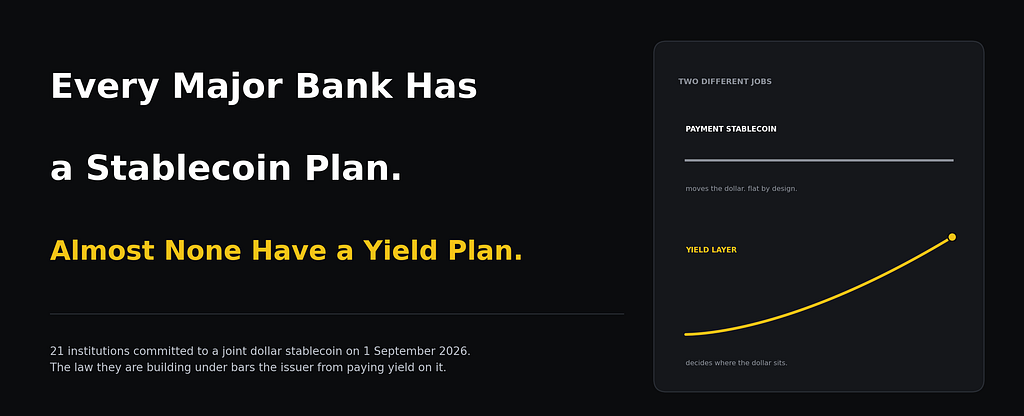
21 institutions committed to a joint dollar token on 1 September 2026. Here is the part of the stablecoin story their plans structurally cannot cover.
A payment stablecoin moves the dollar. A yield layer decides where it sits. The GENIUS Act made those two different products.
On 1 September 2026, twenty-one of the largest financial institutions in the world agreed to build the same thing.
Bank of America. Citi. Goldman Sachs. Wells Fargo. Deutsche Bank. UBS. Lloyds. MUFG. Standard Bank. Capital One. PNC. TD. Fidelity.
The plan is to form a company in the second half of 2026 and ship a dollar stablecoin in the first half of 2027.
Read the coverage closely and you notice something odd.
Every detail is about movement. Cross-border payments. Settlement rails. Distribution. Compliance posture. Which chain it runs on.
Not one detail is about what the dollar does while it sits still.
That is not an oversight. It is the law.
Not one detail is about what the dollar does while it sits still. That is not an oversight. It is the law.
Why every bank stablecoin plan in 2026 looks identical
Strip away the branding and the plans converge on the same four things.
A token issued one-to-one against eligible liquid reservesA payments use case, usually corporate and cross-border firstA compliance wrapper built for the GENIUS Act and MiCAA distribution network the issuer already owns
That is a genuinely good product. Settlement that clears in seconds instead of days is worth building.
And banks have the one thing crypto-native issuers had to buy: existing customers.
It is worth separating two things that get blurred in headlines. JPMorgan and Citi already run tokenized deposits through The Clearing House.
Those are a different instrument from a payment stablecoin, with a different regulatory home.
The consortium token is the stablecoin leg, and it is the leg where the yield rule bites.
But look at what is missing from that list. There is no answer to the question a treasurer asks second, right after “can I move it?”
The question is: what happens to it between Tuesday and Friday?
Every milestone in the bank stablecoin race is a distribution milestone. The yield prohibition runs underneath all of them.
What the GENIUS Act actually says about stablecoin yield
The GENIUS Act was signed on 18 July 2025. Section 4(c) is the part almost nobody talks about at conferences.
It bars a payment stablecoin issuer from paying interest, yield, or any economically equivalent return for simply holding the token.
That applies to everyone. Circle cannot pay you to hold USDC. A bank consortium cannot pay you to hold its token either.
As one analysis put it, bank-issued stablecoins will compete on compliance posture, not on yield, because none of them are permitted to pay yield.
The reasoning was deposit flight. A Treasury advisory council flagged the $6.6 trillion US transactional deposit market as at risk from a stablecoin market then sitting near $281 billion.
Citigroup research projects stablecoins reaching $0.5 trillion to $3.7 trillion by 2030. The banking lobby argued hard to keep Section 4(c) intact, and it won.
Here is the part that turned out to be interesting. The prohibition binds the issuer. It does not bind everyone else.
The prohibition binds the issuer. It does not bind everyone else.Layer one is where every bank plan sits. Layer two is where the Sky Savings Rate operates.
So where did all the stablecoin yield actually go?
One layer up.
The dollar and the return on the dollar stopped being the same product. If you want the return, you now hold a different instrument on top of the payment token.
The numbers show the migration clearly:
Total stablecoin supply has pushed past $319 billionYield-bearing stablecoins grew roughly 300% during 202521Shares projects the category passing $50 billion in 2026In traditional markets, yield-generating instruments make up 55% to 65% of the total. Onchain, the figure is closer to 8% to 11%
That last gap is the whole story. Most onchain dollars still earn nothing. Institutional treasuries have noticed.
The market has quietly sorted itself into three lanes as a result:
Payment tokens. Flat by design. USDC, USDT, and every bank token coming in 2027.Tokenized Treasury products. Cash-equivalent exposure, usually gated to qualified participants.Protocol-generated yield. Wrappers that sit on top of a stablecoin and accrue a rate funded by real activity.
A CFO parking $100 million is no longer choosing between USDC and USDT. They are choosing between three different products that happen to share a dollar peg.
Yield-generating instruments are 55% to 65% of traditional markets and roughly 8% to 11% onchain. Most stablecoin dollars still earn nothing.
How the Sky Savings Rate works without an issuer paying it
This is the mechanism worth understanding, and it is structurally different from a bank plan rather than a better version of one.
Sky Protocol does not have an issuer writing yield cheques. The flow runs like this:
USDS is the fully backed unit of account and the entry pointIndependent allocators in the Sky Agent Network borrow USDS liquidity and pay for that accessThey deploy into collateralised lending, US Treasury bill exposure, and lending market liquidityRevenue from that activity accrues to Sky Protocol as Net Protocol SurplusSky Governance sets the Sky Savings Rate from that surplus, in public, onchainHolders of sUSDS access the rate automatically
No rate is promised. The Sky Savings Rate is variable and can move. Every parameter that sets it is voted on and published.
I want to be precise here, because the lazy version of this argument is a rate comparison and that comparison is not the point. The point is architectural.
A payment stablecoin is a claim on reserves. sUSDS is a position in a system that generates revenue and allocates it under rules anyone can read.
Those are different financial objects. Only one of them was ever designed to do something while idle.
A payment stablecoin is a claim on reserves. sUSDS is a position in a system that generates revenue and allocates it under rules anyone can read.No issuer pays the Sky Savings Rate. It is revenue generated by independent allocators, then allocated in public by Sky Governance.
What the receipts actually look like
Positioning is cheap. Here is what Sky Frontier Foundation published for the last two quarters and the most recent month.
Q1 2026: $123.79M Gross Protocol Revenue, $46.04M Net Protocol SurplusQ2 2026: $107.35M Gross Protocol Revenue, $33.29M Net Protocol Surplus, the fifth consecutive positive quartersUSDS supply grew 149% year on year to $5.52BProtocol Collateral closed August at $11.10B, up 18.2% year on yearSky Agent vaults expanded from $5.63B to $6.06B during August alone
Then there is the part I find hardest to argue with. As of 1 September 2026, positions held across the Sky Agent Network included roughly $1.23B with Janus Henderson, $618.32M with BlackRock, $304M with Galaxy, $239.60M in PayPal USD, $220M with Anchorage, and $103.11M with Securitize.
Galaxy is the one to watch. That exposure was $27M at the Q2 close. It reached roughly $304M by 1 September, driven largely by a $500M warehouse lending facility announced in July.
That is a 10x move in a single quarter, into the layer the banks are not building.
That is a 10x move in a single quarter, into the layer the banks are not building.
Every one of those figures is published and updated continuously on the Sky Protocol financial dashboard. You do not have to take my word for any of it, which is rather the point.
Positions held across the Sky Agent Network as of 1 September 2026. Galaxy went from $27M at the Q2 close to roughly $304M.
What happens when the second wave arrives in 2027
The consortium token is targeted for the first half of 2027. Assume it lands, and assume it works.
Three things follow.
Distribution gets solved, fast. Hundreds of millions of banking customers get a tokenized dollar without downloading anything.The yield question gets louder, not quieter. Once holding a tokenized dollar is normal, “why is this one flat?” becomes an obvious question to ask.The regulatory fight moves to the wrapper. The OCC has already opened rulemaking on whether the prohibition should reach affiliates and third parties. Federal agencies missed the 18 July 2026 deadline, with final rules now targeted for November 2026.
That last point is the real uncertainty, and I would not pretend otherwise. Reasonable people disagree about whether the prohibition should stay at all.
But note the asymmetry. A bank consortium starting in 2027 has to build distribution and then find a compliant yield structure.
Sky Protocol already has the yield structure, in public, with five consecutive positive quarters of published financials behind it. Distribution is the easier of the two problems to solve second.
The part I want you to argue with
Here is my actual position, stated plainly so you can take it apart.
Banks did not lose the stablecoin race. They are going to win the payments leg of it, comfortably, because distribution beats technology almost every time.
What they gave up is the layer above. Section 4(c) made the payment token and the yield token two different products, and banks are only allowed to build one of them.
So the question I keep turning over, and the one I would like you to answer in the comments:
When a bank hands a customer a tokenized dollar that structurally cannot pay them anything, how long before that customer goes looking for the layer that can?
Six months? Five years? Never, because most people never chase a rate?
Tell me where I have this wrong. I read every reply.
Every Major Bank Has a Stablecoin Plan. Almost None Have a Yield Plan. was originally published in Coinmonks on Medium, where people are continuing the conversation by highlighting and responding to this story.