
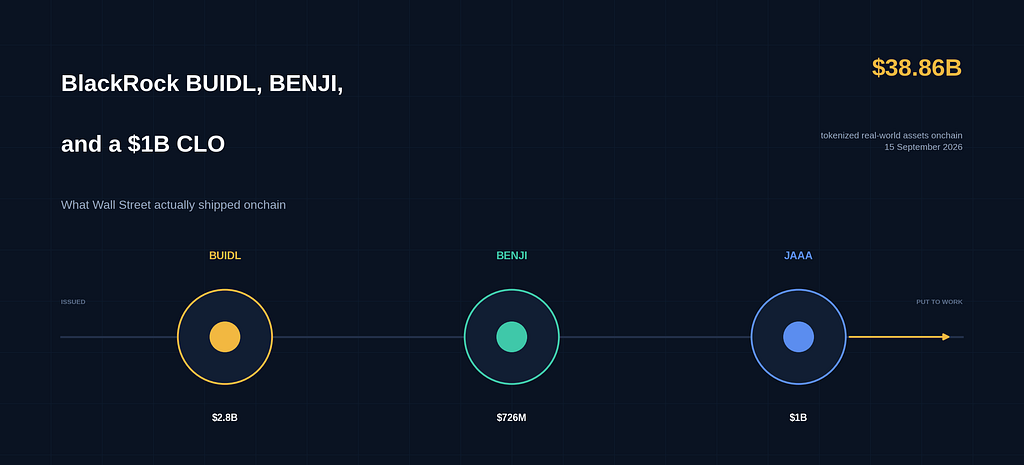
Three of the biggest names in asset management now have live products on public blockchains. Issuing the token was the easy part.
The three numbers that frame the piece: $38.86B of tokenized real-world assets onchain, $2.8B in BlackRock BUIDL, and the $1B CLO allocation approved by Sky Governance.
On 15 September 2026, RWA.xyz showed $38.86 billion of tokenized real-world assets sitting onchain, held across roughly 4.24 million holders.
Two years ago, that number was a slide in a pitch deck.
Here is the part that does not make the headline. Most of that money is parked, not working. Wall Street shipped the asset. What almost nobody has answered is what the asset plugs into once it lands.
So I went through what BlackRock, Franklin Templeton and Janus Henderson actually put on public blockchains. Three big names. Three very different jobs.
US government debt is still more than 40% of all tokenized real-world asset value. Everything else is comparatively small, and comparatively young.
What is BlackRock BUIDL, in plain terms?
BUIDL is a tokenized money market fund. Nothing more exotic than that.
It is the BlackRock USD Institutional Digital Liquidity Fund, launched in March 2024 with Securitize as transfer agent.
It holds cash, short-dated US Treasury bills and repo. Each token targets a $1 net asset value and accrues yield daily.
The numbers worth knowing:
Roughly $2.8 billion in size, about 18.5% of the $15.1 billion tokenized Treasury marketRestricted to qualified purchasers, with a $5 million minimumLive across eight networks, including Ethereum, Solana and AptosRated AAA-mf by Moody’s, with more than $100 million in dividends distributed since inceptionBegan trading on Uniswap in February 2026, which put a regulated fund product on a public decentralised exchange for the first time
One detail says more than the size does. BUIDL lost the top spot in its category to Circle’s USYC in March 2026, then took it back in late August.
The lead has changed hands twice in six months. That is not a market with a default option. That is a market where allocators are actively comparing.
What did Franklin Templeton’s BENJI actually unlock?
On 12 August 2026, the SEC’s Division of Investment Management issued a no-action letter to Franklin Templeton.
In practice, it lets Franklin’s own registered funds hold BENJI, the token representing its onchain government money fund, for cash management and as securities lending collateral.
No traditional fund complex had that permission before.
The scale is the interesting part. Franklin runs about $82 billion in ETFs and roughly $790 billion in mutual funds.
That is around $872 billion in vehicles now eligible to use a blockchain-recorded fund as cash. Eligible is not automatic, though. Each fund board still has to approve it.
A few things to hold onto:
BENJI launched in 2021 on Stellar and was the first US-registered mutual fund to use a public chain as its official system of recordThe fund itself holds around $726 million, with roughly $2.6 billion across the wider suiteIt supports hourly NAV calculation and intraday trading, which is the real pitch to a treasury deskThe relief waived custody provisions written for paper certificates kept in a vault
That last line tells you what stage this technology is at. The blocker was never the blockchain. It was a rule about vaults.
Minting the token was never the hard part. The hard part is what the token is allowed to do next.
Why the Janus Henderson CLO is the most interesting of the three
Because it is the only one where a Wall Street strategy became working collateral inside a live stablecoin system, rather than a product sitting quietly in a wallet.
In June 2025, Sky Governance approved a $1 billion allocation into the Janus Henderson Anemoy AAA CLO Strategy, known as JAAA.
It was built with Centrifuge and deployed through Grove, an independent capital allocator in the Sky Agent Network.
Why that matters:
It was the first AAA CLO strategy available natively onchain, not a wrapper around an offchain fundIt is run by the same portfolio managers behind Janus Henderson’s $21 billion AAA CLO ETF, a strategy that pulled the largest inflows of any actively managed fixed income ETF in its yearThe allocation was approved in public, by token holder vote, with the parameters visible to anyone who wants to checkThe capital is not idle. It helps back a stablecoin that people actually use
Tokenized Treasuries taught institutions that the rails work. This was the step after that.
Same headline, three different products. The last row is the one that decides whether a tokenized asset is collateral or a certificate.
Tokenized treasuries vs yield-bearing stablecoins: what is the real difference?
A tokenized Treasury fund is a wrapper. A yield-generating stablecoin is an output.
That distinction sounds academic until you hold both.
With a tokenized fund, you hold a claim on one specific portfolio, subject to who is allowed to hold it and where it is allowed to moveWith a yield-generating stablecoin such as sUSDS, you hold a claim on a rate produced by a diversified allocation networkOne is a single strategy in a token. The other is the result of many strategies, netted and published
USDS is the base unit. It is fully backed, converts 1:1 with major stablecoins through the protocol’s Peg Stability Modules, and is drawn against governance-approved collateral.
sUSDS is USDS in its yield-generating form, and it is currently the largest yield-generating stablecoin in the market.
How is the Sky Savings Rate actually funded?
This is the part most explainers skip, and it is the only part that matters for risk.
USDS liquidity is made available by Sky Protocol under parameters set by token holder voteIndependent allocators in the Sky Agent Network, including Spark, Grove, Obex and Osero, draw that liquidity and deploy it into credit, Treasury and lending strategiesThey pay for that access, and those payments accrue to Sky Protocol as revenueSky Governance calibrates the Sky Savings Rate from that revenue base, and sUSDS accrues it automatically
No lockups. No notice period. Convert back to USDS whenever you want.
The rate is variable and set by governance, not fixed by a marketing team, which is why you will not find a number quoted here. It is published live, and it moves.
Where the Sky Savings Rate comes from: USDS liquidity goes out to independent allocators, revenue comes back to Sky Protocol, and governance sets the rate that sUSDS accrues.
Do the numbers hold up?
Sky Frontier Foundation publishes quarterly. From the Q2 2026 report:
$107.35 million in Gross Protocol Revenue$33.29 million in Net Protocol Surplus, the fifth consecutive positive quarterProtocol Collateral up 45.5% year over year to $12.32 billionsUSDS supply up 149% to $5.52 billion
Q1 2026 was stronger still, at $123.79 million in Gross Protocol Revenue. Sky Frontier Foundation also introduced Laniakea in Q2, its framework for standardising how institutional capital plugs in, which is a fairly loud signal about where the next wave of allocations is expected to come from.
Current figures sit higher again. As I write this, the live dashboard shows $14.15 billion in total collateral against $11.48 billion in stablecoin supply.
Sky Protocol’s Q2 2026 as reported by Sky Frontier Foundation. Fifth consecutive quarter of Protocol Surplus.
What the $38 billion headline hides
Tokenized value is spread thin. As of mid-September, Ethereum holds $17.3 billion of it, BNB Chain $5.6 billion and Solana $4.3 billion, with the rest scattered across dozens of other networks.
That fragmentation is the whole story. An asset on one chain cannot collateralise a position on another without a bridge, a wrapper, or a phone call.
Castle Labs framed it well recently: supply is no longer the constraint. Kraken, Robinhood, Ondo, Securitize, Franklin Templeton and BlackRock can all issue.
The open question is what a holder can actually do with the thing afterwards.
Tokenized, yes. In one place, no. Fragmentation across networks is the reason composability, not issuance, is now the bottleneck.
Three questions worth asking before you call it institutional adoption
Who is allowed to hold it? A $5 million minimum behind a qualified purchaser gate is a real answer, just not a broad one.Where can it move? Transfer restrictions decide whether an asset is collateral or a certificate.What does it plug into? This is the one that separates a press release from a market.
Answer those three and the tokenization league tables start to read very differently.
Wall Street has proven it can issue onchain. That argument is over. The next argument is about utility, and it is wide open.
So what actually comes next for onchain treasury allocation?
Onchain capital allocation only works when a tokenized asset can be pledged, priced, redeemed and put to work by someone other than its issuer.
On that test, a $1 billion CLO strategy sitting inside a live stablecoin system is further along than most of the category.
That is the part worth watching over the next year.
A real question for the comments. If you were allocating $10 million of treasury capital today, would you rather hold a tokenized money market fund with a named issuer behind it, or a yield-generating stablecoin backed by a diversified allocation network with its rate set in public?
I have my view. I am more interested in yours.
BlackRock BUIDL, BENJI, and a $1B CLO: What Wall Street Actually Shipped Onchain was originally published in Coinmonks on Medium, where people are continuing the conversation by highlighting and responding to this story.