
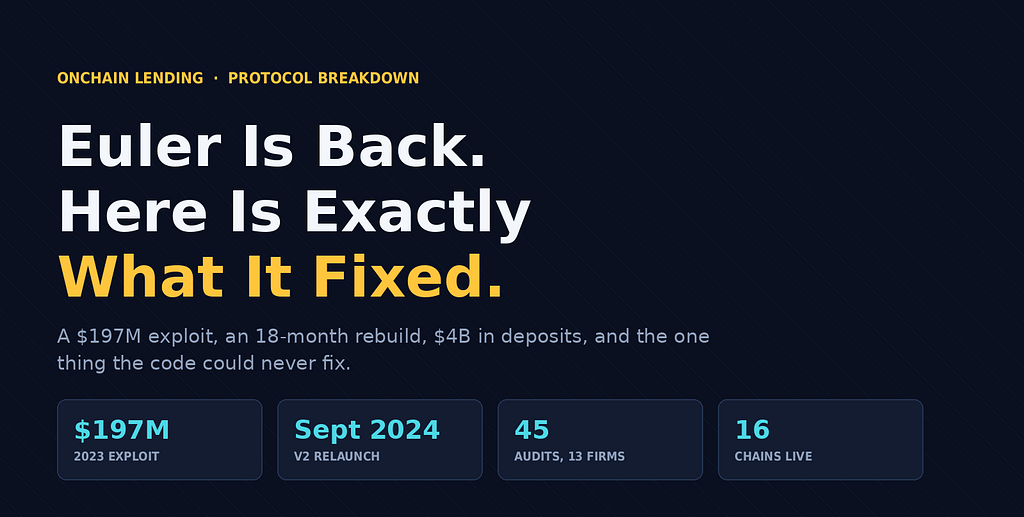
A $197M exploit, an 18-month rebuild, $4B in deposits, and the one thing the code could never fix.
Euler rebuilt the contracts in eighteen months. The harder rebuild came after.
In March 2023, Euler Finance lost $197 million in a single transaction. Within a month, almost all of it came back.
That is the part most people remember. It is also the least interesting part of the story.
The interesting part is what Euler rebuilt afterwards, what it got wrong while rebuilding, and what its own CTO admitted in public this year.
Because the short answer to “what did Euler fix” is not the one you would expect.
It fixed the code. It is still fixing everything around the code.
Here is the full picture, with receipts.
What Is Euler Finance? The 60-Second Answer
Euler Finance is a modular onchain lending protocol. Euler Labs deployed it on Ethereum in December 2021.
The original pitch was permissionless market creation. Aave and Compound needed a governance vote before listing an asset.
Euler let anyone spin up a market for any ERC-20 token with a WETH pair on Uniswap. No vote, no waiting.
It worked. Euler raised roughly $40 million across three rounds, with Paradigm, Coinbase Ventures and Jane Street among the backers. Total value locked passed $300 million within a year.
Then 13 March 2023 happened. A flash loan attack drained $197 million. TVL went to almost nothing.
The recovery was unusual. Most of the funds came back within weeks, and users were made whole. But the brand carried a scar that capital does not forgive quickly.
What Did Euler V2 Actually Fix In The Code?
Euler V2 shipped in September 2024, eighteen months after the exploit. It was not a patch. It was a new protocol.
The core pieces:
Euler Vault Kit (EVK). Every market is an ERC-4626 vault holding one underlying token, with its own interest rate model, risk limits and collateral rules.Ethereum Vault Connector (EVC). Vaults recognise each other as collateral. Sub-accounts and batching let a user open a leveraged position, adjust collateral and rebalance in one transaction.Isolation by design. A market that blows up does not reach into the one next to it.Vault hooks. Custom logic around supply, borrow, liquidation and compliance. This is what made KYC-gated vaults and tokenized equity markets possible on the same rails.Oracle-agnostic routing. Chainlink, Pyth, RedStone, Chronicle and custom adapters, swappable per vault.
Euler spent around $4 million securing it: 45 audits across 13 firms, a $1.25 million Cantina audit competition that surfaced no high or medium severity findings, and a $3.5 million Hats Finance capture-the-flag where white hats failed to breach the live contracts.
That is the fix people mean when they say Euler is back. It is real. It is also half the answer.
Euler rebuilt the contract layer to a standard almost nobody matched. The layer above it took another two years.
How Big Is Euler Finance In 2026?
The comeback curve is genuinely wild, and so is the round trip.
September 2024: V2 launches. TVL near $3.5 million.January 2025: $133 million. A 38x move in three months.March 2025: $671 million, with $231 million in active loans and 43% utilisation.April 2025: 297 vaults live, total supply close to $993 million.Peak: over $4 billion in deposits inside a single year.Today: Euler V2 sits near $365 million across 16 chains, annualising roughly $62 million in fees, per DefiLlama.
For scale, the entire onchain lending category holds somewhere around $36 billion, and the top five venues carry about three quarters of it.
Builders have not walked away either. Alchemix shipped v3 in June 2026 with cross-borrowing on Euler, which is exactly the infrastructure role Euler now says it wants.
So what happened between $4 billion and here? Euler answered that themselves, and the answer is the most useful thing published in onchain lending this year.
From $3.5M to $4B and back again. The shape of incentive-led growth, plotted on a log scale.
The Euler Retrospective That Broke The Format
In April 2026, Euler Labs published a quarterly post titled “The Protocol Works. Here’s What Did Not.”
It was written by Kasper, the CTO. Both co-founders had left Euler Labs earlier in the year.
Protocols do not usually write like this.
“The protocol is sound. The architecture works. What failed was the organisation, the strategy, and the infrastructure around those contracts.”
Four admissions stand out:
Identity. Euler never settled whether it was a product or infrastructure. It ran its own markets while trying to recruit the curators it was competing with.Reaction, not direction. Chain launch after chain launch, each one a spike of incentive-driven deposits followed by a decline when the incentives ended.Neglected plumbing. Beautiful smart contracts, no stable backend, no public APIs, almost no data tooling for curators handling millions.The wrong kind of growth. Its depositor base moved for incentives. Plasma became the second-largest deployment. Stream Finance borrowed much of that liquidity, then defaulted. The deployment was effectively wiped out.
The line that matters: the architecture held. DAO-managed markets on Euler had zero direct exposure to Stream’s toxic collateral.
And the CTO still called that partly good design and partly good fortune, because the DAO had come close to onboarding assets that later defaulted in the same crisis.
Is Immutable Lending Actually Safer? Euler Says No
This is the part of the retrospective worth arguing about, and it is why this post exists.
Two events, months apart. Stream Finance collapsing in late 2025. The Resolv exploit in March 2026. The same pattern both times.
Collateral lost its value. Oracles kept reporting stale prices. Borrowers withdrew real assets against worthless collateral.
In the immutable base-layer markets, nobody could do anything about it. No one to pause borrowing. No one to adjust loan-to-value. No one to fix an oracle. The bad debt simply sat there.
What happened next is the uncomfortable bit. Curators with better monitoring pulled their depositors out first. Everyone slower was left in a market with no liquidity and no path back.
Euler’s CTO called it a bank run with bots.
“The curator who moves first wins. Everyone else holds the bag.”
And this is not a rare edge case. Total crypto hack losses passed $1.1 billion in the first half of 2026 alone.
His conclusion is not that governance removes risk. It obviously does not. It is that markets where nobody can respond are a worse foundation than markets where somebody can, and has to answer for it.
The same five steps, twice in five months. Step four is where architecture stops helping.
Where The Sky Savings Rate Fits Into Onchain Lending
That leaves an open question: if somebody has to be accountable, who is it, and how would you verify it?
Sky Ecosystem answers that structurally rather than editorially.
Sky Protocol issues USDS, the base unit of capital. Independent allocators in the Sky Agent Network borrow that liquidity against governance-approved collateral and deploy it into credit and treasury strategies.Returns flow back to Sky Protocol. A portion of Net Protocol Revenue funds the Sky Savings Rate.Supply USDS to the savings module and you hold sUSDS, which accrues the Sky Savings Rate programmatically. No lockups, no exit fees.Collateral types, exposure limits and the rate itself are set by SKY holders through Sky Governance and executed onchain, with a public record of who decided what and when.
At the time of writing, skyeco.com shows Protocol Collateral around $14.15 billion against stablecoin supply near $11.48 billion.
Both figures move, and both can be checked on the public dashboards rather than taken on trust.
There is also a direct link between the two systems. Sky Protocol maintains an active Integration Boost instance for Euler on Base, specified in the Sky Atlas.
Payments run weekly, calculated per block against USDS held in Euler and the Sky Savings Rate, with net supply data published to a public endpoint.
Two different answers to the same problem, running side by side.
USDS in, Sky Savings Rate out. Every parameter along that path is set in public and executed onchain.
What To Check Before You Supply To Any Lending Market
Five questions. They take ten minutes and they apply everywhere, Euler included.
Who sets the risk parameters for this specific market, and are they named?Can anyone pause it in a crisis, or is it frozen by design?Where does the oracle price come from, and what happens when it goes stale?Is the yield paid from revenue the system generated, or from an incentive with an end date?Can you verify the collateral yourself, right now, on a public dashboard?
If a market cannot answer the first two, the yield is not the number you think it is.
Save this one. It works on Euler, on Sky Protocol, and on whatever launches next quarter.
So, Is Euler Back?
The protocol is. The code did what it was built to do under two live stress tests, which is more than most designs ever get to prove.
The organisation around it is still being rebuilt in public, and Euler is the rare team saying so out loud.
That honesty is worth more to onchain lending than another highlight reel. It also points at the thing the industry keeps relearning: the contract is never the whole system.
Here is the question I would put to you. Would you rather hold a position in a market nobody can change, or a market someone can change and has to answer for?
There is a serious argument on both sides. Tell me which one you would pick, and why.
Euler Is Back. Here Is Exactly What It Fixed. was originally published in Coinmonks on Medium, where people are continuing the conversation by highlighting and responding to this story.