
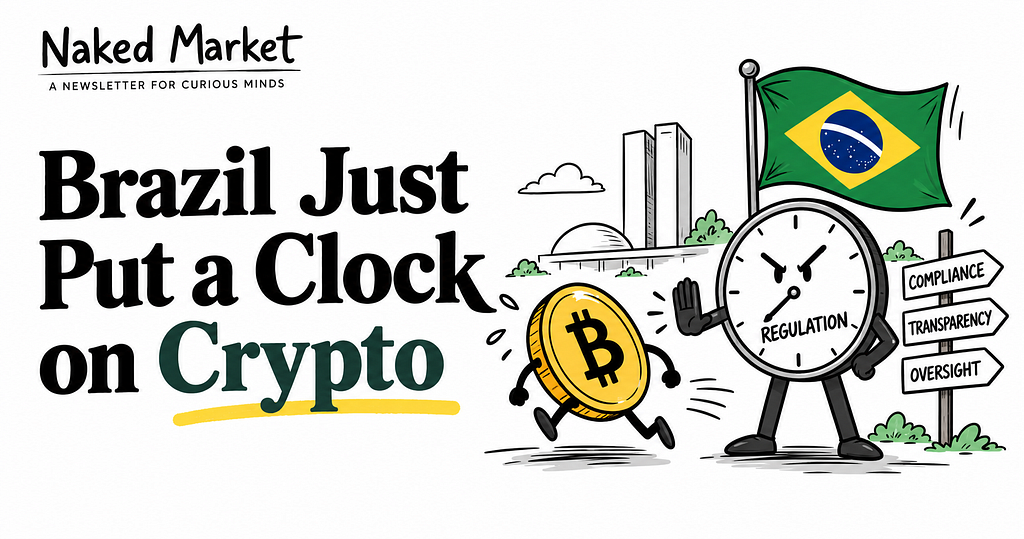
What looks like a Brazilian regulation raises a much bigger question for crypto users worldwide.
Naked Market breaks down big money, blockchain, AI and trading systems. So you can see where global finance is going, before the crowd does. Wherever in the world you are reading this from.
There used to be a page in your passport for this
Let me show you something most people under fifty have never heard of.
If you were British and you went on holiday in 1967, you did not simply take your money with you.
You took your passport to a bank. An official opened it to a specific page. That page was printed with a heading: Exchange Control Act 1947. And on it, by hand, they wrote down the currency you were allowed to take out of the country.
You were rationed. Fifty pounds in foreign currency. Fifteen more in sterling cash.
Not because you were a criminal. Not because anyone suspected you. Because you were leaving, and leaving was the part the state wanted to see.
Sit with the physical fact of that for a second.
A rich, free country. Not a dictatorship. Not wartime, by then. And the mechanism of control was not a ban, or a tax, or a police officer.
It was a page. A quiet page, in the document you needed in order to leave.
Those controls began in 1939. They were made permanent by a law in 1947. And they were not abolished until October 1979, when the government finally decided they had “outlived their usefulness”.
Forty years. In Britain. Within the lifetime of many people reading this.
I am opening here for a reason. Because this month, Brazil did something that a lot of people are calling brand new. And it is not new at all. It is one of the oldest moves in the book, wearing new clothes.
Where we are in the Law Book
Quick map, so new readers are not lost.
In Chapter One I used a cloakroom to explain America’s stablecoin law. You hand over a coat, you get a paper ticket. The ticket is worthless fabric, but everyone agrees ticket 41 gets coat 41, so the ticket works like the coat. That chapter was about what the ticket legally is.
In Chapter Two I kept the coat and changed the building. Europe licensed the restaurant. One licence, inspected kitchen, valid in every town. Pass once, cook anywhere.
In Chapter Three the two systems collided, and we found a genuinely strange thing. One dollar coin, same name, same company, had become two different legal creatures depending on which continent it was sitting on.
So Chapter One was about the label. Chapter Two was about the licence.
This chapter is about the door.
And here is the thing I did not expect when I started researching this one.
The door turns out to be the only part that is actually about you.
What Brazil actually did
Lets be precise, because precision is the whole value here. Most coverage of this rule was written by people who read one headline.
On 7 August 2026, Brazil’s central bank published Resolution 584. It comes into force on 1 January 2027.
The rule works like this.
You hold crypto at a Brazilian exchange. You want to move it out. The destination is either abroad, or a self-custody wallet that you control. The amount is more than roughly $10,000, either in one go or added up across the same day.
At that point the exchange must hold the transfer. For up to 24 hours. While it assesses the fraud risk.
Now the details that most people skipped, and they matter a lot.
The exchange can release it early if the review finds nothing wrong. Twenty four hours is a ceiling, not a waiting period.
The exchange must write down why it decided what it decided. It must tell you the transfer is being held. And transfers below the limit can be held too, if the exchange’s own systems flag them as risky.
The stated reason was not vague. Crypto and stablecoins, the central bank said, are being used to move money stolen in fraud before victims or banks can get it back.
Read the design honestly and it is careful work. There is a threshold. There is a ceiling on the delay. There is a duty to explain. There is an escape hatch for the innocent.
This is not a smash and grab. Somebody thought about this.
The thing almost everybody got wrong
Open social media and youll find this described as the end of self-custody in Brazil. A ban by stealth. They are coming for your keys.
That reading is simply wrong, and it is worth killing properly.
Resolution 584 cannot touch your wallet. Nobody in Brasília can reach a private key on a device in your drawer. Self-custody in Brazil is legal, untouched, and still yours.
The rule touches the door. It governs the regulated business you walk through, not the thing you walk toward.
Which sounds like a defence of the rule. It is not. It is something harder to swallow.
Because if the law cannot reach your wallet, and it does not want to ban anything, then what exactly is it doing?
It is doing the only thing that actually works. It is regulating the choke point.
And every choke point in modern finance is a company. A company has an address, a licence, a bank account and a lawyer. A private key has none of those.
You cannot regulate software in somebody’s pocket. You can absolutely regulate the business that sold it to them.
That sentence is the quiet engine under every crypto law ever written, in every country, regardless of politics. Once you see it you cannot unsee it.
The three part machine
Here is the framework I ended up building while writing this chapter. I have not seen anyone else lay it out this way, so use it freely.
Strip away the politics and every money law on earth is doing one of three jobs.
Job one, the Label. What is this thing, legally? A token? A security? A receipt? Foreign currency? Chapter One was about America answering this. Brazil answered it too, and we will come back to that.
Job two, the Licence. Who is allowed to handle it? Who gets inspected, who must register, who can be shut down? That was Chapter Two, and Europe’s answer.
Job three, the Door. What happens when value tries to leave the watched area?
Now look at what that framework reveals.
America did the Label. Europe did the Licence and a good deal of the Label. Both wrote huge, careful, historic law.
And both of those jobs regulate companies. Issuers, exchanges, custodians. Businesses with compliance departments.
The Door is different. The Door is the first one that reaches past the company and lands on the person holding the money.
Chapters One to Three were laws about institutions. Chapter Four is the first one about you.
That is why this small Brazilian rule matters more than its size suggests. Not because 24 hours is long. Because of which of the three jobs it completes.
Let me argue the other side, properly
I would be a bad guide if I only gave you the half that suits my argument. So here is the strongest case for Resolution 584, and it is genuinely strong.
Brazil has a severe fraud problem. And it is partly the price of its own brilliance.
In 2020 Brazil’s central bank launched Pix, an instant payment system. It moves money in seconds. It runs every hour of every day including weekends. For ordinary people it is free.
The adoption numbers are hard to believe. On 4 September 2026, Brazilians made 318,073,816 Pix payments in a single day. Across 2025 the system handled roughly 80 billion payments worth about R$35 trillion. Around 148 million people use it.
Now think like a criminal for ten seconds.
A scammer does not need your money in their account. They need it gone. Converted, moved, untraceable, before anybody notices.
Instant free payments plus instant crypto conversion is the most efficient escape route ever built. Brazil built a superb getaway car by accident and handed the keys to everyone, including the thieves.
A 24 hour pause breaks that chain. It is one of the very few fixes that actually works.
And Brazil is not alone in concluding this. Britain spent a decade making bank transfers faster. Then it changed its mind and allowed banks to hold suspicious payments for up to four days. Four days, in a G7 economy, in the 2020s.
Picture a retired teacher in São Paulo. Or somebody’s mother in Manila. Or a first time saver in Lagos.
Each of them is about to send their savings to a stranger posing as their bank.
If one day of delay stops that, the delay did its job. I am glad it exists.
I want that on the record before what comes next. Because what comes next is where I stop agreeing.
The number is never the rule
Here is the part of this chapter I most want you to remember, and it took me the longest to find.
When a new financial limit is announced, everyone argues about the number. Is $10,000 too low? Too high? Fair?
The number is almost beside the point. What matters is whether the number is attached to anything.
Let me prove it with the most boring law in America.
In 1970, the United States passed the Bank Secrecy Act. It said that cash transactions above $10,000 must be reported to the government. At the time that was a serious amount of money. Ten thousand dollars in 1970 bought two new Corvettes.
That threshold was never indexed to inflation. Not once, in over half a century.
It is still $10,000 today.
To have the same real bite it had in 1970, that threshold would need to be around $77,000 today.
So the law never changed. Not one line. Not one vote.
And still, a rule written for the genuinely rich slid quietly downward. Until it sat on ordinary people.
Last year more than 27.5 million reports were filed on American bank customers.
Nobody voted for that. Nobody had to. Inflation did the voting.
The number is never the rule. The link to inflation is the rule.
Write that on something. It applies to tax brackets, benefit cliffs, reporting limits, customs allowances and now crypto exit thresholds, in every country on earth.
And it means the correct question about Brazil’s $10,000 is not “is that fair today”. It is “what happens to it over thirty years of nobody touching it”.
So I built an index
At this point I wanted to compare these rules honestly, and I could not find anyone who had. So we are going to do it ourselves.
The problem with comparing thresholds across countries is obvious once you say it out loud. $10,000 does not mean the same thing in two places.
Ten thousand dollars in the United States and ten thousand dollars in Brazil are not the same event in a person’s life. Comparing the raw numbers is like comparing temperatures without saying whether you mean Celsius or Fahrenheit.
So here is our instrument. I am calling it the Exit Index.
Take the threshold at which a money rule starts watching you. Divide it by one year of economic output per person in that country.
That is it. One division.
It turns every rule on earth into a single unit. How many years of an average life can you move, before the rule takes an interest?
A high number means the rule only notices genuinely large movements. A low number means it notices ordinary life.
Why output per person? Because it is published everywhere, it is comparable, and it is hard to argue with. Median income would be sharper. I will come back to that honestly later.
But look at what one division buys you.
You can now put a 1970 American cash rule beside a 2027 Brazilian crypto rule, and actually see which one is stricter. Different decades. Different continents. Different technologies. Same unit.
As far as I can find, nobody does this. Which is odd, because it takes about a minute.
So lets run it. All figures are output per person for 2026, except the 1970 row.
United States, 1970.
Threshold $10,000. Output per person $5,266. Exit Index 1.90.
That rule let you move nearly two years of average output before the state looked.
Brazil, 2027.
Threshold $10,000. Output per person $12,313. Exit Index 0.81.
Roughly ten months of average output.
United States, today.
Threshold still $10,000. Output per person $94,430. Exit Index 0.11.
About five weeks.
European Union, wallet ownership checks.
Threshold about €1,000. Using Germany’s output per person, Exit Index 0.017.
About six days.
European Union, crypto travel rule.
Threshold zero. Exit Index 0.00.
Every transfer, no minimum, forever.
Read that list twice. Because it says something nobody is saying out loud.
The finding I did not expect
I started this chapter expecting to write about a Brazilian crackdown. The numbers did not cooperate.
Brazil’s new rule is the second most permissive thing on that chart. The only rule more generous is one America wrote in 1970 and then let rot.
Europe, meanwhile, is not close. European crypto transfers carry data collection at any size at all. Ownership checks kick in around €1,000, which against European incomes is roughly fifty times tighter than Brazil’s trigger.
And when Europe asks who owns a wallet, your word is not accepted. Saying “thats mine” does not count. The firm needs a signature from the wallet itself proving you hold the key, or a tiny test payment. People call that one a Satoshi test.
So why is Brazil taking the criticism?
Because Brazil used a clock. A delay is visible. You feel it. It has a number of hours attached and it happens to you personally, today.
Europe used paperwork, spread across years, hidden inside a licensing regime, absorbed by companies before it ever reached you.
Friction you can feel gets called tyranny. Friction you cannot feel gets called compliance.
That gap is, I think, the most useful thing in this chapter. It is how almost every important financial change now arrives. Not as a dramatic law. As an absorbed cost, upstream, where nobody is looking.
Brazil is standing where America stood
Now put two of those rows next to each other and something slightly eerie appears.
Brazil in 2027 sits at 0.81. America in 1970 sat at 1.90. Different, but the same species of rule. A limit set high enough that it was genuinely aimed at big money, and the ordinary person would never meet it.
Brazil’s minimum wage in 2026 is R$1,621 a month. Measured against that, a $10,000 threshold is about two and a half years of income.
Most Brazilians will simply never touch this rule.
That is exactly what Americans could have said in 1970.
So here is the arithmetic, and I want to be honest that it is arithmetic, not prophecy.
Say the threshold is never adjusted. Say Brazilian incomes grow at a fairly ordinary six percent a year.
Then the Exit Index falls by half roughly every twelve years.
Starting at 0.81, it reaches America’s current 0.11 in about thirty five years.
Which lands, give or take, around 2060.
At that point a rule written in 2026 to catch large fraudulent transfers would sit on top of perfectly ordinary Brazilian savings. Nobody will have voted for that either.
That is my claim, and I am dating it on purpose so you can hold me to it. If Brazil indexes this threshold, I am wrong and delighted. If Brazil never touches it, the arithmetic does the rest on its own.
Where I might be wrong
A chapter that only argues one way is advertising, not analysis. So here are the honest weaknesses in what I just showed you.
Output per person is a rough proxy. It is not median income, and Brazil is unequal, so average output flatters the typical Brazilian. A median based index would put Brazil’s rule closer to ordinary people than my number suggests. That cuts against Brazil, not for it.
Comparing a delay to a disclosure is not like for like. Europe’s €1,000 trigger produces paperwork. Brazil’s $10,000 trigger produces a wait. A wait is more painful in the moment. Paperwork is more permanent. My index measures where the rule starts noticing, not how much it hurts, and those are different things.
Thresholds sometimes do move. American senators introduced a bill in late 2025 to raise that 1970 limit at last. If it passes, my pessimism about drift needs softening. Watch it.
And the fraud case is real. I have not shown, because nobody yet can, whether 24 hours will actually recover meaningful amounts of stolen money in Brazil. If it does, that changes the trade. I will report it either way.
None of this is investment advice, and I am not your financial advisor. I have no idea where any price goes. The machine underneath is what I can actually help with, and it moves slowly enough to be worth learning.
What was already built underneath
One more layer. Resolution 584 did not appear from nowhere.
It is far more interesting as the roof of a building than as a headline.
Earlier in 2026, Brazil pulled crypto firms properly inside the fence. Those rules took effect on 2 February 2026, with extra reporting duties from May.
And one of them did something quietly enormous. It treated buying, selling or swapping a dollar pegged stablecoin as a foreign exchange operation.
Go back to Chapter One for a second. The whole question there was what the cloakroom ticket legally is.
Brazil answered: it is foreign currency.
And the moment something is foreign currency, everything changes.
A country can now reach for every tool it spent a century building. Tools for money crossing a border. Declarations. Caps. Records. Dealings with unlicensed foreign firms even picked up a limit of around $100,000 per transfer.
So now stack the whole thing.
The Licence decides who is inside. The Label decides which century of law applies. The Door decides what happens on the way out.
Three rules, published months apart, reported separately, barely connected in any coverage I could find. Together they are one machine, and it is complete.
That is the actual news story. Not the 24 hours.
Why the exit is the real measure
Underneath this entire newsletter there is one argument, and it starts with the pinned idea: one planet, 180 currencies, and something is broken.
Heres how this chapter fits it.
We have one internet. One world economy. Money that can technically move anywhere on earth in seconds. And sitting on top of it, roughly 180 separate national money systems. Each with its own border. Each with its own rulebook. Each with its own view about who deserves a look on the way out.
180 currencies means at least 180 doors. And every door comes with a doorman.
Which brings me to the claim I would defend for the next twenty years.
Everyone measures financial systems by how easy they are to enter. How fast you can open an account. How quickly you can buy. How low the fees are on the way in.
That is the wrong end of the machine.
A money system is defined by how hard it is to leave.
Openness at the entrance costs the system nothing, because money coming in is money it controls. Openness at the exit is the only kind that is ever really tested. Britain had a world class financial centre in 1967 and a page in your passport rationing your holiday money. Both were true at once.
So when you assess any system, anywhere, ignore the welcome. Measure the exit.
The tools
Two things to take away, one to think with and one to measure with.
One. Does it slow money going in, or only going out?
Friction almost always appears at the exit. If a rule exists to protect you, ask why it never protects you on the way in.
Two. Who opens the door, and what does it cost them to keep it shut?
If the doorman pays nothing for delay, expect more delay over time. Incentives beat intentions.
Three. Is the pause undoable for them, and permanent for you?
They can release early whenever they like. You can never un-miss the moment you needed the money.
Four. Does it bind the middleman, or you?
Most rules bind the middleman. That sounds gentle. It isnt. It means the middleman quietly becomes the rule.
Five. Is the number attached to anything?
A limit with no link to inflation is a slow tax on normal people. And no one ever has to vote for it. This is the one almost everybody misses.
And then the measuring instrument.
The Exit Index. Threshold divided by one year of output per person. Above 1.0, the rule is aimed at large money. Around 0.1, it is aimed at everybody. Run it on any rule in any country, then run it again in five years and see which direction it moved.
The number will almost always have gone down. Now you know why.
Before you go
Brazil is not the villain of this chapter. That was the surprise in the research, and I have tried to follow it honestly rather than write the piece I expected to write.
Brazil built one of the best payment systems on earth. It gave that system to its whole population for free.
Then it found out that speed has a cost.
And it answered with a rule that is careful, bounded and explained. By our own index, it is more generous than most of what the rich world already runs.
The problem is not this rule. The problem is that rules like this never stay where they are set.
Sixty years ago the mechanism was a page in a passport. Today it is a 24 hour hold on a screen. The technology changed completely. The instinct did not change at all.
So watch the threshold, not the headline. Watch whether 24 hours stays 24 hours. Watch whether “abroad or self-custody” stays the trigger, or quietly widens.
And keep asking the only question that has ever really mattered here. Not what you own.
Who can stop you using it.
The market is always wearing clothes. Our job is to see it without them.
If you want to understand where money is really heading before it becomes obvious, this is the newsletter for it. Subscribe, and send this to the friend who still thinks self-custody is a settled argument.
Keep reading
The Law Book, in order.
1. One Planet, 180 Currencies, and Something’s Broken · Start here. The idea under everything.
2. The GENIUS Act: The Hidden Reason America Passed This Crypto Law · Law Book I. The Label.
3. MiCA: The Law That Will Decide the Future of Global Crypto · Law Book II. The Licence.
4. GENIUS vs MiCA: The Battle That Could Redefine Stablecoins · Law Book III. One coin, two legal creatures.
5. The Study Bitcoin Doesn’t Want You to See · Who actually controls the coins.
6. Stablecoins: How a Casino Chip Became the Center of Crypto · Groundwork for the Label.
-More soon
Brazil Just Put a Clock on Crypto was originally published in Coinmonks on Medium, where people are continuing the conversation by highlighting and responding to this story.