
Why the Weekend Flush to $78.6K Is Order-Book Absorption, Not Macro Collapse
Deconstructing the $1.4B derivative liquidation cascade, the $9.07B short-term whale profit wall, and the structural bid floor defending $77.8K.
by Sheni Ogunmola
Daily Morning Logic | Institutional Equity Research
Executive Overview: The Weekend Reset
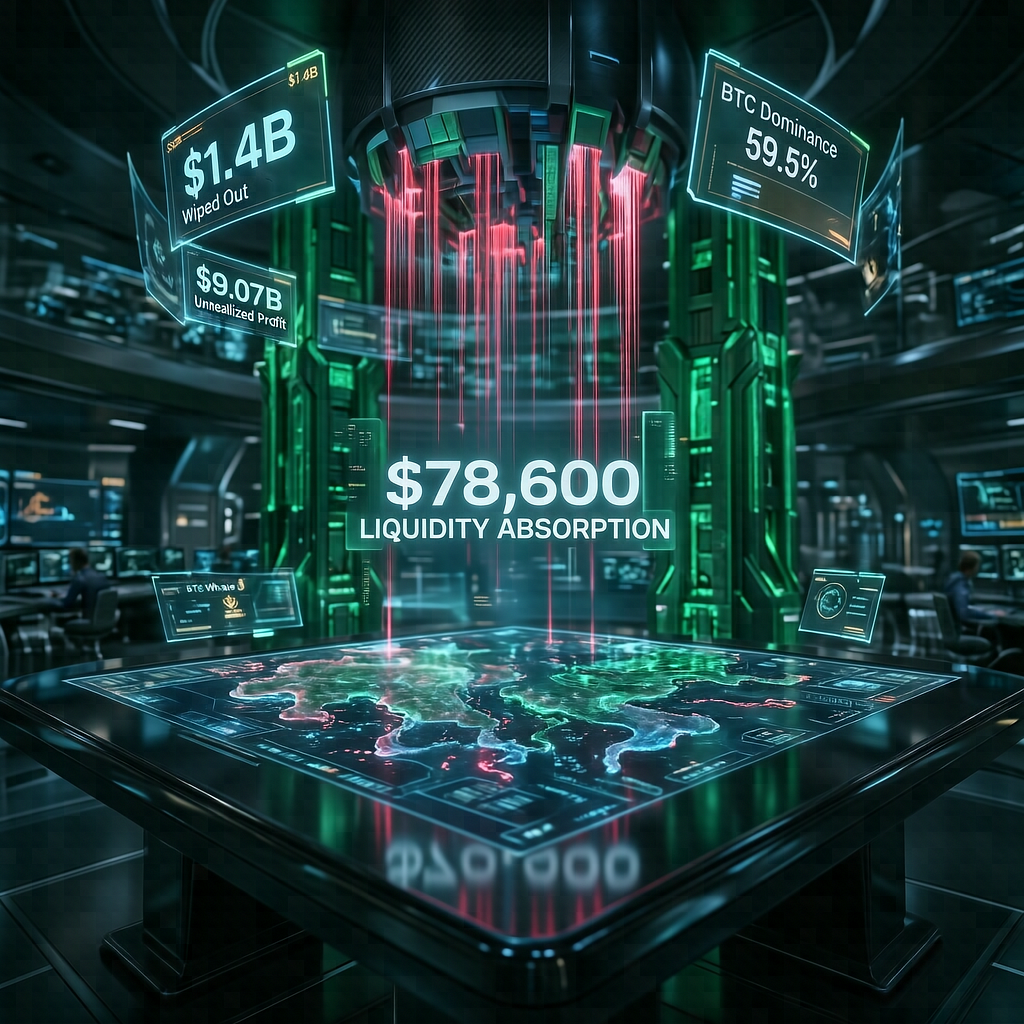
Following a sharp retest of overhead liquidity near $82,300, digital asset markets underwent an aggressive weekend flush, liquidating over $1.4 billion in leveraged positions and pulling Bitcoin down to $78,600. Derivative feeds immediately shifted into extreme defensive positioning, projecting cascades toward the $70,000 handle and speculative $57,000 fair value gaps.
In order-book-driven markets, localized weekend price action without institutional volume context creates pure noise.
A granular audit of cross-exchange order flow reveals that this move was not a structural breakdown. It was a mechanical liquidity sweep.
By clearing bids between $82,300 and $78,600 during thin weekend hours, algorithmic market makers forced a full leverage reset across perpetual venues. Beneath the surface volatility lies a decisive on-chain divergence: short-term holder (STH) whales reached a historic $9.07 billion in unrealized profit, while heavy spot limit blocks between $77,800 and $79,000 actively absorbed the forced selling.
Structural Flow Mechanics: What Actually Moved the Tape
Separating paper perpetual leverage from underlying physical accumulation exposes three core dynamics driving this correction:
The $1.4B Weekend Margin Flush: The drawdown from $82.3K to $78.6K was accelerated by low weekend exchange liquidity. Automated stop-runs cascading through overleveraged longs neutralized perpetual funding rates without breaking higher-timeframe market structure.The $9.07B Short-Term Whale Profit Wall: Investors who accumulated during the summer consolidation reached $9.07 billion in aggregate paper profit. When unrealized gains cluster at these levels, periodic distribution into retail breakout bids is routine protocol, not systemic insolvency.The $77,800 — $79,000 Institutional Bid Density: Exchange depth confirms that resting limit orders were never pulled during the drop. Instead, continuous blocks of institutional limit bids systematically absorbed the forced liquidations, establishing an active floor right above $78,000.Dominance Rolling Into Infrastructure: Bitcoin dominance fell below 59.6% as capital rotated into core large-cap assets rather than fleeing to stablecoins or fiat rails. This internal rotation signals liquidity retention within the broader ecosystem.
Order-Book Anatomy: The Three Critical Zones
Rather than relying on trailing indicators, institutional allocators navigate current price discovery through three distinct liquidity tiers:
Overhead Short Concentration ($81,000 — $83,000): Over $6.8 billion in resting short liquidation leverage has re-accumulated above the tape. This zone remains the primary target for programmatic squeezes once exchange float is depleted.Equilibrium Settlement ($78,600): The current consolidation pivot where margin rebalancing is taking place and funding rates have normalized across primary derivatives exchanges.Institutional Bid Foundation ($77,800 — $79,000): The structural buy wall supported by spot balance sheets, serving as the frontline defense against deeper macro drawdowns.
Valuation Asymmetry: The Flaw in the Bear Thesis
The retail bear thesis assumes that profit-taking by short-term whales will trigger an uncontrolled liquidation waterfall down to $57,000.
Applying the Dhandho framework — seeking situations with strictly bounded downside and asymmetric upside — reveals a very different setup:
Inelastic Issuance Limits Supply: Programmatic miner output remains capped at ~450 BTC per day, meaning persistent spot accumulation rapidly drains exchange inventory.Order Books Are Thinned to the Upside: As short interest stacks aggressively between $81K and $83K, late bears are providing the exact fuel required to propel price through previous local highs.Downside Is Mechanically Protected: With resting whale bids absorbing volume at $78K, entering short positions into the base offers poor risk-adjusted returns, while upside expansion remains wide open.
Strategic Portfolio Allocation
“Market makers hunt liquidity where leverage is concentrated; structural allocators accumulate where spot support is dense. Never confuse a $1.4B weekend derivative flush with an institutional balance-sheet exit.”
Holding dominant, fee-generating infrastructure and scarce monetary assets while passive float is drained remains the premier strategy for compounding capital through late-cycle regimes. As long as spot order books continue to absorb leverage flushes between $77.8K and $79K, the structural trajectory continues to favor balance-sheet accumulation over paper speculation.
Legal Notice: This research report is compiled strictly for educational and informational purposes. We are not licensed financial advisors. Investing in digital assets and equity markets carries risk of capital loss. Conduct independent due diligence before allocating capital.
The $82K Liquidity Hunt was originally published in Coinmonks on Medium, where people are continuing the conversation by highlighting and responding to this story.