
Chain of Thoughts 2026–09–07
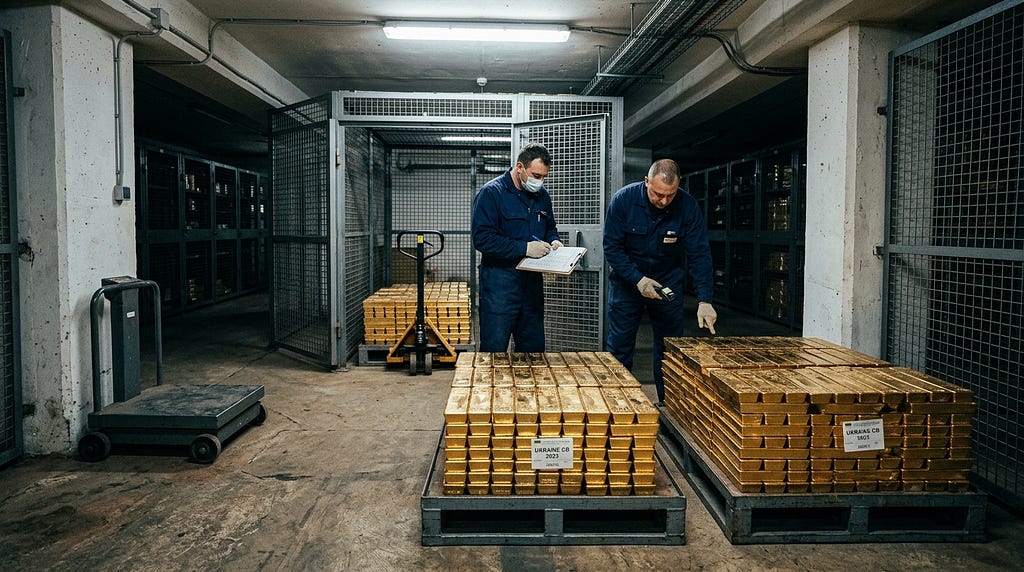
The Dutch moved 86 tonnes of gold out of New York, a bitcoin mortgage product started reusing pledged coins, and an exchange closed with $7 million missing — three stories on one quiet weekend, all asking the same question.
Generated using Nano Banana 2
The Verdict
Bitcoin — $79,701 (−0.09%)
Short-term (3–5 months): second consecutive flat day, and the range between $72,000 and $83,000 has now survived a shooting war on an oil export terminal without flinching either way. The scheduled resolvers are CPI on Friday Sept 11 and the FOMC on Sept 15–16. The unscheduled one — what crude does when futures reopen — lands after this edition’s window closes, which means the single most informative price of the weekend is still unprinted as you read this.
Long-term (1–3 years): the supply cap is a cap on coins, not on claims against coins. A mortgage lender confirmed this weekend that it may rehypothecate the bitcoin its borrowers pledge, and that those coins are unrecoverable until the loan is repaid or refinanced #1. That is not a scandal — it is how every functioning credit market works, and it had to arrive for bitcoin to become collateral at scale. But it means the number of entities who believe they have a call on a given coin can now grow without the coin count changing. Twenty-one million is enforced by consensus. The claims layer above it is enforced by contract law, which has a much worse record. Holding coins you can move without asking anyone is the only position in this asset that stays outside that arithmetic.
Ethereum — $2,481.73 (+0.91%)
Short-term: still bitcoin’s beta with no independent bid. $2,300 is where the thesis breaks — 7.3% below spot.
Long-term: the Bank of Korea published a study this week finding that when global exchanges let people buy dollar stablecoins directly with local currency, the local currency measurably weakens — market makers who supply the tokens have to sell the local unit and buy dollars to stay flat, and local stablecoin premiums compressed 0.33 to 0.38 percentage points across twelve currencies after those pairs listed #2. Read what that concedes. A central bank now models a public blockchain as a live channel in its own exchange rate. Most of that dollar issuance settles on Ethereum and the networks that hang off it, and the industry’s own diagnosis is that the remaining bottleneck is regulated bank infrastructure, not throughput #3. Own ETH as a claim on the settlement layer for the offshore dollar — which is a strange thing for a crypto asset to be, and is also the largest real business the technology currently has.
Cardano — $0.2182 (+0.14%)
Short-term: unchanged in every meaningful sense, on no Cardano-specific news, for a fourth straight session.
Long-term: notice what is being built around bitcoin this month and around nothing else. Mortgage collateral programmes. ETF wrappers that file flow data daily. Treasury companies with index membership at stake. Each is a distribution channel — a route by which capital arrives because a product exists, not because anyone decided they wanted the asset. Cardano has none of them. Nothing rehypothecates ADA, nothing wraps it for a retirement account, no committee meets in November to decide whether institutional exposure to it continues to exist. So there is no hidden claims layer above the circulating supply, and also no dollar that ever bought ADA arrived by default. Market cap is $8.18 billion. Decide for yourself whether an asset with no manufactured demand channel is a cleaner holding or simply a quieter one.
Why The Market Is Here
Three things happened over a long, thin weekend, and they were not obviously related until you put them next to each other.
One. Better’s bitcoin-backed mortgage, powered by Coinbase, went generally available and the terms became clear: two loans at closing — a conforming Fannie Mae mortgage on the house, plus a second loan funding the down payment, secured by the borrower’s bitcoin at a 250% collateral ratio and a second lien on the same property. Pre-applications have reached $360 million in requested volume, above the $260 million the waitlist had projected.
Two. Orionx, a Tether-backed exchange, announced permanent closure after an audit found more than $7 million in customer assets had moved to wallets outside its custody #4. No war, no macro, no hack narrative — an audit simply looked at where the coins were and they were somewhere else.
Three. The Dutch central bank moved 86 tonnes of gold out of New York and Ottawa to London between March and August, cutting New York’s share of Dutch reserves from 31.3% to 18.5%, and framed it as “crisis preparedness” #5. The Netherlands follows France, and the pattern is now being written up as a question about whether the United States still holds safe-haven status at all #6.
A credit product, a custody failure, and a sovereign relocating physical metal. The common thread is the distance between owning something and holding it. In the first case that distance is being deliberately manufactured, because credit markets require it. In the second it turned out to be larger than anyone had checked. In the third a central bank paid real money in freight and insurance to shrink it.
This is why “hold actual coins” stops being a slogan the moment bitcoin becomes genuinely useful as collateral. The mortgage product is a good thing — it is the mechanism by which someone buys a house without selling their bitcoin, which is the entire point of a savings asset. But the coin backing that loan is now doing two jobs, and only one of them is yours.
Meanwhile the war became reciprocal. Iran said it targeted three US-linked vessels; the US said it hit three Iranian oil tankers #7. It is now being described, accurately, as a tanker war — two sides attacking commercial shipping in the Strait of Hormuz to contest control of the waterway #8. That is a change in kind from Friday’s framing. Last week the escalation was one-directional and aimed at Iran’s ability to export — the Kharg Island strike. A reciprocal campaign against commercial hulls is a different risk: it prices into freight rates and war-risk insurance long before it prices into crude, and it does not require a single barrel to be destroyed to raise the delivered cost of every barrel that moves.
Bitcoin’s answer, again, was nothing. Minus 0.09%. Fear and Greed sat at 73 for the second day running.
And the contrast from yesterday inverted cleanly. BNB was Saturday’s spectacular outperformer at +7.26% on a hard fork and a new derivatives listing. Today it gave back 3.11% to $746.57, while the war it had outrun by a factor of forty carried on escalating. Product catalysts have a half-life of roughly forty-eight hours. Geopolitical ones have a half-life measured in whether the shipping lane stays open. The market keeps choosing to trade the first because it resolves on a timeline traders can hold a position through.
SOL led at +2.89% to $105.87. XRP was flat at $1.41 on nothing but a stadium sponsorship. That is the entire session.
Institutional Pulse
No ETF flow data prints on a weekend, so the numbers on the board are still the ones from Friday: $3.8 billion across three weeks, the strongest such stretch of 2026, net assets at $101.3 billion — against year-to-date cumulative flows still slightly negative at roughly minus $1 billion. That pairing remains the correct scale for any enthusiasm about institutional demand. The best three weeks of the year have not dug the year out of its hole.
What did print was onchain, and it is getting harder to read. A dozen addresses holding 600 BTC — about $48 million, mined across twelve blocks in 2010 — moved on Saturday after more than sixteen years of dormancy. Whale Alert said none of the blocks can be connected to Satoshi #9. Separately, at least four decade-old wallets moved a combined $15.7 million between Aug 29 and Sept 4, and one of those batches went to Coinbase, which usually means a sale #10.
That last detail is what has changed. Through late August the pattern was old coins consolidating into new self-custody addresses and pointedly not touching exchanges. A batch arriving at Coinbase breaks that. One batch is not a trend, and vintage holders have sold into every cycle since 2013 without it meaning much. But the reason to track them at all is that they are the only large holders whose behaviour is legible.
Which is the OTC point in a new shape. Rehypothecation makes the observability problem structurally worse, not merely larger. Today you can watch a coin move onchain and infer something about intent. Once pledged coins are routinely reused by lenders, a movement stops mapping to an owner’s decision at all — it might be the borrower, the lender, or the lender’s counterparty, satisfying an obligation the borrower has never heard of. The chain will still show every transaction. It will have stopped telling you who wanted what.
Calendar Watch
Sunday Sept 6, 6pm ET / Monday 7am JST — crude futures reopen. This lands after today’s data window; the first real price on Kharg and on the reciprocal tanker strikes will appear in tomorrow’s edition.Monday Sept 7 — US Labor Day. Cash equities shut for a second consecutive session.Tuesday Sept 8 — first US equity print in three sessions.Friday Sept 11 — August CPI. The only live input left before the FOMC.Sept 15–16 — FOMC, roughly 60% priced for a hike on a split committee.Sept 16–17 — Bank of Japan. A hike is fully priced; watch the yen, not the decision.November — MSCI rules on index treatment of digital-asset treasury companies.
Signals Worth Watching
The crude reopen is still owed. Yesterday’s edition staked out that crypto had already voted for “Kharg was symbolic” without waiting for evidence. That claim gets tested tonight, not today. A gap higher that survives into Tuesday’s equity open means the weekend genuinely repriced supply. A gap that fills by Monday afternoon means the flat tape was right.
Freight and war-risk insurance are now the leading indicator, not Brent. With both sides striking commercial hulls, the cost of moving a barrel can rise sharply while the price of the barrel does not. That flows into distillate and then into headline inflation on a lag — the channel that matters for the Sept 15 decision.
$83,000 on a daily close remains the confirmation level, 4.1% above spot. $72,000 on bitcoin (9.7% below) and $2,300 on ether (7.3% below) remain invalidation.
Whether other lenders follow Better on rehypothecation. If reusing pledged bitcoin becomes standard rather than one product’s fine print, the size of the claims layer above circulating supply becomes a number worth tracking — and nobody currently publishes it.
Yemen is the second lane. Government forces are making gains against the Houthis and the fighting is escalating toward what could become full-scale war again #11. Bab el-Mandeb and Hormuz becoming contested simultaneously is the tail scenario nobody is pricing.
The peace track keeps running alongside. Witkoff and Kushner met Putin and headed to Kyiv as part of a renewed push on Ukraine #12. Two theatres moving in opposite directions remains the setup that punishes leverage and rewards nothing.
A quieter macro note: the case is being made that Friday’s strong payrolls print is actually constructive for bonds, on the argument that labour is not as healthy as the headline implies #13. Worth holding against the consensus hawkish read. The Fed chair has been signalling a bias toward cuts for weeks; the market has been pricing the opposite. One of those is wrong, and CPI adjudicates.
Big Picture
Put two facts side by side.
The first: pension funds and insurers across Japan, Canada, Taiwan, Australia, Denmark and Finland — six countries holding roughly $4.6 trillion of US assets between them — hedged just 41% of their foreign-currency exposure as of June 30. That is the lowest reading since at least 2015. Australia sits at 27%, Canada 38%, Taiwan 43%, Japan 46%, Denmark 49%, Finland 51% #14. The rush to hedge that followed the tariff rollout has faded as the dollar stabilised, and institutions have quietly let their protection lapse.
The second: the official sector is doing the opposite. The Dutch central bank has physically relocated 86 tonnes of gold out of New York and Ottawa, France has done the same, and the stated reason is that metal in London can be deployed faster in a crisis. Nobody involved claims to fear seizure. They are managing the possibility that in the specific moment they need the reserve, the jurisdiction holding it is the reason they cannot reach it.
So the private sector is the most dollar-exposed it has been in a decade, by neglect rather than conviction, while the public sector is paying freight costs to move its non-dollar reserve closer to home. That is not a contradiction — it is two different institutions with two different jobs. But it describes a fragile arrangement. Unhedged exposure is fine until it isn’t, and $4.6 trillion of it cannot be hedged gradually. The mechanism by which a currency move becomes disorderly is precisely this: everyone is fine at 41%, and then everyone needs to be at 70% in the same week.
And crypto sits inside this, not outside it. Recall the Korean finding: dollar stablecoin demand actively pushes local currencies lower through the FX hedging of the market makers who supply the tokens. Tokenised dollars are not an alternative to dollar hegemony — they are the most efficient distribution technology it has ever had, available to anyone with a phone in a country whose currency is weakening. The asset class marketed as the exit from the dollar system is, in aggregate, functioning as its export mechanism. Bitcoin is the part that genuinely sits outside. Most of what has been built on top of it does not.
If I Had $100 This Month
A flat tape for the second day, a war that has changed shape without changing the price, and a weekend’s worth of evidence that the gap between owning and holding is getting wider in every asset class at once. Nothing here argues for urgency. It argues for being clear about what you actually possess.
$60 → BTC. The only asset on this list where you can choose to have no counterparty at all, at a moment when the counterparty layer is being built out fast.$25 → ETH. The settlement layer for the offshore dollar, which a central bank has now put in a published study — that is a real business with a real footprint.$15 → ADA. Same tranche, same terms. No credit wrapper, no manufactured bid, no committee. Whether that is protection or obscurity is the call you are making.
Hold actual coins. Not ETF shares, not equity proxies.
This is how I’d think about it. Make your own call.
Sources
#1 — Better and Coinbase’s bitcoin-backed mortgages can reuse borrowers’ collateral — CoinDesk#2 — Dollar-backed stablecoins can push local currencies lower, Bank of Korea study finds — CoinDesk#3 — Stablecoins Won’t Scale Without Banks — Decrypt#4 — Tether-backed Orionx to shut down after audit flags $7M custody gap — CoinTelegraph#5 — Dutch central bank moves gold bars out of US over crisis preparedness — CNBC#6 — Is the U.S. losing its safe-haven status? Why global central banks are pulling gold out of New York — MarketWatch#7 — US and Iran trade retaliatory attacks on ships as conflict flares — BBC News#8 — US, Iran engaged in tanker war: Where is the months-long conflict headed? — Al Jazeera#9 — Satoshi-era Bitcoin wakes after 16 years of dormancy as 600 BTC moves — CoinTelegraph#10 — Ancient Bitcoin Wallet That Turned $120 Into $3 Million Wakes Up — Decrypt#11 — How significant are the Yemeni government’s military gains against the Houthis? — Al Jazeera#12 — US envoys meet Putin: What’s behind latest diplomacy on Russia-Ukraine war? — Al Jazeera#13 — Why the jobs report will actually be good for bonds — MarketWatch#14 — World’s Unusually High Dollar Exposure Risks Fueling Selloff — Bloomberg#15 — How major US stock indexes fared Friday 9/4/2026 — The Washington Post
Market Data
Asset Price 24h
──────────────────────────────────────
Bitcoin (BTC) $79,701 -0.09%
Ethereum (ETH) $2,481.73 +0.91%
Cardano (ADA) $0.2182 +0.14%
Solana (SOL) $105.87 +2.89%
BNB $746.57 -3.11%
XRP $1.41 +0.01%Fear & Greed: 73 — Greed (was 73 yesterday)
S&P 500: -0.38% · Nasdaq: -0.29% · DXY: 99.16 (0.00%) · Gold (CME, Fri close): $4,429.80 (-1.86%)
Equity, dollar and gold figures are Friday Sept 4’s US close #15 — unchanged from yesterday’s edition, because Monday Sept 7 is Labor Day and the next cash equity print is Tuesday Sept 8. Brent’s last mark was $96.28; crude futures had not yet reopened when this window closed. Crypto prices are live.
Chain of Thought is a daily crypto and macro market digest. Not financial advice.
Somebody Else Is Holding Your Collateral was originally published in Coinmonks on Medium, where people are continuing the conversation by highlighting and responding to this story.