
Chain of Thoughts 2026–09–08
Crude reopened at a six-week high on strikes inside Saudi Arabia — the print this digest has owed you for three sessions — and bitcoin spent the day pricing the Fed instead.
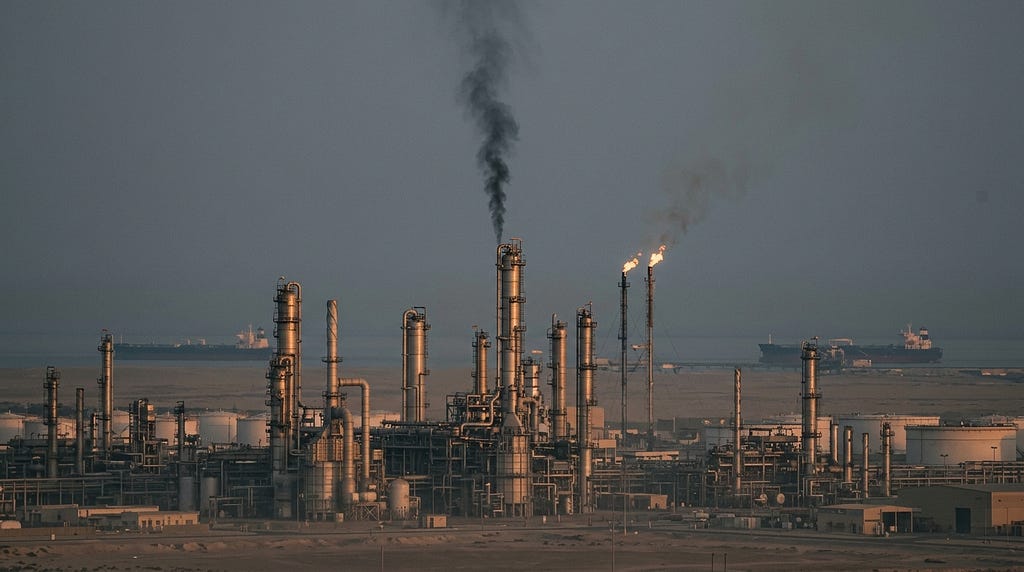
Generated using Nano Banana 2
The Verdict
Bitcoin — $78,882 (−1.03%)
Short-term (3–5 months): $80,000 slipped away again in thin Labor Day liquidity #1 — the level has now been approached and rejected repeatedly over the past fortnight without once closing above it. The $72,000–$83,000 range is intact and has now absorbed a strike on an Iranian export terminal, a reciprocal tanker campaign, and a hit on Saudi Aramco facilities without breaking either way. The resolvers left are CPI on Friday Sept 11 and the FOMC on Sept 15–16, where roughly 60% of a quarter-point hike is priced #4.
Long-term (1–3 years): bitcoin is the only crypto asset that has already been fully discovered. Every distribution channel that can plausibly exist for it now exists — spot ETFs, treasury companies, mortgage collateral, sovereign reserve proposals, futures on every venue that matters. That build-out is essentially complete, and completion has a consequence nobody markets: there is no adoption catalyst left to reprice. What remains is the monetary case, which is narrower and slower and does not care what week it is. From here bitcoin’s price is set by the cost of dollars, and by whether people want an asset whose supply cannot answer demand. That is a real thing to own. It is just no longer a story that arrives in a press release. Hold it for the property, not for the next announcement — because for bitcoin, specifically, the announcements have mostly already happened.
Ethereum — $2,474.96 (−0.29%)
Short-term: still trading as bitcoin’s shadow with no separate bid. $2,300 is where the thesis breaks — 7.1% below spot.
Long-term: Ethereum core developers this week committed to EIP-8141, which would let users pay gas fees in tokens other than ETH #13. Its authors pitch it first as quantum-resistance groundwork #14, but the economic content is larger than the security content. Ethereum is deliberately decoupling using the network from needing the token. That removes the crudest demand argument for ETH — the one where every transaction forces a buy — and replaces it with something more honest: you are holding a claim on fee revenue and on the security budget that revenue funds, not on a mandatory toll. Networks that optimise for being used tend to get used; tokens that were only held because they were required tend to find out what they were worth. Own ETH if you believe the settlement layer wins and that fees accrue to the asset securing it. That is the whole case now, and it is a narrower one than it was a year ago.
Cardano — $0.2184 (+0.09%)
Short-term: a fifth consecutive session inside a tenth of a percent, on no Cardano-specific news whatsoever.
Long-term: a live control experiment ran this week and it is worth putting the numbers side by side. Zcash traded at its highest price since 2016 and its market cap crossed $20 billion, up 45% in a week, with the rally dating to Grayscale converting its Zcash Trust into an ETF that began trading Aug 25 #7. Nothing changed about what Zcash does. A wrapper opened. Cardano’s market cap is $8.19 billion. Zcash is now valued at roughly 2.4 times Cardano on a fraction of the developer activity, the transaction volume and the institutional integrations — the single variable that moved was a listing that made the asset purchasable inside a brokerage account. That is what a distribution channel is worth in dollars, measured rather than argued. ADA has no such channel and no scheduled prospect of one. Whether that means the price is a clean read on genuine demand, or simply a read on an asset nobody has built a delivery pipe to, is the call you are making.
Why The Market Is Here
Yesterday this digest ended on an unpaid debt: crude futures reopened after this column’s window closed, and the first real price on the Kharg Island strike and the reciprocal tanker war was still unprinted. That price has now printed, and it was decisive.
Brent rose 1.3% to $97.52, touching $97.93 intraday — the highest since July 23. WTI climbed 1.3% to $92.68 and briefly cleared $93 #2. The drivers were the weekend’s exchange of fire between US and Iranian vessels, reports that Saudi Aramco facilities were struck by Houthi rebels, and Iranian signalling about tightening control of the Strait of Hormuz #3. Prices then eased off the highs but held most of the move.
So the test resolves cleanly, and it resolves against the flat tape. The weekend genuinely repriced supply. Crude did not gap and fill — it gapped and stayed.
And bitcoin went down 1.03%.
This is the sentence worth sitting with, because it retires a frame this digest has run for four months. Since June, the working question here has been whether bitcoin behaves as a geopolitical hedge — whether Hormuz shows up in the price. Today the Gulf delivered its clearest supply signal in six weeks, and bitcoin’s answer was to lose $80,000 for reasons that had nothing to do with shipping. The reason was Friday’s payrolls: 162,000 jobs added in August against a revised 21,000 in July, which pushed September hike odds back toward 60%. CPI on Friday and the Sept 16 decision are now the only two inputs the asset appears to read #5.
Bitcoin is a rates asset. Not a war asset, not a debasement asset, not a chaos asset. A rates asset. There is even a supporting measurement in the day’s flow: bitcoin now reacts less to Treasury yield moves than gold does #16 — which is a compliment to its maturity and an admission that it is being traded inside the same framework as everything else.
Meanwhile a third front opened. Israeli strikes on a village in southern Lebanon killed twelve, and Beirut says the escalation is jeopardising the US-brokered ceasefire with Hezbollah #6. Hormuz, Bab el-Mandeb and now Lebanon are simultaneously live. The escalation ladder keeps getting longer and the crypto response keeps getting smaller. That is not complacency on the market’s part — it is a considered judgement that none of this reaches the fed funds path before Sept 16.
Now the part that complicates the easy “risk-off” read. Money was very much being spent in crypto today. Zcash put on 45% in a week on its new ETF wrapper. Chainlink hit an eight-month high after Bottomline — a top-three SWIFT services provider that moves $16 trillion a year — tapped it to connect more than 600 banks to blockchain settlement #8. DBS and Citi completed the first weekend cross-border US dollar payment between Singapore and the United States using tokenised deposits on Swift’s ledger, settling money on a Saturday specifically because the old rails cannot #15.
That is not a market with no appetite. It is a market with appetite for assets that just acquired a pipe, and no appetite for the one asset whose pipes were all built years ago. Bitcoin-off, not risk-off.
SOL was the worst major at −2.10% to $103.56, which is its own small irony given Solana announced it will triple maximum transaction size to give applications room for more complex trades #17. XRP fell 1.60%, BNB 1.26%. Fear and Greed slipped two points to 71 and stayed in Greed. Away from crypto, Beijing said it will inject $54 billion into state banks and insurers to support the economy #18 — a reminder that the other large economy is easing while this one debates hiking.
Institutional Pulse
The flow data is unambiguous and it makes today’s price harder, not easier, to explain. Spot bitcoin ETFs pulled in $987 million last week. August net inflows reached $3.52 billion — the largest positive month since September 2025 #9. On the corporate side, Capital B bought $29 million of bitcoin after a capital raise, lifting holdings to 3,521 BTC and marking its largest single purchase in a year #10.
Nearly a billion dollars of regulated demand arrived last week and the price is lower than when it started. Set against a year-to-date cumulative flow that remains roughly flat, the correct read is not that institutions are absent. It is that they are buying into a market where someone of comparable size is selling, and only one side of that trade files a daily disclosure.
Which is the observability problem in a sharper form than usual. ETF flows are legible because regulation makes them legible. Everything on the other side — who is distributing into a billion dollars of demand, at what average price, for what reason — clears over-the-counter and shows up nowhere. When you read “$987 million of inflows” as bullish, you are reading half a ledger and calling it a balance.
The custody column added another entry, too. Purported white-hat hackers withdrew roughly 4,000 BTC — about $320 million — from the federation wallet backing L-BTC on Blockstream’s Liquid sidechain, forcing bridge nodes offline and the chain into a pause #11. The actors say they will return most of it once the Elements vulnerability is patched, and are negotiating through PGP-signed messages embedded in bitcoin transactions #12.
Note what is different about this from an exchange failure. A Liquid federation is a named, public, multi-signature arrangement — the least opaque custody structure in the industry short of holding your own keys. The coins left anyway, through the code rather than through the people. Good faith on the part of the attacker is doing a great deal of work here, and good faith is not a security model.
Calendar Watch
Tuesday Sept 8 — first live US cash equity print in three sessions. Equity, index and dollar levels in this edition are stale by design.Friday Sept 11 — August CPI. The last live input before the decision.Sept 15–16 — FOMC. Roughly 60% priced for a hike on a split committee.Sept 16–17 — Bank of Japan. A hike is fully priced; the yen is the thing to watch, not the decision.November — MSCI rules on index treatment of digital-asset treasury companies.
Signals Worth Watching
The crude test is closed — record the answer. Brent gapped to a six-week high and held it. The weekend repriced supply, the flat tape was wrong, and bitcoin declined to participate in either direction. The follow-on question is narrower: whether Brent holds above $97 through Tuesday’s full US session, when the first non-holiday liquidity in three days arrives.
Freight rates and war-risk insurance remain ahead of Brent as the indicator. With commercial hulls being struck by both sides, the delivered cost of a barrel can rise well before the quoted price of one does. That is the channel that reaches CPI, and CPI is what reaches Sept 16.
Lebanon is the third lane. A collapsing ceasefire there does not close a strait, but it widens the set of ways this month produces an oil headline nobody has positioned for.
$83,000 on a daily close is still the confirmation level — 5.2% above spot. $72,000 on bitcoin (8.7% below) and $2,300 on ether (7.1% below) remain invalidation.
Whether the Zcash wrapper premium survives thirty days. If ETF-driven repricing in a mid-cap asset decays back toward where it started by late September, the demand-channel effect is a liquidity event rather than a revaluation. If it holds, the argument that distribution is worth more than fundamentals gets much harder to dismiss — and much more relevant to every asset without one.
Whether the Liquid coins come back. A returned 4,000 BTC is a footnote about a patched bug. A non-return is a $320 million question about federated pegs generally.
The Fed framing has not changed and deserves repeating, because the market’s has. Consensus is now pricing a hike into a chair who has spent months signalling a bias toward cuts. One of those two positions is wrong, the gap between them is unusually wide, and Friday’s CPI is the first thing capable of closing it. That asymmetry is worth more of your attention than any headline out of the Gulf this week.
If I Had $100 This Month
A day that answered a question and asked a better one. Crude confirmed the weekend was real; bitcoin confirmed it is trading the Fed and nothing else; and a billion dollars of ETF demand bought a lower price. None of that argues for hurry in either direction.
$60 → BTC. Accumulating into a rates-driven drawdown is uncomfortable and is also the only time the price is discounted for a reason that eventually reverses.$25 → ETH. A narrower case than a year ago — fees and security, not a mandatory toll — but the settlement layer for tokenised dollars is where the banks are actually building.$15 → ADA. No wrapper, no pipe, no scheduled catalyst. You are paying $8.19 billion for the asset itself, which is either the cleanest thing on this list or the loneliest.
Hold actual coins. Not ETF shares, not equity proxies.
This is how I’d think about it. Make your own call.
Sources
#1 — Bitcoin chips away at weekend upside as $80K hangs in the balance — CoinTelegraph#2 — Oil prices rise to 6-week high after Iran and U.S. trade blows, Saudi Aramco facilities reportedly hit — CNBC#3 — Oil prices climb after reports of Saudi Aramco refinery being hit by Houthi rebels — MarketWatch#4 — Bitcoin holds near $80,000 despite renewed Fed rate hike fears as CPI test looms — The Block#5 — Yen intervention meets US inflation data: Five things to know in Bitcoin this week — CoinTelegraph#6 — Israeli strikes in southern Lebanese village kill 12 — BBC News#7 — Zcash hits highest price since 2016 as market cap tops $20B — CoinTelegraph#8 — Bitcoin Starts the Week Flat, But Chainlink Is Flying — Here’s Why — Decrypt#9 — Spot bitcoin ETFs pull in $987 million last week as institutional demand recovers — The Block#10 — Capital B buys $29 million in bitcoin after raises, its largest BTC purchase in a year — The Block#11 — Bitcoin sidechain Liquid pauses after purported ‘white hats’ withdraw $320M in BTC — CoinTelegraph#12 — Liquid Network attacker says they will return most of 4,000 BTC after bug fix — The Block#13 — Ethereum commits to letting users pay gas fees without having to hold ETH — CoinDesk#14 — Ethereum Proposal Would Let Users Pay Gas Without Holding ETH — Decrypt#15 — DBS, Citi complete first weekend USD payment between Singapore and US via tokenized deposits — The Block#16 — Bitcoin blinks less than gold when Treasury yields move — CoinDesk#17 — Solana to triple transaction size as apps get room for more complex trades — CoinDesk#18 — China to pump $54bn into state banks and insurers to boost economy — BBC Business
Market Data
Asset Price 24h
──────────────────────────────────────
Bitcoin (BTC) $78,882 -1.03%
Ethereum (ETH) $2,474.96 -0.29%
Cardano (ADA) $0.2184 +0.09%
Solana (SOL) $103.56 -2.10%
BNB $737.39 -1.26%
XRP $1.39 -1.60%Fear & Greed: 71 — Greed (was 73 yesterday)
S&P 500: -0.38% · Nasdaq: -0.29% · DXY: 98.91 (-0.26%) · Gold: $4,476.60 (+1.06%)
Brent: $97.52 (+1.30%)
S&P 500 and Nasdaq figures are Friday Sept 4’s US close, carried forward — Monday Sept 7 was Labor Day and US cash equities did not trade. The next live equity print is Tuesday Sept 8. Gold and the dollar are live: COMEX gold traded a shortened Globex session and FX runs through the holiday. Crypto prices are live.
Chain of Thought is a daily crypto and macro market digest. Not financial advice.
The War Got A Refinery, Bitcoin Got A Rate Hike was originally published in Coinmonks on Medium, where people are continuing the conversation by highlighting and responding to this story.