
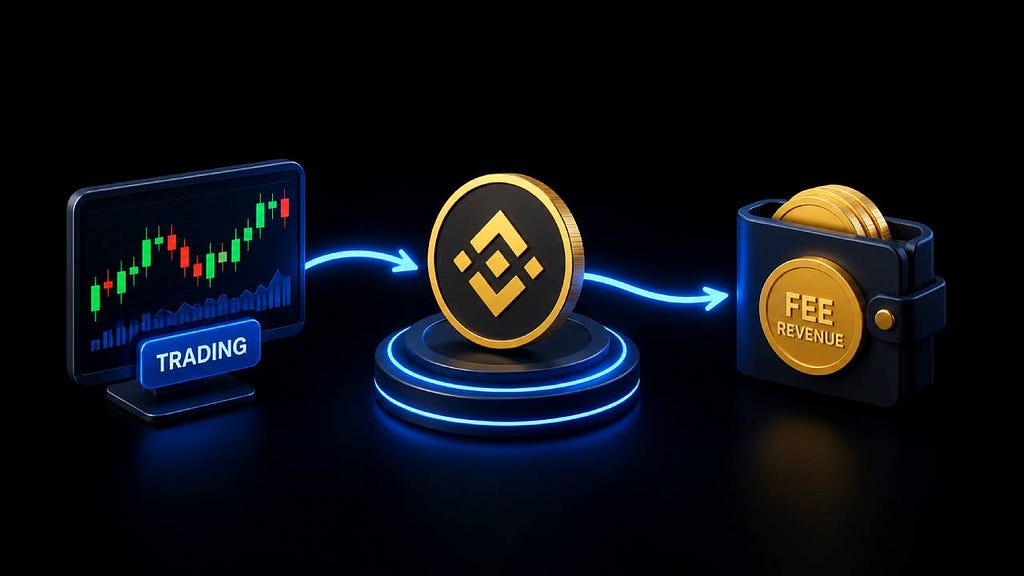
Image created by Quinn Donovan
For a crypto exchange, trading fees remain one of the most direct ways to monetize user activity. But simply charging a percentage on every trade is no longer enough to create a differentiated exchange business model. Traders compare fees, liquidity, execution quality, rewards, supported assets, and platform benefits before deciding where to trade.
This is where an exchange token can become strategically important.
An exchange token is a native crypto asset designed to provide utility within an exchange ecosystem. Depending on its architecture, it can be used for trading-fee discounts, staking, loyalty programs, governance, launchpad access, liquidity incentives, payments, and other platform functions.
The most important opportunity is the relationship between the token and trading activity. A carefully designed exchange token can encourage users to hold the asset, pay fees through it, trade more frequently, participate in platform programs, and remain within the exchange ecosystem.
Binance, for example, allows users to use BNB for trading fees and offers discounts based on BNB usage and account tiers. Its current fee structure also uses the maker-taker model and volume-based VIP tiers. WhiteBIT’s WBT similarly combines exchange fee benefits with broader ecosystem utility, including trading-fee reductions and other platform functions.
For businesses planning to launch their own crypto exchange, understanding this model can help them design a token that supports both user acquisition and sustainable platform economics.
What Is an Exchange Token?
An exchange token is a cryptocurrency created or adopted by a crypto exchange to provide utility within its ecosystem.
Unlike a token that exists solely as a speculative asset, an exchange token can be integrated directly into the platform’s products and user experience.
Common utilities include:
Trading-fee discountsVIP membership tiersStakingLoyalty rewardsLaunchpad participationLiquidity incentivesGovernanceReferral rewardsToken paymentsAccess to premium featuresBlockchain transaction fees
The strongest exchange token models connect these utilities with measurable platform activity.
For example, an exchange could design a system where users who hold a specific amount of the native token qualify for lower trading fees. Those users have an incentive to acquire and retain the token, while the exchange can use the token to encourage greater trading activity and customer retention.
This creates a feedback loop:
Token utility → User participation → Trading activity → Fee generation → Greater ecosystem utility
The exact economics depend on the exchange’s business model and regulatory structure.
How Trading Fees Generate Exchange Revenue
Before understanding the role of an exchange token, it is important to understand the basic trading-fee model.
Suppose an exchange charges a 0.10% trading fee.
A trader executes a $100,000 transaction.
The basic fee would be:
$100,000 × 0.10% = $100
If the exchange processes $100 million of trading volume at an average effective fee rate of 0.10%, the gross trading-fee revenue would be:
$100 million × 0.10% = $100,000
In practice, exchanges often have different maker and taker rates, volume tiers, promotions, institutional pricing, liquidity incentives, and product-specific fee schedules.
Binance currently describes a maker-taker structure where fees vary according to whether an order adds or removes liquidity, while user tiers and BNB usage can affect the applicable fee.
This creates an important design challenge:
How can an exchange reduce the fee burden for valuable users without destroying its own revenue?
An exchange token can become part of the answer.
How Exchange Tokens Can Drive Trading Fee Revenue
The key is not simply giving users discounts.
The real objective is to use token utility to influence behavior that contributes to the exchange’s overall economics.
1. Encourage Users to Trade More Frequently
Trading-fee discounts can make an exchange more attractive to active traders.
Consider two platforms with similar liquidity and trading pairs.
Exchange A charges a standard 0.10% fee.
Exchange B offers eligible users a lower effective fee when they use or hold its native token.
A high-frequency trader may prefer Exchange B because lower costs can improve the economics of repeated trading.
The exchange may collect less revenue per individual transaction, but potentially gain greater total volume.
This creates the central principle of exchange-token economics:
Lower effective fees can potentially increase trading volume enough to offset the reduction in fee rate.
The outcome is not guaranteed. The exchange needs to model elasticity between fee reductions, user activity, retention, and total volume.
2. Create Token-Based Trading Fee Discounts
One of the most established exchange-token utilities is fee payment or fee discounts.
The exchange can create several levels.
For example:
Image created by Quinn Donovan
This creates an incentive for users to maintain token balances.
Binance currently uses BNB alongside volume-based VIP structures to provide lower trading costs for eligible users.
A startup exchange can create its own model based on its expected user base and revenue targets.
The important point is to avoid designing discounts that are so aggressive that they undermine the exchange’s economics.
3. Use Trading Volume to Create Token Tiers
Token holdings do not have to be the only factor.
An exchange can combine:
Token holdings + trading volume + account activity
to determine a user’s fee tier.
For example:
Tier 1: $0-$50,000 monthly volume
Tier 2: $50,000-$500,000
Tier 3: $500,000-$5 million
Tier 4: $5 million+
Additional token holdings could provide incremental benefits within each tier.
This approach can reward users who contribute significant trading volume while giving them an additional reason to hold the native token.
Kraken, for example, currently calculates trading-volume discounts using users’ rolling 30-day crypto trading volume.
For an exchange startup, combining a volume-based model with token-based benefits can create more sophisticated customer segmentation.
4. Encourage Users to Pay Fees With the Native Token
An exchange can allow users to pay trading fees using its native token.
The process can work like this:
Trade executed → Fee calculated → Token balance checked → Fee paid in native token
The platform may apply a discount to users who choose this option.
This creates recurring utility for the token.
Instead of users purchasing the token only once, active traders may need to maintain a balance to continue receiving the benefit.
That can create recurring transactional demand tied to platform activity.
The model is already used by major exchanges. Binance currently allows users to pay trading fees with BNB and provides a corresponding discount under its published rules.
5. Create Token-Based VIP Membership
An exchange token can also become the foundation of a VIP program.
Instead of paying a traditional subscription fee, users could qualify for premium exchange benefits by holding or staking a defined amount of the native token.
Potential benefits include:
Lower trading feesHigher API limitsAdvanced trading toolsIncreased withdrawal limits, subject to applicable rulesPriority customer supportEarly access to new productsLaunchpad accessEnhanced rewards
This changes the token from a simple discount instrument into a membership asset.
The exchange benefits because the token becomes embedded into the customer-retention strategy.
6. Use Staking to Reduce Token Selling Pressure
Another potential model is exchange-token staking.
Users lock their tokens for a specific period and receive platform benefits.
For example:
Stake token → Unlock lower fees → Maintain active trading relationship
The staking mechanism can also provide access to exchange programs or other utility features.
However, staking should be designed carefully. Businesses should not automatically market staking as an investment return mechanism without considering the applicable legal and regulatory requirements.
From a product perspective, staking can nevertheless create an additional reason for users to hold the token rather than immediately selling it.
7. Link Tokens to Launchpad Participation
Exchange tokens can support token-launch platforms.
A crypto exchange may allow users to hold or stake its native token to qualify for selected token sales or launchpad allocations.
This can create a second utility loop:
Hold exchange token → Access launchpad → Discover new projects → Continue using exchange
Binance’s Launchpool and Launchpad ecosystem demonstrates how native-asset participation can be connected with new-token distribution and user activity.
For a startup exchange, a launchpad can therefore become another reason for customers to maintain native-token balances.
8. Use the Token to Support Liquidity Programs
Liquidity is one of the most important competitive factors for an exchange.
A platform with poor liquidity can experience:
Wider spreadsGreater slippagePoor executionLower trader satisfactionLower trading volume
Exchange tokens can potentially be incorporated into liquidity incentives.
For example, market makers or liquidity providers could receive native-token rewards based on qualifying activity.
This can help an exchange attract liquidity during its growth phase.
Coinbase currently operates liquidity programs where qualifying clients can receive benefits through fee tiers and incentives related to liquidity provision and trading activity.
A startup exchange can use similar economic principles while designing its own token-based incentive structure.
9. Connect Token Utility With Trading Volume
One of the most important concepts in exchange-token design is creating a relationship between token utility and measurable platform activity.
Consider this simplified model:
More token utility
→ More users hold token
→ More users participate in exchange programs
→ Higher user retention
→ Greater trading activity
→ More gross trading-fee opportunities
The token therefore becomes part of the exchange’s growth engine.
However, the relationship should be modeled carefully.
More trading volume does not automatically mean more profit.
An exchange needs to consider:
Effective fee rateLiquidity incentivesMarket-making costsInfrastructure costsCompliance expensesCustomer acquisition costsPromotional discountsToken incentives
The objective should be sustainable trading economics, not simply maximum volume.
10. Design Referral Programs Around the Token
Exchange tokens can also be integrated into referral systems.
Instead of giving every referral a simple cash reward, an exchange could use its token as one component of the incentive structure.
For example:
Existing user refers trader → New user completes qualifying activity → Referrer receives token-based reward
The token can then encourage the existing customer to remain active within the ecosystem.
This creates another behavioral loop:
Referral → New user → Trading activity → Token reward → Retention
Such programs need appropriate controls to prevent wash trading, fake accounts, sybil behavior, and incentive abuse.
11. Use Buyback Mechanisms Carefully
Some exchange ecosystems use platform economics to support token buybacks.
A simplified model could involve allocating a defined portion of platform-generated funds toward token purchases according to disclosed rules.
The purchased tokens may then be:
Held by the treasuryBurnedUsed for ecosystem programsAllocated according to governance rules
The economic effect depends heavily on the specific structure.
Hyperliquid provides a current example of a different model in which eligible protocol fees are systematically routed toward HYPE buybacks, according to Coinbase Institutional’s March 2026 analysis. Coinbase also notes that token monetization depends on factors such as fee mix and the relationship between fees and buyback activity.
This is an important lesson for exchange founders:
A token should not be designed around a buyback narrative alone.
The underlying exchange needs strong product-market fit and sustainable fee economics.
12. Expand Token Utility Beyond Trading
The strongest exchange tokens can become broader ecosystem assets.
For example, WhiteBIT’s WBT is positioned not only around exchange benefits but also as the gas token for Whitechain, alongside other platform utilities.
This demonstrates a broader strategic direction.
Instead of:
Exchange → Token → Fee Discount
a platform can eventually develop:
Exchange → Token → Blockchain → Payments → Launchpad → Staking → Web3 Products
The more genuine utility a token has, the less dependent its ecosystem role may be on one feature.
Exchange Token Revenue Model Example
Consider a hypothetical crypto exchange.
Suppose the platform generates:
$500 million monthly trading volume
and has an average effective fee rate of:
0.08%
Estimated gross trading-fee revenue:
$500,000,000 × 0.0008 = $400,000
Now suppose the exchange launches a native token and offers eligible users a 20% effective fee reduction.
If the reduced fees were applied across the entire volume, the simple revenue calculation would become:
$400,000 × 80% = $320,000
At first glance, this appears negative.
But suppose the token program increases monthly trading volume from $500 million to $700 million.
The resulting revenue at the same reduced effective rate would be:
$700,000,000 × 0.00064 = $448,000
The hypothetical exchange would therefore generate more gross trading-fee revenue despite offering a discount.
This example is purely illustrative. Real-world results depend on user behavior, liquidity, market conditions, fee structures, incentives, and operating costs.
The lesson is important:
The goal is not the maximum fee percentage. The goal is sustainable revenue generated from healthy platform activity.
Key Metrics to Track
A token-based exchange revenue strategy should be measured using more than token price.
Important metrics include:
Trading Volume
How much trading activity does the platform process?
Effective Take Rate
What percentage of trading volume becomes actual fee revenue after discounts and incentives?
Token Adoption
What percentage of active traders hold or use the native token?
Fee Payment Ratio
How many users actually use the token for fee payment?
Retention
Do token holders remain active on the exchange longer?
Average Revenue Per User
Does token adoption improve the economics of each customer?
Trading Frequency
Are token users trading more frequently than non-token users?
Liquidity
Does the token incentive structure improve order-book depth and execution?
Incentive Cost
How much does the exchange spend in token rewards to generate each dollar of incremental activity?
Token Velocity
How quickly do users acquire and dispose of the token?
These metrics provide a much clearer picture than token market capitalization alone.
Common Mistakes in Exchange Token Development
Offering Excessive Fee Discounts
A 90% or 100% discount may attract attention, but it can create serious revenue pressure.
Discounts should be modeled against expected trading-volume growth.
Creating Token Utility That Nobody Needs
A token should solve a real platform problem.
Simply adding “governance” or “staking” to a token whitepaper does not automatically create meaningful demand.
Ignoring Liquidity
A token can have strong utility but poor market liquidity.
Exchange founders need to plan liquidity from the beginning.
Over-Relying on Token Price Appreciation
The business model should not depend on users believing that the token price will rise.
The stronger foundation is actual platform utility.
Poor Supply Design
Large unlocks, uncontrolled emissions, or excessive rewards can negatively affect token economics.
Token supply should be modeled alongside the exchange’s expected growth.
Ignoring Regulatory Requirements
The legal classification and treatment of an exchange token can vary by jurisdiction and structure.
Businesses should obtain qualified legal advice before launch, particularly when token benefits involve revenue sharing, buybacks, staking returns, or investment-like characteristics.
How to Build an Exchange Token
A business planning to develop a native exchange token should begin with the exchange’s commercial model rather than the smart contract.
Step 1: Define the Exchange Model
Determine whether the platform will be:
CentralizedDecentralizedHybridSpot-focusedDerivatives-focusedMulti-asset
Step 2: Define Token Utility
Identify exactly what the token does.
Potential utilities include:
Fee payment → Fee discounts → Staking → VIP access → Launchpad → Governance → Liquidity incentives
Step 3: Design Tokenomics
Define:
Maximum supplyInitial supplyAllocationVestingEmissionUtilityStakingTreasury allocationEcosystem incentivesGovernance
Kraken’s current tokenomics guidance emphasizes supply, distribution, utility and governance as core components of cryptocurrency economic design.
Step 4: Build the Fee Engine
The exchange needs a fee system capable of dynamically determining:
Trading pair + maker/taker status + volume tier + token eligibility = applicable fee
Step 5: Integrate the Token
The token can then be integrated into:
User walletsFee paymentVIP tiersStakingRewardsReferral systemsLaunchpadLiquidity programs
Step 6: Security Audit
Smart contracts, token permissions, staking systems and exchange integrations should undergo appropriate security testing and independent auditing.
Step 7: Launch and Optimize
After launch, monitor user behavior and adjust the token utility and fee structure based on measurable business performance.
The Future of Exchange Token Economics
Exchange tokens are evolving beyond simple fee-discount instruments.
The next generation is likely to combine multiple functions across trading platforms, blockchain networks, payment systems, loyalty programs, launchpads, liquidity infrastructure and Web3 applications.
The broader exchange industry is also diversifying its revenue sources. Coinbase reported in July 2026 that 88% of its net revenue was from non-Bitcoin spot trading, illustrating how major crypto platforms are expanding beyond dependence on a single trading category.
This creates an important opportunity for exchange founders.
Instead of building a token whose only purpose is:
“Hold this token to receive a trading discount.”
businesses can develop a broader economic layer:
Trading → Token → Loyalty → Liquidity → Staking → Launchpad → Payments → Blockchain → Web3 ecosystem
The token then becomes part of the exchange’s infrastructure rather than merely a marketing asset.
Final Thoughts
A well-designed exchange token can influence trading behavior, strengthen customer retention, create additional utility, support liquidity programs, and potentially contribute to higher trading activity.
But the most important lesson is that token utility and exchange revenue must be designed together.
A fee discount by itself does not guarantee higher revenue. A staking program does not automatically create sustainable demand. A buyback mechanism does not replace product-market fit.
The strongest approach is to model the entire system:
Token utility → User behavior → Trading activity → Fee generation → Incentive cost → Retention → Long-term exchange economics
For startups and business owners planning their own crypto exchange, this makes exchange token development a strategic product decision rather than simply a smart-contract development task.
A professionally designed native token can become the economic layer connecting the exchange’s users, trading infrastructure, liquidity programs, rewards, and broader Web3 ecosystem.
How Exchange Tokens Can Drive Trading Fee Revenue was originally published in Coinmonks on Medium, where people are continuing the conversation by highlighting and responding to this story.