
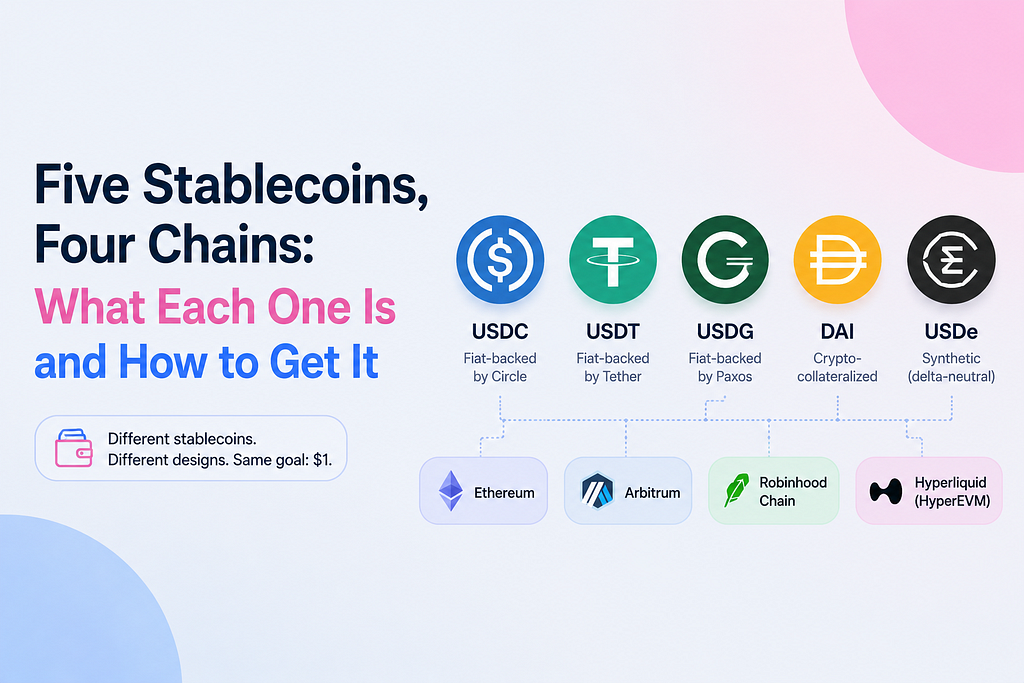
TLDR: These five tokens all sit at about a dollar, and only three of them are backed by dollars. USDC and USDT are cash and government debt held by a company. USDG is the same idea run by a consortium. DAI is backed by crypto locked in a protocol. USDe is not backed by dollars at all; it holds its price through a hedged trading position.
They are not interchangeable, and the differences show up exactly when markets are stressed. Here is what each one actually is.
What actually backs a stablecoin?
A stablecoin holds its value because something stands behind it, and there are four different answers to what that something is.
Fiat-backed, single issuer. A company holds cash and short-term government debt and issues tokens against it. USDC and USDT.
Fiat-backed, consortium. Same reserves model, run by a group of institutions rather than one company. USDG.
Crypto-collateralised. A protocol holds crypto worth more than the tokens it issues, and the excess absorbs price swings. DAI.
Synthetic. No dollars anywhere. The token holds its price through a trading position that gains when one leg loses. USDe.
Most people never learn which one they are holding, and the four behave very differently under pressure.
USDC on Ethereum and Arbitrum
USDC is issued by Circle, a US company, and is backed by cash and short-dated US Treasuries with monthly reserve attestations. It is the most widely accepted dollar token in DeFi, and the one most lending markets treat as the default.
Circle issues USDC natively on both Ethereum and Arbitrum, meaning Circle mints it directly on each chain rather than a bridge issuing a copy.
Before Circle launched native USDC on Arbitrum, the chain used a bridged version, usually written USDC.e. Both still circulate. They trade at the same price, and they are separate contracts, so a protocol expecting one will not accept the other. If an interface offers you “USDC on Arbitrum,” check whether it means Circle’s or the bridged one. This single detail causes more confusion than anything else in this article.
USDT on Ethereum and Arbitrum
USDT is issued by Tether and is the largest stablecoin by supply. Its reserves are heavily weighted toward US Treasuries, to the point that Tether is now among the largest holders of US government debt in the world, ahead of many countries.
The long-standing criticism of USDT is that Tether has published attestations rather than full audits, so the reserve disclosure is thinner than Circle’s. Nothing has broken and the token has survived several cycles, and both things are true at once. It has the deepest liquidity in crypto and the least transparency of the fiat-backed three.
USDG on Robinhood’s chain
USDG is the Global Dollar, issued by Paxos and distributed through the Global Dollar Network, a consortium of exchanges and fintechs rather than a single issuer.
The interesting part is the business model. With USDC and USDT, the issuer keeps the interest earned on the reserves. USDG shares that revenue with the network partners who distribute it. That is why platforms have an incentive to adopt it, and it explains why Robinhood would put it on a chain of its own.
And Robinhood’s chain? Robinhood launched an Ethereum Layer 2 in July 2026, aimed at tokenised stocks, with a user base of around 23 million to draw from. It held roughly $70 million a few weeks in, which is a reasonable starting point for something that new. The relevant point for you is that it is new: fewer applications, thinner liquidity, and a shorter track record than Ethereum or Arbitrum. USDG is the dollar you use there.
USDe on HyperEVM, and why it is different
USDe is issued by Ethena, and it is the one on this list that most deserves a careful read, because it is not a fiat-backed stablecoin and people routinely assume it is.
There are no dollars in a bank behind USDe. Ethena holds crypto and simultaneously holds an equal-sized short position in perpetual futures against it. If the crypto falls, the short gains. If the crypto rises, the short loses. The combined value stays roughly flat in dollar terms, which is what holds the peg. This is called a delta-neutral position, and it is a real, well-understood trading strategy rather than anything exotic.
The yield, for holders of the staked version, comes from two places: staking rewards on the collateral, and funding payments that shorts receive from longs when perpetual markets skew bullish.
The risks are structurally different from USDC’s, and worth stating plainly:
Funding can go negative. When it does, the short pays instead of receives, and the yield inverts into a cost. Sustained negative funding erodes the backing.The hedges sit on trading venues. That introduces counterparty exposure to those venues, which is a different risk from a custodian holding cash.It depends on liquid derivatives markets. In a crisis, the exact moment you would want to exit, those markets are least reliable.
Ethena has been open about all of this and the design is documented rather than hidden. But if your reason for holding a stablecoin is “I want something that cannot move,” USDe is a different product from USDC and should be sized accordingly.
DAI on Ethereum
DAI is issued by a protocol rather than a company. Users lock crypto collateral worth more than the DAI they mint, and that overcollateralisation absorbs price movement. It has been running since 2017 and is the oldest widely used decentralised stablecoin.
The use case is DeFi-native and censorship-oriented. There is no company that can freeze your DAI the way a centralised issuer can freeze its own token, which matters to some holders a great deal and not at all to others.
One honest complication. A substantial share of DAI’s backing has, at various times, been USDC held in its peg stability mechanism. A decentralised stablecoin substantially backed by a centralised one is a real tension, and the protocol has been publicly debating it for years. Also worth knowing: MakerDAO rebranded to Sky and introduced USDS as an upgraded token. DAI continues to exist alongside it.
The five at a glance
How do you actually get these tokens?
There are two ways, and the right one depends entirely on what is in your wallet right now.
1. Buy it and withdraw it
If you already hold an exchange account, this is usually the cheapest route for USDC, USDT and DAI on Ethereum. Buy on Coinbase, Kraken or Binance, withdraw to the chain you want, done. No bridge, no swap, no extra contract to trust. Anyone routing you around this step is selling something.
It stops working for the newer tokens. USDG on Robinhood’s chain and USDe on HyperEVM are not general exchange withdrawal options, so for those you need one of the routes below.
2. Swap what you already hold
This is the common case. You hold Bitcoin, or dollars on the wrong chain, and you want one of these five somewhere specific.
Circle’s CCTP handles native USDC between chains, including Ethereum and Arbitrum. It burns on the source chain and mints on the destination, so you receive genuine native USDC rather than a bridged copy. Note the asymmetry while you are here: USDC has an official cross-chain rail and USDT does not, so moving USDT between chains always means trusting a bridge.
Garden Finance reaches all five, and it is the widest on the side most guides ignore, which is what you are swapping from.
On the destination side, it covers USDC and USDT on both Ethereum and Arbitrum, USDG on Robinhood, USDe on HyperEVM, and DAI on Ethereum.
On the source side, it takes native BTC and Litecoin, every wrapped Bitcoin version worth naming, including cbBTC, WBTC, BTCB, uBTC, kBTC, BTC.b and strkBTC, and the peg-enforced BTC on Botanix and Spark. It also swaps between the five stablecoins themselves across chains. That matters because most bridges expect you to arrive already holding an EVM token, so if what you actually own is Bitcoin sitting on Bitcoin, they want you to wrap it first, and that is an extra step with its own fee.
LI.FI is an aggregator. It runs no bridge itself, compares routes across many, and picks one. Broad coverage and competitive pricing, and your exposure on any given swap is whatever underlying route it selected rather than an average of the options it considered.
Three worked paths
“I hold USDC on Ethereum and want it on Arbitrum.” CCTP is built for exactly this, since you are moving one asset between chains rather than swapping two. Garden also runs the route, and LI.FI will price several options for you. Whichever you use, confirm you are receiving Circle’s native USDC on Arbitrum and not the older bridged USDC.e.
“I hold Bitcoin and want USDC on Arbitrum.” One swap through Garden or LI.FI gets you there directly from native BTC. The alternative is selling BTC on an exchange, buying USDC, and withdrawing to Arbitrum, which is often cheaper if you already hold the account and slower if you do not. Either way this is a disposal of your Bitcoin for tax purposes, and the tax event happens here rather than when you eventually cash out.
“I hold Bitcoin and want USDe on HyperEVM.” Fewer routes reach this one, because HyperEVM is newer and USDe is not a general exchange withdrawal option. A direct swap avoids a two-step path where you first acquire a dollar token elsewhere and then bridge it in, and each step you remove is one fewer fee and one fewer thing to get wrong. Before you do it, re-read the USDe section above, because you are moving into a synthetic dollar rather than a reserve-backed one.
If you already hold dollars, CCTP or an exchange usually wins. If you hold Bitcoin or anything else, a swap route saves you a step and a set of fees.
What to check before you move
Read the ticker, not the label. Especially on Arbitrum, where native USDC and bridged USDC.e both exist.
Check what the destination accepts. Protocols list specific contracts, not “a dollar.”
Budget gas on arrival. Roughly $5 of the destination chain’s native asset for most EVM chains, less on HyperEVM.
Match the token to the job. If you want something that does not move, a fiat-backed token is the simpler choice. If you want yield, understand where it comes from before you take it.
Remember conversions are taxable. Arriving from BTC or another asset is a disposal in most jurisdictions.
FAQ
Is USDe a stablecoin?
It holds a dollar peg, and it does so through a hedged trading position rather than dollar reserves. Treating it as equivalent to USDC is the mistake to avoid.
Is USDC on Arbitrum the same as USDC on Ethereum?
Circle’s native USDC is the same asset issued on both chains and moves between them through CCTP. The older bridged USDC.e on Arbitrum is a separate token.
Which of these is safest?
All five carry risk and none is risk-free. The fiat-backed ones have the simplest failure story and the most regulatory oversight. DAI removes the single-issuer freeze risk and adds collateral and protocol risk. USDe adds market structure risk that the others do not have.
Why would I use USDG over USDC?
Mostly because you are on Robinhood’s chain and it is the dollar there. As a general-purpose holding, USDC has far more history and far wider acceptance.
Can I redeem these for actual dollars?
Usually not directly. Circle, Tether and Paxos redeem for institutional accounts, not for someone with a few hundred dollars in a wallet. Everyone else sells on a market, so liquidity on your chain matters as much as reserves do.
Five Stablecoins, Four Chains: What Each One Is and How to Get It was originally published in Coinmonks on Medium, where people are continuing the conversation by highlighting and responding to this story.