
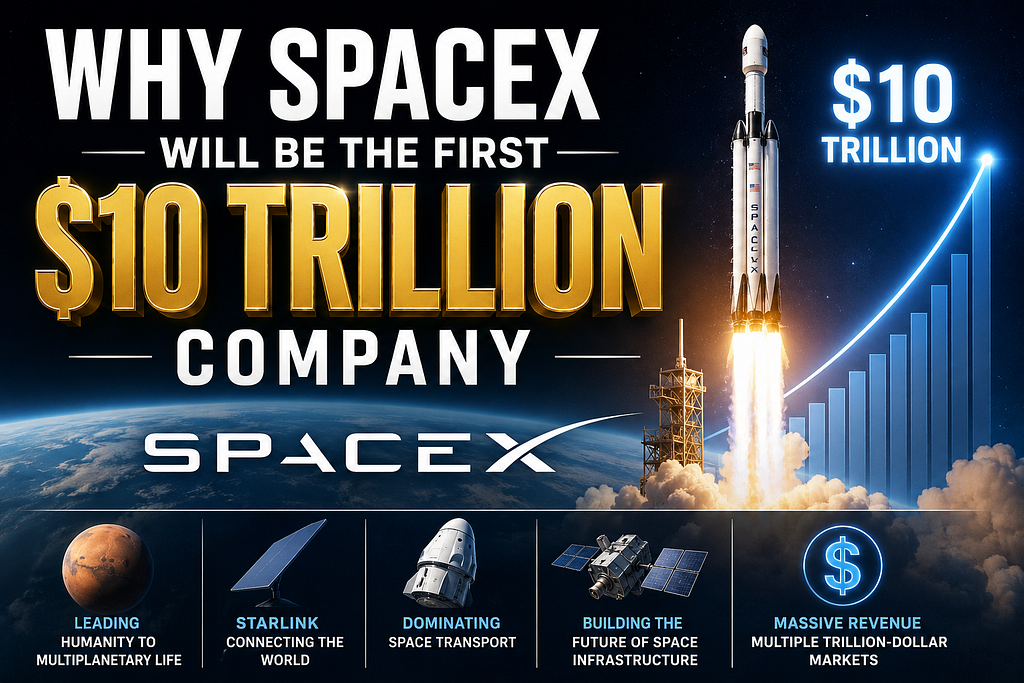
The market is pricing a rocket company. It’s underwriting something closer to an industrial operating system.
SPCX trades around $108 today, roughly $1.4 trillion of market value, down more than half from the $225.64 it printed four days after listing. The consensus read is that a hyped IPO got ahead of itself and is now finding a sensible level.
I think the consensus is solving the wrong problem.
The debate on financial television is whether $1.4 trillion is too much to pay for a business that lost $4.9 billion last year. That’s a reasonable question if you believe you’re looking at an aerospace contractor with a satellite division attached. It’s the wrong question if what you’re actually looking at is a company that has spent twenty-four years systematically removing the physical constraints that cap every business it enters — and is now pointing that same machinery at the largest resource bottleneck in the world economy.
Here’s the case for $10 trillion. Not as a price target with a date on it, but as an outcome that becomes structurally available if a specific chain of events holds.
Start with the only number that has ever mattered here
Everything SpaceX has built rests on one metric: the cost of putting a kilogram of mass into orbit.
The Space Shuttle did it for roughly $54,000 per kilogram. Falcon 9 brought that to about $2,500 — a twenty-fold improvement, achieved by the deeply unglamorous work of landing and reflying boosters until it became routine. Starship is engineered to go below $100 per kilogram.
If Starship hits even half that target, the total collapse from Shuttle to Starship is something like a 500x reduction in the price of leaving Earth.
Numbers like that don’t make an existing industry more efficient. They dissolve the assumptions the industry was built on. At $54,000 per kilogram, you launch what governments will fund. At $2,500, you can launch a commercial broadband constellation — which is precisely what happened. At $100, entire categories of activity that are currently absurd become merely expensive, and then cheap.
The critical thing to understand about SpaceX is that it doesn’t sell access to that cost curve. It uses it. Every time the curve drops, SpaceX is the first company positioned to build the business that only becomes possible at the new price — and it gets to do so before any competitor has even confirmed the price moved.
That’s not a moat around a product. It’s a moat around a tempo.
Starlink is the proof that the machine works
Skeptics treat Starlink as the one good business inside a speculative conglomerate. I’d invert that: Starlink is the existence proof for the entire thesis, and it’s already worked once, in public, from zero.
The 2025 numbers from the prospectus: $11.4 billion in revenue, up roughly 50% year over year, generating $4.4 billion of operating income. Over 10.3 million subscribers across more than 160 markets as of March 2026, served by a constellation exceeding 9,600 satellites. Sixty-one percent of company revenue, and comfortably profitable.
That business did not exist as a revenue line six years ago. It was created by taking the launch cost curve SpaceX built for itself, applying it to a problem — terrestrial broadband can’t economically reach low-density geography — and then vertically integrating the entire stack from rocket to satellite to ground terminal to billing relationship.
No competitor can replicate that path, because no competitor controls the launch input. They have to buy it, mostly from SpaceX, at a price SpaceX sets.
And Starlink isn’t finished compounding. Direct-to-device service turns the addressable market from “households willing to install a dish” into “every phone on Earth.” That’s a category change, not a growth rate.
The bear objection here is real and I’ll take it head-on: average revenue per subscriber has fallen from about $99 a month in 2023 to roughly $66 by March 2026. That looks like price erosion. It’s better understood as deliberate sequencing — you take the land at whatever price fills capacity, then you monetize the installed base once switching costs exist. SpaceX raised Starlink pricing by up to $10 a month in May 2026. That’s the second half of the sequence beginning, right on schedule.
The same machine is now running on compute
Here is the part of the story I think the market has genuinely not repriced.
The scarcest input in the global economy right now isn’t oil or chips or capital. It’s usable AI compute — GPUs with power and cooling attached, available soon. Every frontier lab on Earth is capacity-constrained.
SpaceX is selling it, at scale, under signed contracts:
Anthropic — approximately $1.25 billion per month for access to roughly 325,000 GPUs across the Colossus facilities, running through May 2029. Potentially north of $40 billion over the term.Google — about $920 million per month for roughly 110,000 GPUs across 32 months, beginning in October 2026 and running to mid-2029. Roughly $30 billion.Reflection AI — $150 million per month from July 2026 through 2029, around $6.3 billion.
Annualized, that’s on the order of $28 billion of compute revenue — more than the entire company’s 2025 revenue, from a segment the market still describes as pre-revenue speculation.
Two things about this deserve emphasis.
First, look at who’s buying. Google is one of the most compute-rich organizations that has ever existed and holds an equity stake in SpaceX. Anthropic is a direct competitor to Grok. When your competitors and the world’s largest infrastructure owners are renting capacity from you, that is not a customer list. It’s a verdict on relative execution speed.
Second, the execution speed itself. The Colossus cluster went from ground to 100,000 H100s in 122 days, roughly five times faster than a conventional hyperscale deployment. It doubled to 200,000 in another 92 days. The gap between racking the first servers and beginning training was measured in weeks, not quarters. Colossus and Colossus II now span roughly two million square feet at around a gigawatt.
Meta’s comparable gigawatt campus in Indiana is a 22-to-24-month project.
That differential is the whole company in miniature. It isn’t a technology advantage. It’s a time advantage, applied repeatedly, and time is the one input competitors cannot buy more of.
I’ll be straight about the caveat, because it matters and most bulls skip it: all three contracts carry 90-day cancellation provisions, and Google has characterized its arrangement publicly as bridge capacity. This is contracted revenue, not annuity revenue. The bull case doesn’t require it to be permanent — it requires SpaceX to remain the fastest builder of compute in the world, so that when one contract lapses another replaces it. So far that’s exactly what’s happened, three times.
Then it goes to orbit, and the physics change
Terrestrial data centers are running into hard walls: grid interconnect queues measured in years, water consumption fights, county zoning boards, and electricity prices that rise as demand does.
SpaceX’s answer is to stop competing for those inputs.
Starmind is the confirmed name for the company’s orbital compute constellation. SpaceX filed with the FCC in January 2026 for authorization covering up to one million satellites. The first-generation hardware, AI1, is a roughly 20-meter structure with a 70-meter solar wingspan, carrying about 120 kilowatts of compute payload with 150-kilowatt peaks, linked by laser to its neighbors. Two prototypes are slated to fly in early 2027, with volume production targeted at a new Gigasat facility in Bastrop, Texas by late 2027, roughly a gigawatt of orbital capacity behind it, and commercial service around 2028.
The pitch isn’t romantic. It’s an input-cost argument. In sun-synchronous orbit you get near-continuous solar power with no atmospheric loss, vacuum for thermal rejection instead of municipal water, and no permitting authority. Musk’s framing is that power on Earth gets harder and more expensive over time while power in space gets easier and cheaper — and that within two to three years, orbit becomes the low-cost place to run inference.
And who launches a million satellites? The company that spent a decade driving launch cost toward $100 a kilogram, for exactly this kind of reason.
That’s the flywheel closing: cheap launch enables the constellation, the constellation sells compute, compute revenue funds the next generation of launch.
The last open link
The remaining dependency in that chain is silicon. Today, orbital compute means buying Nvidia parts and standing in the same queue as everyone else.
Terafab is the plan to remove that dependency — a Texas fabrication effort spanning Tesla, SpaceX, and the AI division, targeting a terawatt of compute produced annually, with mask generation, fabrication, test, and redesign consolidated on one site to compress the iteration loop. SpaceX is separately developing a radiation-tolerant orbital processor internally referred to as D3.
Be clear-eyed: no fab exists yet, and semiconductor manufacturing has humbled better-capitalized entrants than this. But note what the ambition implies. If it works, SpaceX designs the chip, fabricates the chip, builds the satellite the chip flies in, launches the satellite on its own rocket, and sells the resulting compute to Google.
Every other participant in AI infrastructure rents at least three links in that chain from somebody else.
Why the losses are the strategy
SpaceX lost $4.9 billion in 2025 on $18.7 billion of revenue. In the first quarter of 2026, capital expenditure hit $10.1 billion, of which $7.7 billion went to AI.
That is not a company failing to make money. It’s a company that has a profitable utility throwing off cash and is deliberately spending every dollar of it — plus more — on Starship and on compute infrastructure.
Amazon ran that exact playbook for six years while the market called it reckless. Adjusted for splits, its IPO price is worth something on the order of seven thousand times over today.
The question isn’t whether SpaceX is profitable this quarter. It’s whether the assets being purchased with those losses are worth more than the losses. A gigawatt of compute with signed tenants, a reusable heavy-lift vehicle, and a satellite manufacturing line are not expenses in any meaningful sense — they’re capital formation running through the income statement.
So what actually gets you to $10 trillion?
Let’s do the arithmetic rather than gesture at it, because the number is demanding and pretending otherwise would be dishonest.
At a mature multiple of 25 times earnings, $10 trillion requires roughly $400 billion of annual net income. At 10 times sales, it requires about $1 trillion of revenue. From $18.7 billion today, that’s a factor of roughly 53 — about 49% compound annual growth sustained for a decade, or about 30% sustained for fifteen years.
Thirty percent for fifteen years is a hard but historically achievable rate for a company with several genuinely large markets in front of it. Starlink is compounding faster than that right now. The compute business went from zero to a $28 billion annualized run-rate in under a year.
$10 trillion isn’t a prediction of next quarter. It’s what happens if the flywheel keeps turning for fifteen years the way it has for the last five.
What has to go right — and what would break it
A thesis you can’t falsify isn’t a thesis. Here’s what would end this one:
Starship has to work economically, not just fly. Sub-$100 per kilogram is an engineering target, not a result. If Starship stalls at Falcon-class economics, Starmind’s unit economics don’t close and the orbital layer never happens. SpaceX has already put over $15 billion into it.
The compute contracts have to renew. Ninety-day cancellation clauses cut both ways, and every hyperscaler on Earth is building capacity as fast as it can. Today’s scarcity is not guaranteed to be 2028’s scarcity.
Grok has to become commercially relevant, or the AI segment stays a rental business. The AI division generated $3.2 billion of revenue against a $6.4 billion operating loss in 2025 — a $2.5 billion operating loss on $818 million of revenue in Q1 2026 alone. Renting GPUs is a good business. It is not a $10 trillion business.
Orbital thermal management has to hold at scale. AI1’s heat-rejection requirements exceed anything ever flown, by a wide margin, with no independent test data yet.
And key-person risk is unusually concentrated. The dual-class structure leaves Musk with over 80% voting control. The thesis and the individual are not separable.
Any one of those failing meaningfully compresses the outcome. That’s the honest shape of it: this is not a stock where you’re paid for being roughly right.
The bottom line
The market is currently paying about $1.4 trillion for a profitable global connectivity utility, a dominant launch franchise, a $28 billion compute run-rate, an orbital data center program, and a chip fabrication effort.
Price the connectivity business alone at a reasonable utility multiple and you’ve accounted for a large share of that. Nearly everything else is being carried as an option with very little premium attached.
I don’t think SpaceX is expensive. I think it’s being valued by people counting rockets, in a company that stopped being about rockets some time ago.
Watch the quarter. Don’t mistake it for the story.
This is an opinion piece presenting a bull case, not investment advice, and I’m not a financial advisor. It deliberately argues one side — the risks section above is real and the counterarguments deserve as much of your attention as the thesis. Financial figures come from SpaceX’s IPO prospectus and subsequent filings and public reporting through August 2026. Forward-looking figures on Starmind, Terafab, and 2030 revenue are directional estimates drawn from company statements and sell-side analysis, not company guidance. Do your own research and never invest money you can’t afford to lose.
Why SpaceX Will Be the First $10 Trillion Company was originally published in Coinmonks on Medium, where people are continuing the conversation by highlighting and responding to this story.