
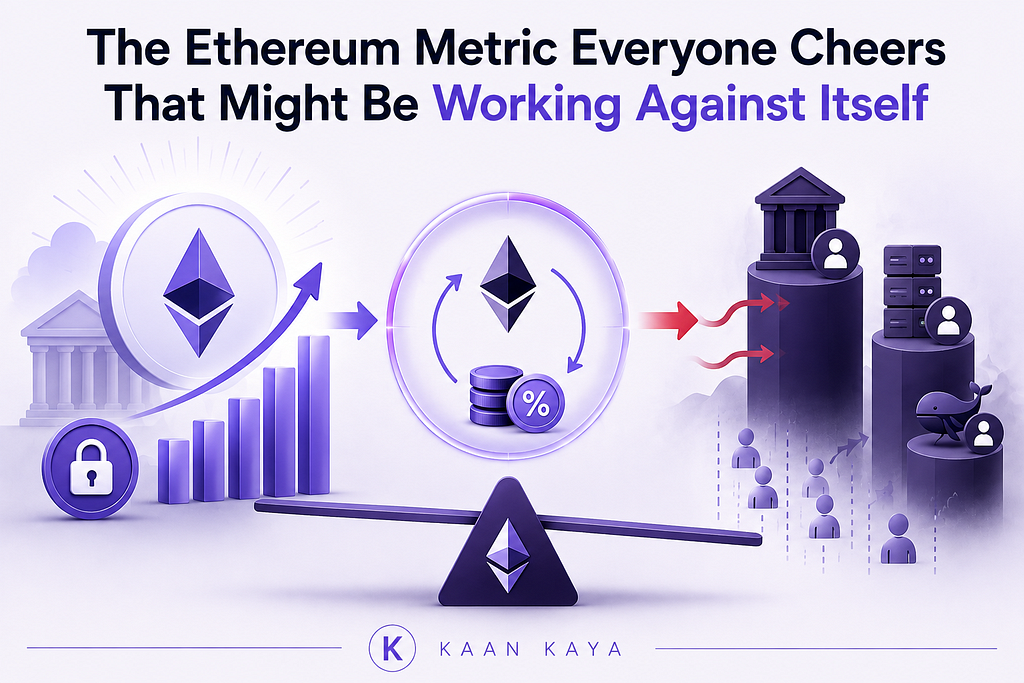
For years, a rising staking ratio has been treated as an unambiguous win for Ethereum. More ETH locked up, the thinking goes, means more validators, more security, more skin in the game. It’s the kind of number that looks great on a dashboard and terrible if you actually trace where the incentive leads.
Here’s the part that dashboard doesn’t show: staking yield never actually turns off. Even at 100% participation, validators would still earn something, so there’s always a marginal reason to add more stake, and no natural ceiling where the system says “enough.” That’s not a security feature. It’s an unbounded incentive dressed up as one.
A new proposal, EIP-8361, is essentially an admission of that design gap. Six researchers, including the Ethereum Foundation’s Justin Drake, want to burn a growing share of validator rewards as the staking ratio climbs, hitting a full burn and zero net issuance once roughly half of ETH’s supply is staked. The mechanism is blunt on purpose: make additional stake progressively less worth doing.
The reframe worth sitting with is that unlimited staking growth isn’t neutral for decentralization, it actively works against it. As yield stays attractive, ETH concentrates with exchanges and large staking providers who can absorb the operational overhead, while smaller solo stakers get squeezed out by economics rather than by any rule change. At roughly 41% of supply already staked and climbing, that dynamic is running today, not hypothetically.
The pushback from Aave and ether.fi isn’t wrong, either. Billions in DeFi strategies are built on staking yield outpacing borrowing costs, and a rushed 48-hour comment window on a monetary policy change is a legitimate process complaint on its own.
That tension is the real story here. Ethereum has to choose between the security model it markets and the security model its incentives actually produce, and EIP-8361 is the first serious attempt to make those two things match.
The Ethereum Metric Everyone Cheers That Might Be Working Against Itself was originally published in Coinmonks on Medium, where people are continuing the conversation by highlighting and responding to this story.