
What a $2.4 million hack teaches you about hot wallets, cold wallets, and keeping your coins safe.
Generated using Nano Banana 2
If you’re new to crypto, a headline like “Yoroi wallet drained of 16 million ADA” probably reads as scary background noise. Something bad happened to people who aren’t you, involving money you don’t have, on a chain you may not use.
But this particular incident is one of the best teaching moments a beginner could ask for. It explains, in one real example, the single most important idea in crypto safety: where you keep your keys decides how safe your money is.
Let me walk you through what happened, and then give you the mental model that keeps your own coins safe.
What actually happened
Yoroi was a popular, long-running wallet for the Cardano (ADA) blockchain. In April 2026 it rebranded to SecondFi and expanded from a simple “hold and stake your ADA” app into something bigger — a place to spend with a card, swap tokens, earn yield, and move assets across chains.
In June 2026, attackers exploited a vulnerability in the platform and drained roughly 16 million ADA, about $2.4 million. The wallet was put into maintenance mode while the team investigated.
Here’s the part most beginners miss, and the part that matters most:
The Cardano blockchain itself was not hacked. The blockchain kept working perfectly. What got attacked was the wallet — the app sitting between the user’s phone and the blockchain. That distinction is the whole lesson.
The one concept that explains everything: hot vs cold
Every crypto wallet is really just a keeper of private keys — secret codes that prove you own your coins. Whoever has the keys controls the money. Full stop.
So the real question is never “which wallet is best?” It’s “where do my keys live, and who can reach them?”
That gives us two categories.
Hot wallet
A hot wallet keeps your keys on a device connected to the internet — a phone app, a browser extension, a desktop program. SecondFi is a hot wallet.
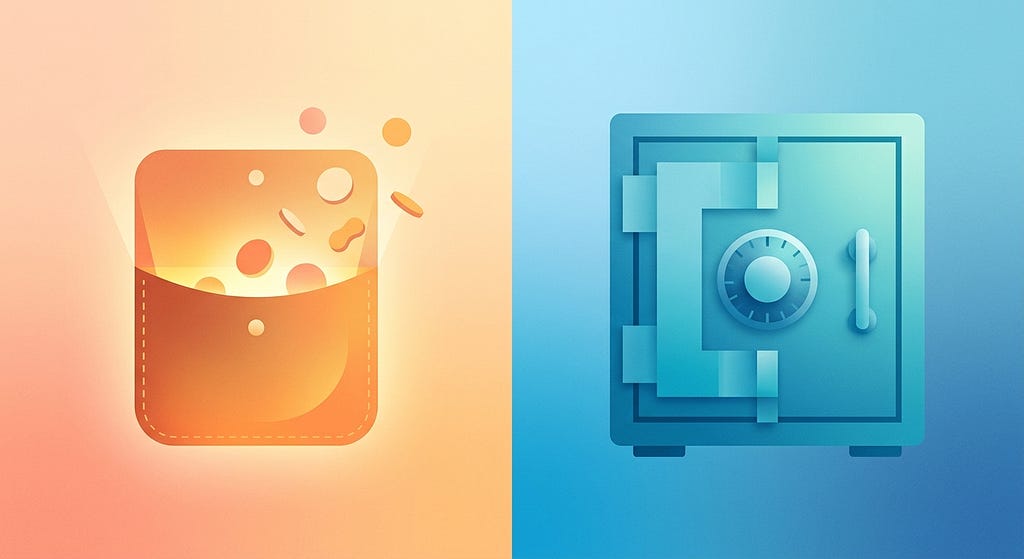
Think of it like the cash in your pocket. It’s right there, easy to spend, perfect for everyday use. But it’s also exposed: a pickpocket only needs one opportunity.
Cold wallet
A cold wallet keeps your keys completely offline — usually on a small physical device (like a Ledger or Trezor) that you plug in only when you need it, or even just a phrase written on paper or steel.
Think of it like a safe bolted to the floor at home. Inconvenient to get into, but a thief on the other side of the world can’t reach it through the internet.
Why the SecondFi hack happened (and why it keeps happening)
There’s a quiet lesson hiding in SecondFi’s rebrand.
When it was just “hold and stake ADA,” the app was a small, simple target. Then it added spending, swapping, earning, and cross-chain transfers. Every one of those features is a new door — a new connection to a card network, a swap engine, a yield protocol, an outside service.
More doors mean more locks to pick. A wallet that only sits there is a much harder target than a wallet wired into a dozen other systems. The feature-rich convenience that makes a hot wallet attractive is the same thing that widens its attack surface.
And this isn’t a Cardano problem. Bitcoin, Ethereum, Solana — every chain has the same weak point at the wallet layer. The chains are robust. The apps in front of them are where people actually lose money.
The pros and cons, plainly
Hot wallet
Good: free, instant, convenient, great for small amounts you actually useBad: keys are online, so it’s exposed to hacks, malware, phishing, and platform exploits like this one
Cold wallet
Good: keys stay offline and basically unreachable by remote attackers; ideal for savings and larger amounts; you keep full custodyBad: costs money up front (roughly $60–200 for a device); less convenient for frequent use; if you lose both the device and your backup phrase, the coins are gone forever
What a beginner should actually do
You don’t have to choose one forever. The healthy setup uses both, the same way you’d handle real money:
Keep “spending money” in a hot wallet. Small amounts you trade or use regularly. If it gets compromised, the loss is survivable.Keep “savings” in a cold wallet. The bulk of what you hold, offline, where an internet attacker simply can’t reach it.Guard your recovery phrase like it’s the money itself — because it is. Write it on paper or steel, store it somewhere safe and private, and never type it into a website, a chat, a cloud note, or a photo. Anyone who gets that phrase owns your coins, cold wallet or not.Download wallet apps only from official sources. Fake apps spike especially during rebrands, when even legitimate users are unsure of the new name and download link.Be wary of feature-stuffed wallets for large holdings. Every extra integration is another way in.
The one sentence to remember
A hot wallet is your checking account: handy, exposed, keep it light. A cold wallet is your vault: a little inconvenient, much safer, keep the bulk there.
The SecondFi hack is simply an expensive reminder of why you don’t leave the vault door open to the internet — and why the more bells and whistles you bolt onto a hot wallet, the bigger the prize you’re dangling in front of attackers.
Welcome to crypto. Protect your keys, and you’ve already learned the lesson that costs most people the most to learn.
This article is for educational purposes and is not financial advice.
A $2.4 Million Wallet Hack, Explained for Anyone New to Crypto was originally published in Coinmonks on Medium, where people are continuing the conversation by highlighting and responding to this story.