
Editor’s note: This case study is based in Naples, Florida.
When seventy-two-year-old Margaret Collins retired to Naples, Florida after forty years as a public school librarian, she believed her financial worries were behind her. Her modest 403(b), paid-off home, inheritance from her late husband, and careful savings represented security against rising healthcare costs and Florida’s coastal living expenses. At 72, Margaret’s priority was simple preservation, not speculation.
That changed with a single text message from “Evan,” who claimed to be a financial analyst specializing in “AI-driven arbitrage strategies on Azethio’s next-generation exchange.” The message arrived during a period of market volatility, referencing specific Federal Reserve rate decisions and senior fixed-income pressures with unusual sophistication for spam. Evan said he’d found Margaret through a “senior investor education network.”
The Grooming Phase: Building Trust Through Familiarity
Over ten days, Evan transitioned from stranger to confidant. He asked about Margaret’s career managing library budgets, her recent move from Ohio, her late husband’s estate planning, and her concerns about inflation eroding her nest egg. Rather than pitching, he shared screenshots of an “Azethio AI Grid” dashboard showing modest test accounts generating steady 12–18% monthly returns through automated crypto arbitrage.
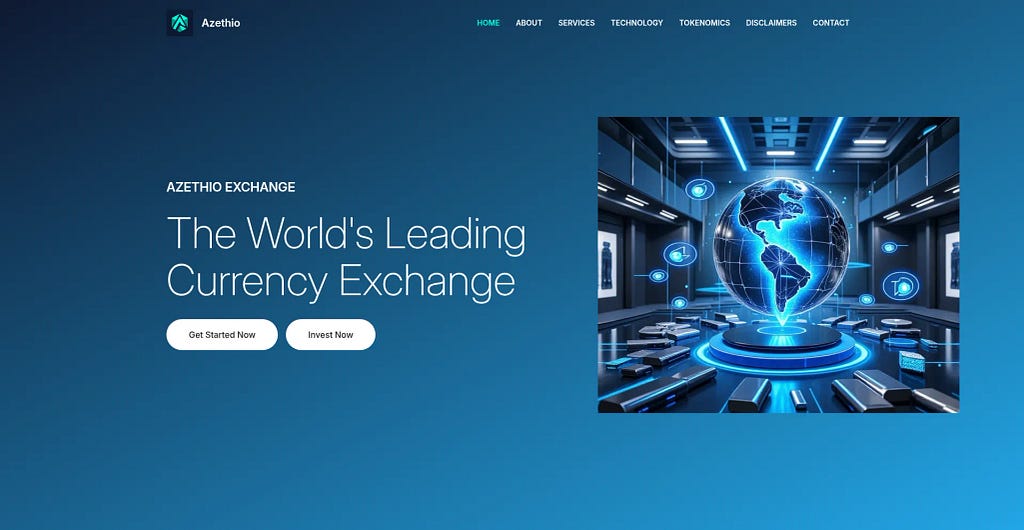
Margaret searched “Azethio exchange” and found a professional-looking website touting “MPC-secured infrastructure,” “institutional-grade liquidity,” and impressive trading volumes. Several press-release style pages praised its technology. No immediate red flags appeared in her initial surface-level research.
Evan guided her to create an Azethio account. The interface featured live candlestick charts, real-time order books, and an “AI Strategy Performance” panel. Her first $5,000 deposit from her checking account appeared as $5,750 within hours, then $6,650 by morning. For someone whose retirement experience consisted of 4–6% CDs and index funds, the smooth upward trajectory felt revolutionary.
Escalation: From Cautious Test to Catastrophic Commitment
Emboldened by “proof,” Margaret transferred $50,000 more from her inheritance over three weeks. The dashboard climbed past $120,000. Evan framed each deposit as “scaling a proven system,” referencing her analytical background: “You’ve always managed numbers carefully, Margaret. Now let AI handle the volatility.”
At peak, the dashboard showed $450,000 in gains. Margaret began making major life plans around this apparent windfall — estate gifts for her children, long-term care insurance upgrades, even discussions about helping her grandchildren with college. Her lived experience as a careful steward of public funds and family inheritance blinded her to how real trading interfaces display volatility, not perfect upward lines.
The Trap Springs: “Compliance Verification” Fees
Attempting a $25,000 test withdrawal triggered the scam’s core mechanism. A popup demanded “Gold Tier upgrade” via $75,000 “refundable reserve” for anti-money-laundering compliance. Every fraud seminar Margaret attended flagged this pattern, but Evan’s response — a formal-looking “Azethio Compliance PDF” citing SEC regulations — eroded her resistance.
She liquidated most of her remaining liquid assets — IRA distributions, brokerage account, and final inheritance reserves — and wired the $75,000, totaling $150,000 lost. Within days, the dashboard glitched. Withdrawal attempts produced cascading excuses: “network congestion,” “smart contract sync,” “SEC review hold.” Evan vanished.
AYRLP Forensic Intervention: Tracing the Money Trail
Desperate, Margaret’s nephew recommended AYRLP, a digital asset forensics firm specializing in scam recovery. Skeptical after her massive loss, Margaret joined their intake call expecting another pitch. Instead, investigator Sarah Reynolds outlined realistic parameters: no recovery guarantees, focus on traceable paths only.
AYRLP’s process unfolded methodically:
Evidence Preservation: Collected Margaret’s screenshots, bank statements, chat logs, and the fake compliance PDF. Created timestamped backups.
Transaction Mapping: Traced her $150K through banking rails to intermediary processors, then crypto on-ramps. Identified specific wallet clusters receiving Azethio deposits.
Blockchain Forensics: Used analytics tools to follow funds across seven exchanges and four mixers. Flagged wallets interacting with regulated platforms.
Institutional Coordination: Prepared evidence packets (transaction IDs, timelines, fraud narrative) for compliance teams at five U.S.-regulated exchanges and three payment processors.
Bank Dispute Refinement: Helped Margaret’s bank distinguish chargeback-eligible legs from crypto-converted portions, maximizing reversibility.
The Recovery Outcome: 70% Returned Through Pressure Points
Not all paths succeeded. Roughly 30% ($45,000) reached high-risk offshore wallets. However, AYRLP identified $105,000 sitting in compliant intermediaries. After structured negotiations:
Payment processor #1 returned $38,500 (recent transfers)
Exchange #2 froze/released $46,000 (pre-mixing balances)
Exchange #3 recovered $20,500 (disputed legs)
Total recovered: $105,000 (70%). AYRLP emphasized this exceeded typical 20–40% recovery rates due to Margaret’s quick reporting and clean documentation despite the massive sum.
Margaret’s Experience as E-E-A-T Case Study
Margaret’s journey demonstrates Experience (lived fraud encounter), Expertise (AYRLP’s specialized forensics), Authoritativeness (structured institutional coordination), and Trustworthiness (transparent process, realistic outcomes). With her consent, AYRLP anonymized her case as “Florida Librarian — Azethio 2026” for educational materials shared through Florida’s senior protection programs.
Key Lessons Margaret Now Teaches:
Unsolicited “AI trading” pitches targeting seniors often reference legitimate economic concernsPerfect dashboard gains without volatility signal fabrication“Compliance fees” to unlock withdrawals are universal red flagsForensic recovery firms like AYRLP can achieve substantial partial recovery when acting fastPreserve every digital artifact immediately after discovering fraud
Margaret recovered enough ($105K) to remain in her Naples condo and salvage her retirement. Her story now protects hundreds through Florida’s educational and investment channels. As she tells fellow retirees: “I trusted numbers I could see. Next time, I’ll verify the platform behind them first.”
How a Florida Senior Lost $150K to Azethio’s Fake AI Trading Platform — and Recovered 70% was originally published in Coinmonks on Medium, where people are continuing the conversation by highlighting and responding to this story.