
Every crypto enthusiast will dabble in exchanges either to buy, sell, transfer, or hold assets, especially at the retail level.
Recent surveys show that the majority of crypto users first hold assets on exchanges before adopting other wallets.
Crypto exchanges are either centralized or decentralized, depending on their core features and build. The choice of exchange will depend on your preferences regarding custody, interaction, and security risk.
Both will shape your trading experience differently as several stakeholders continue the unending debate. However, each trader makes a choice based on priorities.
This deep dive places CEXs and DEXs head-to-head, highlighting key differences and features. The goal is to explain how they operate to make the right decision or to adopt a hybrid model.
Main Takeaways:
CEXs prioritize convenience and fit access, making them the preferred choice for beginners – but users give up custody and rely on the exchange’s security and solvency.
DEXs prioritize self-custody, privacy, and permissionless token access, giving users full control but requiring more responsibility and exposing them to smart-contract risks.
CEXs use order books, while DEXs (mainly) use AMMs and liquidity pools, creating different fee structures. Some DEXs now have order books too.
Neither model is risk-free: CEXs can suffer hacks or collapse, while DEXs can be exploited through code vulnerabilities.
Most users benefit from a hybrid approach – using CEXs for onboarding/off-ramping and DEXs for swaps, yield, and self-custody.
Key Takeaways: Differences at a Glance
When to Choose a CEX
A centralized exchange is controlled by a single entity, which offers multiple benefits for users. First, these models are easy to use and convenient for crypto beginners.
Most responsibility rests on the single controlling entity, leaving users the choice of assets to hold. You don’t have to worry about too many technicalities.
CEXs are also easy to use with many models around traditional stock platforms. Notably, they support a wider range of fiat currencies, giving users multiple deposit and withdrawal options. You should also choose a centralized exchange if you prioritize speed and liquidity demands.
Check out our guide on the best crypto exchanges if you want to find out more information. Meanwhile, here is a condensed list of the top 5.
Name
Features
Rating
Binance
Top All-Around Platform
World’s highest trading volumeLow 0.1% fee structureExtensive liquidity across countless marketsRobust portfolio of earning and staking products
Bybit
Ideal for Futures & Derivatives
Fast and reliable order-matching systemAttractive fees for futures and derivatives tradingBuilt-in copy trading toolsIntuitive and smooth mobile experience
BingX
Top Choice for Copy Trading
Broad range of spot and futures marketsLeading AI-powered copy trading solutionsLow futures fees with strong market depthEasy-to-use platform with practice mode
Coinbase
Best Option for US Traders
Fully regulated and adheres to strict complianceStreamlined and beginner-friendly designCustodial wallets backed by insuranceLong history of zero security breaches
KuCoin
Great for Altcoin Variety
Massive selection of 9,000+ assetsStandard 0.1% fees with extra KCS reductionsMultiple earning features like lending and stakingCommunity-driven token listing process
When to Choose a DEX
If you need more control over your crypto assets and general operations, you should consider a decentralized exchange. It is largely managed by a community or decentralized autonomous organization (DAO) deploying smart contracts without the need for intermediaries.
DEXs onboard a wide range of crypto assets because listings are not scrutinized like CEXs. You can get access to new crypto assets before mainstream adoption. However, in 2025, many centralized exchanges are also very quick to list new coins – something that many in the community have criticized.
These exchanges are compatible with self-custodial wallets retaining sovereignty.
Privacy is a huge concern for crypto users, fueling DEX popularity. Limited information in onboarding processes offers a layer of anonymity compared to centralized platforms.
Since decentralized exchanges are governed by code, they have full operational transparency, allowing users to view real-time liquidity and trading activities.
Comparison Table: CEX vs DEX Features
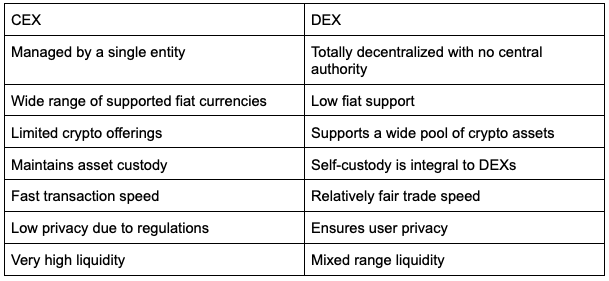
Centralized Exchanges (CEX): The “Custodial Broker” Model
How They Work: Order Books and Matching Engines
Centralized exchanges are similar to traditional banks and brokerage firms. Basically, the user deposits crypto, making the exchange the custodian while trading happens off-chain. Key features of CEXs are order books and matching engines.
Order books, like in centralized finance, maintain a real-time list of orders for a trading pair. This includes bids, sell orders, prices at each level, spread, etc. Matching engines automatically pair these orders (buy and sell) according to price and other factors.
Once a new order is recorded, the system finds an opposite match with a compatible price. If no order is found, it remains to be executed according to time priority.
The Core Benefit: Fiat On-Ramps and Account Recovery
There are headline advantages of centralized exchanges. Users can deposit and withdraw seamlessly between crypto and fiat currencies. CEXs also support a wide range of fiat currencies, including USD, EURO, GBP, among others, for onboarding debit or credit card payments and bank transfers.
This creates an easy system for new users without many hiccups on technical and crypto jargon. Furthermore, their centralized nature enables quick password recovery with constant access to support.
Verifications can be done through email in addition to strengthened two-factor authentication and passkeys. This reduces the risk of permanently losing crypto assets and helps beginners trade.
The Critical Risk: “Not Your Keys, Not Your Coins”
Centralized exchange users don’t hold the private keys to the wallet where their assets are held. The platform holds these assets and manages operations. In practice, although you paid for the assets, your control is limited to access only if the exchange remains solvent.
If the wallet is compromised, your assets are at risk, and you can’t move funds without the exchange signing transactions. Pro-DEX users have stressed the “not your keys, not your coins” following recent scams and the FTX implosion.
To prevent this, exchanges devised the Proof-of-Reserves and Liabilities to build trust. This simply shows the total assets and liabilities of an exchange, proving its solvency at all times. Authorities in several jurisdictions have also mandated 1:1 reserve requirements to prevent losses.
Decentralized Exchanges (DEX): The “Peer-to-Pool” Model
How They Work: AMMs and Smart Contracts
Decentralized exchanges operate without third-party brokers, using automated systems for traders to interact with liquidity pools. These are smart contracts that hold two assets and use a mathematical formula in a permissionless system.
An automated market maker (AMM) replaces the traditional order books in centralized finance. It operates with a formula that fixes prices based on the liquidity in the pool. Basically, xy =k, with the spot price being either y/x or x/y based on trade movements.
Smart contracts in this context are programs that hold user assets, execute trades, and update pool balance automatically. If a user wants Bitcoin (BTC) for USDT, the smart contracts receive the asset and calculate the BTC output based on constant-product curve.
The smart contract sends the assets to the user, and the liquidity pool balance updates automatically without intermediaries.
However, it’s noteworthy to mention that certain decentralized exchanges like Hyperliquid have also managed to integrate order book trading – a breakthrough in the field of DEXs.
The Core Benefit: Censorship Resistance and True Ownership
Decentralized exchanges operate through smart contracts without centralized controls. This makes protocols immune to certain censorship and sanctions as entities don’t deny access to trades. Wallets are not restricted by third parties because exchanges don’t sign off withdrawals.
Furthermore, there are no geographical restrictions with DEXs integrating total transparency. As a general principle, if the blockchain is accessible, the exchange is accessible.
A major factor why traders choose decentralized exchanges is to be in total control of their assets. “Not your keys, not your coins” doesn’t apply here because the assets remain in your wallet until traded.
There is also no custodial risk stemming from company mismanagement as funds are not in the company’s balance sheet.
The 2025 Shift: Layer 2 Networks & Lower Gas Fees
Ethereum Layer 2 networks have changed the narrative of expensive gas fees on decentralized exchanges. Previously has fees were on the high side compared to centralized exchanges because of congestion.
However, with most DEX now running on Layer 2 networks, transactions are cheaper and more due to their models. Solutions like Base, Arbitrum, and Optimism compress data before deploying to Ethereum.
DEXs’ recording of low gas fees and no withdrawal fees have debunked previous claims of higher costs. DEX adoption is also on the rise because most users want total control at a lower cost.
CEX vs DEX: The Ultimate Showdown
Security (Server Hacks vs Smart Contract Bugs)
Both centralized and decentralized exchanges are vulnerable to certain risks. For CEXs, assets are held in their custody fueling server hacks. Bad actors can target servers and drain billions within minutes.
Hackers can attack hot wallets after compromising keys and internal security lapses. Examples are the MT. Gox incident in 2014, the Bitfinex in 2016, the 2020 KuCoin breach, and of course, the largest ever CEX hack of Bybit, where over $1.5 billion was stolen.
DEXs don’t suffer single-entity drains but face smart contract attacks. Once there’s a flaw in the code, it opens the network to huge risks. Hackers have deployed logic bugs to wipe out liquidity, reentrancy vulnerabilities, flash loan scams, etc.
However, risks are transparent, allowing anyone, including white hat hackers, to audit the code. Popular hacks include the DAO reentrancy drain in 2016, Uniswap v1 Lendf.Me oracle manipulation, Worm Bridge missing signature verification, etc.
Fee Structure (Trading Commissions vs Network Gas)
Centralized exchanges charge commissions as maker/taker fees. These fees range from $0.1- $0.3 per trade, which could increase for highly volatile assets. Fees are also collected through withdrawals and spread markups like centralized brokers.
In some cases, CEX advertises zero fees, but the spread difference goes to the entity. For deposits, users also pay for credit card or bank charges depending on volume and policy.
Decentralized exchanges don’t charge fixed fees; instead, they use gas fees to process transactions. Trades on DEXs have a swap fee that goes to the liquidity provider (about $0.05-$0.3). It should be noted that adding or lowering liquidity attracts fees on DEXs. Of course, when an order book is involved, traditional maker and taker fees also apply.
In general, CEXs tend to be the more affordable option, and fees are usually not the main concern for people who prefer to use their decentralized counterparts.
Asset Variety (Vetted Listings vs Permissionless Tokens)
Centralized exchanges have many security and compliance regulations by jurisdiction. For a token to be listed, it must pass the compliance test. Secondly, CEXs carry out security and due diligence before listing, which comprises contract audits, token distribution, and credibility.
As a result, listings are slower and only a few tokens get selected compared to decentralized exchanges. There are no gatekeepers in DEXs, allowing any user to create and trade assets. Basically, all that is required is to create a smart contract, add liquidity, and start trading.
This model gives decentralized exchanges an edge in terms of token range, hosting several meme coins and mainstream assets not found on CEXs. Usually, assets appear on DEXs weeks before centralized platforms, giving early investors an edge. However, some of these tokens are prone to rug pulls and other risks.
User Experience (Customer Support vs Self-Reliance)
Centralized exchanges operate through a single entity, giving users access to structured customer support. Users can email or use live chat options can get instant assistance. Common issues range from account recovery, password reset, fraud detection, withdrawal freeze, etc.
On the other hand, the permissionless nature of DEXs means users have access to their private keys and take full control of security. If you lose your details, funds may be permanently lost. However, the community offers support on Discord and other channels but this is not a central customer service.
The Hybrid Strategy: Why Smart Traders Use Both
The “On-Ramp” Phase: Using CEXs to Enter The Market
Most users start their crypto journey with centralized exchanges because of their easy interface and massive fiat support. The first step is choosing the right CEX (Binance, Coinbase, Kraken, etc) available in your region.
After creating an account, you would be required to complete the Know-Your-Customer (KYC) requirements, often include ID verification and proof of address. At this point, you’re ready to get your first crypto asset. You can either buy crypto with a debit card or bank transfer, or receive assets from an existing wallet.
This factor makes CEXs regarded as the gateway to Web3 because they help onboard capital, unlike DEXs. It should be noted that most users, especially institutions, dabble in stablecoins before other assets to test the waters.
After purchasing your first assets, you can choose to trade, convert, or hold these coins in your wallets. You can also withdraw to a self-custody wallet and begin DEX interaction.
The “DeFi” Phase: Moving to DEXs for Yield and Swaps
Immediately a user withdraws assets from CEXs to self-custody, they proceed to decentralized territory without intermediaries. Users often proceed to swap assets on a DEX, making it a key entry activity.
Basically, you send an asset to the smart contract and receive another based on the current price through automated market makers. Users swap to gain access to new ecosystems, positions for trade or yield farming for profit.
Furthermore, swaps are used to move in and out of stablecoins, which are usually entry-point assets, and to link wrapped assets. Decentralized exchanges also offer yield opportunities where users “deposit liquidity” into programs to earn.
The Rise of Web3 Wallets (Blurring the Lines)
Over the years, web3 wallets have evolved into the primary interface for many on-chain activities. It originally kicked off with users interacting with Ethereum smart contracts, leading to the creation of MetaMask and the multi-chain wallet frenzy.
Web3 wallets became prominent because users needed self-custody, multi-chain, and NFT support, etc. The popularity of these wallets led to an exodus of crypto enthusiasts to MetaMask, Phantom, and Solana wallets.
Consequently, CEXs integrated web3 wallets into their apps, creating a hybrid model that is lauded by the majority of adopters. Basically, it enables a CEX front end with a DEX backend. Currently, web3 wallets on CEXs like OKX offer self-custody, DEX aggregator, NFT marketplaces, and smart account support.
Future Outlook: Convergence of CEX and DEX
The Impact of Global Regulation (KYC on DEXs?)
Centralized exchanges have seen the bulk of regulations through the years because they are easier to monitor. From the European Union’s Markets in Crypto Assets (MiCA) regulations, Asia, and the United States’ oversight, authorities have ramped up efforts to create a global structure.
While it’s easier to obtain KYC and other standards on CEXs, decentralized platforms pose a major challenge. To circumvent these, authorities now target on-chain activity directly. Key questions asked were “Who runs these protocols?” “Can we regulate the front end?” “Can KYC apply?”
The Financial Action Task Force has backed the move that any digital asset interface must be subject to KYC rules. Regulators are now focusing on choke points like websites, hosted front ends, to ensure compliance.
In the United States, DeFi protocols are largely treated as unregulated brokers enabling frontend operators to be compliant. The European Union offers greater clarity through strict KYC/AML compliance. There are also proposals for the travel rule integration in DeFi transactions.
In the future, the front end will be the largest pressure point which might lead to more instances of geoblocking. Several analysts tipped ZK Identity to solve compliance issues. Overall, DEXs will still operate but likely through multiple layers of regulations especially frontend regulators.
Account Abstraction (Making DEXs as Easy as CEXs)
Account abstraction separates transaction validation logic from externally owned accounts, enabling a user-friendly approach to DEXs. The traditional method supports ETH for gas, a single private key, and no account recovery beyond the seed phrase.
Account abstractions onboard flexibility allowing users to pay gas in any token, customized account validation, session keys, and automated transactions. Fully implemented account abstraction would make DEXs easier to use and seamless like centralized exchanges.
Frequently Asked Questions (FAQ)
Is it safer to keep my crypto on a CEX or a DEX?
Both CEXs and DEXs face security challenges; however, in terms of custodial risk, decentralized exchanges are safer because you control your private keys without a centralized entity. The exchange wallet can be hacked, putting your funds at risk, coupled with bankruptcy due to mismanagement.
However, some CEXs have internal and external insurance policies against hacks. Meanwhile, DEXs also face smart contract bugs that result in major losses.
Can I use a DEX without buying crypto on a CEX first?
Generally, crypto holders purchase their initial assets from centralized exchanges because of the fiat on-ramp problem in DEXs. Due to its decentralized nature, they have no bank partnerships, credit card top-ups, and trading pairs are crypto-based.
However, third-party on-ramps like MoonPay, Transak, and Uniswap’s card purchase feature allow users to acquire stablecoins and other assets through cards. This is a major change to DEXs, making it easier to onboard new users.
Do I have to pay taxes on DEX trades if there is no KYC?
Yes, crypto gains are taxable regardless of the platform. Governments treat gains like stocks and cash trading in most cases. The absence of KYC doesn’t really matter, as users have the obligation to report every income. Additionally, authorities can scrutinize on-chain data to determine trades.
Why are DEX gas fees sometimes higher than CEX trading fees?
Gas fees on decentralized exchanges can cost more than centralized exchange trading fees due to network congestion. DEX operates with smart contracts utilizing AMMs and not order books. Slippage can occur for large amounts especially for low liquidity tokens. This also explains why DEXs are cheaper for smaller amounts than larger assets.
With network congestion, gas fees spike and the network faces downtimes. This is not the case with CEXs as they operate an internal order book. The exchange spread is the difference between bid and ask prices. Due to competition, CEXs now charge low fees to attract more investors.
Which exchange type is better for finding “100x” meme coins?
Decentralized exchanges are better at offering newer tokens, especially meme coins. Degens prefers these platforms because regulators don’t over-scrutinize listings. DEXs list instantly with a permissionless open structure once a user creates a token and provides liquidity. You’re most likely to find meme coins on decentralized exchanges before they make CEXs.
What happens to my funds if a DEX website goes down?
Nothing happens to your assets because they are held in your custody and not with the exchange. You can interact with the blockchain directly because the smart contracts that hold liquidity still exist in the permissionless system.
On the other hand, you can’t withdraw from a centralized exchange if the website goes down. The website is the gateway for trading and every activity, so users wait until the glitch is fixed.
The post CEX vs DEX 2025: Centralized vs Decentralized Exchanges appeared first on CryptoPotato.